|
|
|
|
|
|
|||||||||||||
|
|
|
|||||||||||||
|
|
|
|
| |

Chinese-Canadians in the business and nation-building of Canada The first record of Chinese in what is known as Canada today can be dated back to 1788. British Captain James Meares hired a group of Chinese carpenters from Macau and settled them on Nootka Sound, Vancouver Island, British Columbia. However, there is no surviving information related to the whereabouts of these early immigrants to Canada or their possible survivors. The next wave of Chinese immigrants into British North America began in 1858. Most of these Chinese were "sojourners" in a sense, in that most of them planned on returning to their homeland after working in British North America for a period of time. They were mostly rural Cantonese who were at the lower end of the social ladder. Most of them came to British Columbia as common labourers and most were paid only in vouchers so they were captives of the firm that imported them. Gold rushes at the BC interior also attracted a significant number of Chinese to BC. Many workers from Fujian and Guangdong Province arrived to help build the Canadian Pacific Railway in the 19th century. Many of these workers accepted the discriminatory disadvantages of working long hours, lower wages than non-Chinese workers and dangerous working conditions such as explosions for the mountain passes, in order to support their families that stayed in China. Their willingness to endure hardship for low wages enraged fellow non-Chinese workers who thought they were unnecessarily complicating the labour market situations. From 1885, the Canadian government began to charge a substantial racist head tax for each Chinese person trying to immigrate to Canada. The Chinese were the ethnic group that had to pay such a tax.
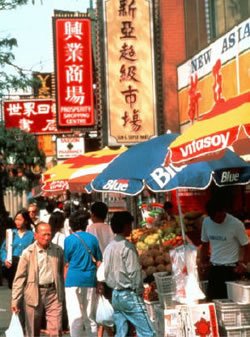
In 1923 the Conservative government under Arthur Meighan banned Chinese immigration completely. With the passing of this act, the Chinese became the only people that Canada specifically excluded on the basis of race. During the next 25 years more and more racist laws against the Chinese were passed. Most jobs were closed to Chinese men and women, so many Chinese opened their own restaurant and laundry businesses. In British Columbia, Saskatchewan, and Ontario, Chinese employers were not allowed to hire white females, so most Chinese businesses became Chinese-only. Some of those Chinese Canadian workers settled in Canada after the railway was constructed. But most could not bring the rest of their family, not even their immediate family, to Canada because of government restrictions and enormous processing fees. Their contacts with non-Chinese were restricted as well, officially and unofficially. They established Chinatowns and societies in undesirable sections of the cities. During the Great Depression, life was even tougher for the Chinese than it was for other Canadians. In Alberta, for example, Chinese-Canadians received relief payments of less than half the amount paid to other Canadians. And because The Chinese Exclusion Act prohibited any additional immigration from China, the Chinese men who had arrived earlier had to face these hardships alone, without the companionship of their wives and children. Census data from 1931 shows that there were 1240 men to every 100 women in Chinese-Canadian communities. To protest The Chinese Exclusion Act, Chinese-Canadians closed their businesses and boycotted Dominion Day celebrations every July 1st, which became known as "Humiliation Day" by the Chinese-Canadians. Canada was slow to lift the restrictions against the Chinese-Canadians and grant them full rights as Canadian citizens. Because Canada signed the United Nations Charter of Human Rights at the conclusion of the Second World War, the Canadian government had to repeal The Chinese Exclusion Act, which contravened the UN Charter. In that same year, 1947, Chinese-Canadians were finally granted the right to vote in federal elections. But it took another 20 years, until the points system was adopted for selecting immigrants, that the Chinese began to be admitted under the same criteria as any other applicants. Some educated Chinese arrived in Canada during the war as refugees. Since the mid-20th century, most new Chinese Canadians come from university-educated families, one of whose most essential values is still quality education. These newcomers are a major part of the "Brain gain" the inverse of the infamous "Brain drain", i.e., Canadians leaving to the United States of America. Chinese Indonesians first arrived in Canada in 1960's during anti-Chinese riots in Indonesia. From 1970's - 1999, many more Chinese Indonesians settled Canada. Many Chinese from Vietnam, Laos, and Kampuchea came to Canada as refugees in the aftermath of Vietnam War. Early Chinese Canadians have close relationships with them as a result of their Chinese heritage. They lived mostly in Quebec province. Many Chinese from Latin America also came in large numbers. Most important are Nicaraguans who fled from the dictatorial Somoza rule and dangerous earthquake in 1980's, Peruvians who also escaped from earthquake and cruel Velasco regime, and Brazilians. These Chinese are concentrated in Victoria, Vancouver, Toronto, and Montreal. There was a significant influx of wealthy Chinese from Hong Kong in the early and mid-1990's. These Chinese immigrants were worried about the pending handover of Hong Kong to the People's Republic of China and Canada was a preferred location, in part because investment visas were significantly easier to obtain than visas to the United States. Vancouver, Richmond, and Toronto were the major destinations of these Chinese. Few Chinese came from Pacific Islands, mostly Fiji, French Polynesia, and New Zealand. Chinese Australians also stayed in Canada.  |
|
|
|
|
|||||||||||
|
Copyright © 2005 The Canadian. All rights reserved. | |
|
| ||||||||||||||
 |
||||||||||||||||||