|
|
|
|
|
|
|||||||||||||
|
|
|
|||||||||||||
|
|
|
|
| |

The Indian Sari: Fashioning the Female Form Compiled by Indian Fashion Staff
Legend has it that when the beauteous Draupadi - wife of the Pandavas, was lost to the Kauravas in a gambling duel, the lecherous victors, intent on humiliating and harassing Draupadi, caught one end of the diaphanous material that draped her demurely, yet seductively. They continued to pull and unravel, but could not reach the end, and thus undrape her. Virtue triumphed yet again in this 5,000 year old Indian epic, the Mahabharata. Legend, fantasy, history or fact, it is the first recorded reference to the enduringly attractive Sari - the longest running 'in fashion' item of feminine apparel in the world. In a metaphysical sense the Kauravas symbolize the forces of chaos and destruction, trying to unwind what is in effect, infinity. They are finally forced to stop, frustrated and defeated. A charming folktale explains the origin of the Sari as follows:
"The Sari, it is said, was born on the loom of a fanciful weaver. He dreamt of Woman. The shimmer of her tears. The drape of her tumbling hair. The colors of her many moods. The softness of her touch. All these he wove together. He couldn't stop. He wove for many yards. And when he was done, the story goes, he sat back and smiled and smiled and smiled". Indian myths often use weaving as a metaphor for the creation of the universe. The sutra or spun thread was the foundation, while the sutradhara (weaver) or holder of the thread was viewed as the architect or creator of the universe. The etymology of the word sari is from the Sanskrit word 'sati', which means strip of cloth. This evolved into the Prakrit 'sadi' and was later anglicised into sari. There is ample evidence of the sari in the earliest examples of Indian art. Sculptures from the Gandhara, Mathura and Gupta schools (1st- 6th century AD), suggest that the sari in its earlier form was a briefer garment, with a veil, and usually no discernable bodice. There are also several references to the fact that in South India the sari had been for a long time one piece of material that served as both skirt and veil, leaving the bosom bare. Even today in some rural areas it is quite common for a woman not to wear a choli.
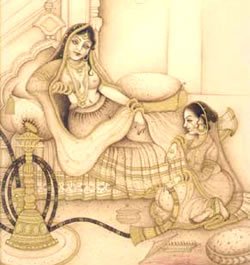
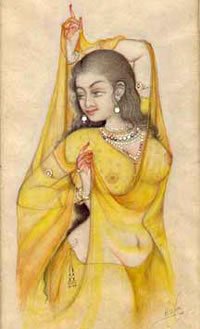
In extant North Indian miniature paintings, (particularly Jain, Rajasthani and Pahari schools from the 13th to the 19th centuries) it seems to consist of the diaphanous skirt and an equally diaphanous veil draped over a tiny bodice. This style still survives as the more voluminous lehanga of Rajasthan and Gujarat. Gradually this skirt and veil were amalgamated into one garment, but when and how this happened is not precisely clear. One theory, not fully substantiated, is that the style was created by Noor Jahan (d. 1645) wife of the Mughal emperor Jehangir (reigned. 1605-27). Perhaps it would be more accurate to speculate that the confrontation between the two cultures, Islamic and Hindu, led the comparatively relaxed Hindus to develop a style that robed the person more discreetly and less precariously. Some costume historians believe that the men's dhoti, which is the oldest Indian draped garment, is the forerunner of the sari. Till the 14th century the dhoti was worn by both men and women. Thereafter it is conjectured that the women's dhoti started to become longer, and the accessory cloth worn over the shoulders was woven together with the dhoti into a single cloth to make the sari. Indian civilization has always placed a tremendous importance on unstitched fabrics like the sari and dhoti, which are given sacred overtones. The belief was that such a fabric was pure; perhaps because in the distant past needles of bone were used for stitching. Hence even to the present day, while attending pujas or other sacred ceremonies, the men dress up in dhotis while women wear the sari. Thus even though the different waves of Islamic expansion (13th - 19th century AD) resulted in new versions of stitched garments, the primacy of the sari and its gently changing form couldn't be changed. Even today, when the Islam influenced Salwar-kameez (loose trousers with a tunic) is an increasingly popular garment, the Sari continues to hold its sway. The flow it confers to the natural contours of the female form enhances the gracefulness of the fairer sex, as no other apparel can.
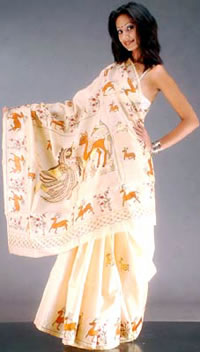
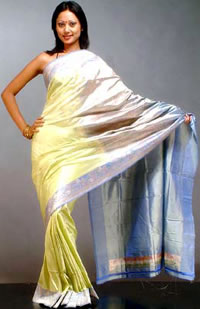
The Sari, like so many other textiles, gives the lie to the hierarchical distinction made between fine arts and crafts. The approximate size of a sari is 47 by 216 inches. Although it is an untailored length of cloth, the fabric is highly structured and its design vocabulary very sophisticated. The main field of the sari is framed on three sides by a decorative frieze of flowering plants, figurative images or abstract symbols. Two of the borders define the edges of the length of the sari and the third comprises the end piece, which is a visible, broader, more complex version of the other two borders. This end piece is the part of the sari that is draped over the shoulder and left to hang over the back or front, known popularly as the Pallav. The pallav usually elaborates the theme found in the two borders and the actual field of the sari, a sort of repetition and amplification in the manner of the Indian musical mode, the raga. The raga has a set number of notes and these are intoned in a form of verbal mnemonics, before the song is actually sung. No new notes other than those in the introduction are used, but improvisation is allowed and results in endless permutations and combinations. This beautiful metaphor thus compares the two narrow borders to the introductory recital of the pure notes and the pallav to the song.
The design, whether woven, embroidered, painted or block-printed, needs to maintain the proportion and balance between the actual field of the sari, the borders and the pallav. The pattern creates its own rhythm. For instance, the scattering of spot weft gold dots increase in the pallav for a denser, richer pattern and gradually and softly decrease on the actual ground of the sari. Pattern and content are often dictated by the traditions of the region where the sari is produced. The great sari capitals are Varanasi (Banaras), by the sacred river Ganga, Chanderi in Madhya Pradesh and Kanjivaram in South India. Banaras is renowned for its silk and gold brocades. The weavers who are usually Muslims, are famed for producing brocades so stiff with gold that they cannot be used as garments and are reserved wholly for ritual use. The Banaras sari itself is ubiquitous in India. No bridal trousseau would be complete without a 'Banarasi' brocade which is available within a broad price range. Along with their very intricate patterns, the most interesting aspect of Banaras brocades is the tremendous variety of silk yarns with which they are woven. Ranging from heavy silks such as 'Jamawars' and 'Tanchois' to gossamer fine organzas and tissues, the choice is mind-boggling. Chanderi is primarily a weavers town. It produces fine shimmering cottons with pale delicate zari borders and motifs of the utmost delicacy. The characteristic feature of the Chanderi sari is the quality of the gold thread that is used. Early craftsmen have even gone to the extent of describing it as the gold thread that shone like a mirror. Kanjivaram is synonymous with hand woven silk saris and known for its dark, heavy silks, usually with flat stripes of gold decorating the borders. These conservative designs are considered to be more restrained and dignified than the occasionally flamboyant Banarasi sari. Kanjivaram silk also has a reputation for durability. A very distinctive feature of these saris, as opposed to those from other parts of India, is the contrasting colour of the border and the pallav, as compared to the body of the sari. Such a restricted mention of sari capitals is invidious for it overshadows other regions with equally sophisticated textile traditions. Almost every district and sometimes even different villages have their own sari tradition which employ a complex language of symbols. But though characterized by geographical considerations, all Indian symbolism, abstract or figurative, is rooted in the natural or physical world. The purist often bemoans the fact that the traditional borders, the field and the end piece motifs have been interchanged between the regions, creating an unwelcome hybrid and often destroying the fine balance and subtle harmony between the three. Yet innovation, not stagnation is the hallmark of the weavers and artists engaged in the creation of these magnificent textiles. Even in the 19th century, the Baluchari sari of Bengal introduced images of British sahibs and memsahibs in railway carriages, thus expanding a traditional vocabulary, which was almost exclusively drawn from religious epics, and making the sari a vehicle for social satire and a mirror of the times. Ingenuity too is a frequently employed device. The Orissa calligraphy sari has coded love messages in the shape of puzzle poems. Thus with the sari, pattern and content also do frequently inform one another. The material always light enough not to interfere with the fluidity of the drape is another source of varied tactile delight - cottons, silks, cottons mixed with silk, chiffons and tissues are some of the preferred mediums. But in recent times, to the dismay of the weavers, synthetic polyester has made inroads into the fashion world of the sari. There are several reasons for this. The number of women who now have careers of their own has increased dramatically in the last twenty-five years. Handloom cotton normally used for everyday wear, requires a tremendous amount of maintenance. After each wear the sari has to be laundered and starched since unstarched cottons have an unattractive limpness. Ironing such a sari is a laborious process and not everyone can afford a laundry service. The drip dry polyester, which requires no ironing has presented itself as an attractive alternative. The sari takes final shape in visual terms only when it is draped on a person. The slightly off-center fan of pleats in the front, the floating pallav with the intricate border thrown over the shoulder and the relatively smooth drape of the material at the back; the wound, pleated, tucked and coiled material give the proportions an aesthetic and intelligent rationality. To an unaccustomed onlooker, a draped sari seems an insecure affair, in danger of coming undone at the slightest movement. Actually, this apparently flimsy concoction is buttressed by a stout, distinctly unromantic, cotton petticoat. The top edges of the pleats are tucked into the waistband of this nether garment, thereby almost eliminating the risk of the sari coming adrift. The art of draping the sari is in itself an expression of a woman's creativity. In urban India, saris tend to be draped in four or five styles requiring approximately six yards of material. It is, however, immensely versatile, and there are a surprising number of regional variations of draping. Women working in the fields of Maharashtra, drape the sari in the kasota fashion, not unlike a pair of trousers, enabling complete freedom for the limbs. Rita Kapur and Amba Sanyal in their book on the saris of Madhya Pradesh document at least ten distinct styles of draping the sari in that state alone. For an unstitched length of material, the wearing of a sari entails a lot of preparation. Most saris have a fall made of cotton attached to the inside lower border, and the choli or bodice that teams up with the sari should match the ground color of the sari, or at least echo one of the tints in the borders or motifs. The sari follows the shape of the body, yet conceals, it is often said, a hundred imperfections. It is true that not only is it one of the most graceful of garments, but also one of the kindest. This perhaps explains its perennial charm. Not only beautiful, it is compassionate. The success of the sari through the ages is attributable to its total simplicity and practical comfort, combined with the sense of luxury a woman experiences. Though men are intrigued by the demure, floor-length attire and tantalizing display of a bare midriff at the back, it is said that sari rarely fails to flatter a woman, making her feel fragile and feminine. It is an instant fashion, created by the hands of the wearer and subject to none of the vagaries and changes which plague the modern fashion scene. But ironically this flowing luxuriousness of the sari does lead to a corresponding restriction on physical activity and has prompted critics to describe the sari as "a 5½ metre cloth entangling the woman with serpentine viciousness", a modern poetess has put it thus: BURN THIS SARI
Burn this sari.
It does not let me stand up straight
It hypnotizes me telling You
I feel like screaming "No, No I am not"
It is blame generations have laid on me.
If I've to stop being the walking dead But the defenders of the sari are quick to add their rejoinder: SAVE THIS SARI
Oh my beautiful sari
When I see this end of the sari
It helps me cover my head from sun
And because of that it stands for generations.
If I've to stop being the walking dead "It would be a loss to the whole world if the Indian woman should cease to wear her native costume. India is practically the only civilized country where one can see on living models how woman can and should dress".  |
|
|
|
|
||||||||||||||||||||||||||||||||
|
Copyright © 2007 The Canadian. All rights reserved. | |
|
| |||||||||||||||||||||||||||||||||||
 |
|||||||||||||||||||||||||||||||||||||||