|
|
|
|
|
|
|||||||||||||
|
|
|
|||||||||||||
|
|
|
|
| |
Prime Minister Stephen Harper's Tory Impostors Face Parliament Well-financed ultra-right fringe fraudulently hides behind a Great Canadian tradition by Bill Mitchell
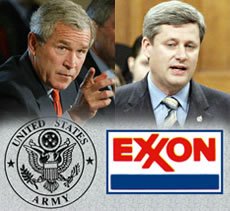
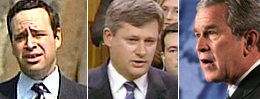
Now that Prime Minister Stephen Harper has faced Parliament in his Throne Speech, it is useful to reflect on the kind of government that Canadians now have. What is the nature of this "Tory" government? The members of the new minority Conservative Party of Canada government are frequently referred to as "Tories" by the corporate-owned mass-media. However, today's 'Conservative Party' is far from being substantively 'Tory', in our Canadian tradition. These "Conservatives" are in fact substantively an ultra-right wing organization, with a somewhat well-managed and "slicked-up" corporate veneer. Today's Conservative Party is as "Tory", as U.S. President George W. Bush is a strident liberal. You might ask, how did such a ultra-right wing group, form a government in such a relatively progressive country like Canada? After all, Canada has been viewed not only by Canadians in general, but other peoples internationally, as a beacon of progressive values in the world; notably symbolized in multiculturalism, Canada's world renowned universal public healthcare system, and its peacekeeping traditions. The work of commercially wealthy individuals The election of a Conservative Party minority government, is the product of the work wealthy individuals. These apparently include very skilled U.S. Republican Party public relations managers, and the owners of mass-media organizations in Canada, like Global Television, the National Post, its local newspaper affiliates like the Ottawa Citizen and the Montreal Gazette; the Toronto Star; and Bell Canada's Globe and Mail. "Canada for sale..." Canada, presents a bountiful commercial opportunity to these 'owners of capital' that they would like to seize for commercial gain, at the expense of Canadian rights; jobs; livelihoods; and the environment. A U.S. Big Business Agenda The apparent objective of these corporate individuals, is for Canada to be little more than an extension of a U.S. elite-controlled Big Business domain. In such a domain, only the commercially "fittest" are supposed to survive. The kind of corporate-oriented Americanized culture which current Stephen Harper's Conservative Party seeks to champion, is not what the Canadian Tory or "Progressive Conservative" tradition is all about. Tory loyalists formed the Progressive Canadian Party
Tory 'loyalists' rejected calls to "Unite the Right" that was led by the "Reformer" Stephen Harper. These Tory 'loyalists' formed the officially registered Progressive Canadian Party. This party is currently led by Tracy Parsons. The Parsons-led Progressive Canadian Party emerged from the illegal take-over by ultra-right "Reformers" that generated the now defunct Progressive Conservative Party of Canada (PC). The Canadian mass-media, under the apparent control of U.S. oil and a variety of other Big Business interests, has tried its best to conceal from the Canadian electorate, the Parsons-led Progressive Canadian Party. The prelude to an American conservative coup d'état The illegal take-over of the PC Party, was the result of a breach by Peter Mackay of a written Agreement against David Orchard. This occurred during the former PC leadership race. David Orchard, a PC leadership candidate, drew up a written Agreement with Peter Mackay, another PC leadership candidate. Mr. Mackay pledged in this Agreement not to support any such "Reformer" take-over. In exchange for this written commitment by Mr. Mackay, Mr. Orchard pledged his own delegates', and personal support to Mr. Mackay. However, once Peter Mackay officially became leader, he almost immediately set-out to pursue such a "Reformer" take-over of the PC Party, by Harper's "Reformers" in violation of his written Agreement with David Orchard. The mythology behind the "Unite the Right" campaign The rhetoric surrounding the take-over of the PC Party that pivoted on "uniting the right" hid a basic fact. The PC Party had always been a moderate-centrist party, rather than an ideological ultra-right wing party, characterized by Stephen Harpers's "Reformers". "Reformers" evolved from an Alberta provincial political economy that was beholden to significant commercial investments which had exerted political control that was orchestrated by a largely U.S. owned oil industry, related transnational corporations. Globalization is just another word for 'Americanization' American-led Corporate Globalization, seeks to take-over the world, and significantly Canada, for U.S. commercial interests, at the expense of human rights and environmental protection. Within the context of this onslaught, these U.S. interests (historically entrenched in Alberta) have sought to opportunistically extend their control into the rest of Canada. The current "Conservative Party" creation was a sought vehicle of a well-financed 'ultra right' and essentially fringe group. This fringe group in Canada, has sought to use their great financial wealth toward the consolidation of their U.S.-backed political economic influence and power. Canadian Tory "conservatism" versus American "conservatism"
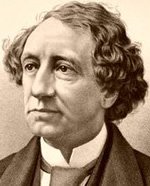
While "Tories" inspired the very Confederation of Canadian in 1867 led by Sir John A. Macdonald, against an American threat to take-over Canada, Harper's "Conservatives" seek to assimilate Canada into the corporatized context of the Mr. Bush's neo-McCarthyistic America. Harper's Conservatives indeed represent an American version of "conservatism", which is much different than its Canadian namesake. The American version of "conservatism" is driven by the need to "conserve" corporate dominance, in the insatiable pursuit of commercial profit, status, and power. "American conservatism" envisions the use of power through the police, and military force, if necessary, as a means to enforce the will of these corporations against the "threatening masses". American conservatism, is as materialistic, as it is mean-spirited. Historically, the Canadian Tory (or alternatively "Progressive Conservative") tradition in Canada has sought to safeguard Canada from 'Americanization'. "Progressive Conservatism" in Canada, may appear to be empty in content if one uses an American perspective of "conservatism". However, in the Canadian political historical context, the context is substantive. A defended communitarian-oriented "Tory" national identity "Tory" conservatism in Canada has traditionally pivoted on protecting the cultural values and heritages that we have evolved, as Canadians. There have been three great champions of this Canadian "Tory" sprit. This includes the original champion, Anglican Bishop John Strachan. Former Prime Minister Sir John A. Macdonald, another "Progressive Conservative" champion who fought tirelessly for Confederation, and against U.S. attempts to use "Free Trade" to take-over Canada. Former charismatic Prime Minister John Diefenbaker, the other champion, rallied Canadians to support his pro-Canada vision of a "New National Policy". His "New National Policy" had been inspired by Sir John A.'s use of the 'National Policy' to unite Canada, against U.S. economic continentalism, toward a then planned political take-over of Canada. Progressive Conservatism and the genesis of the Canadian national identity
The "Progressive" context of "Progressive Conservatism" refers to a characterization of the values that inspired Canada as a nation, as being inherently "enlightened". What is this enlightenment that these Tories conceived of themselves as having? Canadian "Tories" conceived that society ought to be driven by the need to protect the quality-of-living of people in a communitarian context. Canadian Tories correspondingly believed that these values ought to prevail over the drive for private commercial ambitions, that existed and still exists in the United States. Canadian Tories from the Very Reverend John Strachan to Sir. John A. to Diefenbaker did recognize the importance of 'commerce'. However these substantive and spiritually-inspired Tories, recognized a cultural character for 'commerce', beyond that of 'making money' as an end in itself. These Tories would never, for example, have allowed the Canadian Railway companies, or the Hudson's Bay Company, to be sold-out to American entrepreneurs. These substantive Tories conceived that in their desire to fulfill their perceived destiny of Canada as a Great Society, distinct from the United States, 'commerce' should serve nationalistic ends of Canadian socio-economic, cultural, political development. Therefore, Progressive Conservatism in Canada in a simplified context, refers to the "conserving" of Canada as a progressive communitarian society. While American "conservatives" use an oppressive version of religion that complements their elite desire for social control, Canadian "Progressive Conservatives" were inspired by religion in a different context. The "Progressive Conservative" tradition as originally championed by Bishop John Strachan, had been inspired by a vision of Christianity that sought to develop a 'gentler-kind-of-society'based on notions of civility, and "Britishopile" 'Old Country' Victorian concern for the plight of 'the poor'. Former Ontario Premier Bill Davis led Canada's last substantively Tory "Progressive Conservative" inspired government
This Tory vision viewed government intervention as a very natural and accepted means of protecting the quality of communities from selfish materialistic considerations. This is a spirit in which more recently, former Premier Bill Davis of Ontario, had infused his Progressive Conservative provincial government during the 1970's. His government supported such policies as rent control, and the consolidation of Ontario Hydro as a public utility (Bill Davis also supported a strong central government, in the spirit of Sir John A. Macdonald). Rent control that was enacted by the Davis government, in order to protect the plight of the poor in Toronto, and other parts of Ontario, from apartment-owner exploitation; and corresponding public utility development related policies, would have been unthinkable to Premier Mike Harris. Mr. Harris had lead a so-called "Progressive Conservative Party" government in Ontario, after the political failure of the NDP's Bob Rae. The Loyalists and Canadian Tory "Progressive Conservatism" American conservatism has sought to "conserve" a legacy of the pursuit of greed-driven "ambition" by force, if necessary, that evolved from the milieu of the American Revolution. America expanded by buying-out, or by military conquest of perceived political adversaries. In comparison, Canada's "conservatism" has sought to "conserve" or protect Canada from which the values which the Loyalists had fled, and which they saw as leading to barbaric and senseless violence and oppression. Meanwhile owners of mass media organizations (which have viewed "Tory nationalism" as frustrating their commercial "ambitions"), have sought to blur the respective critical 'cultural distinctiveness' between American and Canadian conservatism. Indeed, these conservatisms are almost as compatible as 'water' is with 'oil'. Genuine Tory "Progressive Conservatives" are Canadian civic nationalists who are against American continentalism
Commercially wealthy interests in Canada that are driven by greed, (as are their associates in the United States), have sought to execute slick public relations and related mass-manipulation. These apparent interests include the Aspers ownership clique of CanWest Global. The Aspers, who are huge Conservative Party donors, and others like them, have sought to use the media in a campaign to assimilate Canadian Tories into thinking that they are "no different" than right-wing American conservatives. The accompanying well-financed "Unite the Right" campaign of these Business lobby interests led by former Prime Minister Brian Mulroney, was the climax of efforts by pro-American conservative interests in Canada, to try to wear down the Canadian Tory spirit. To the wealthy fringe of pro-American conservative sympathizers, the PC Party symbolized a Tory Spirit that must be defeated, to expedite the American take-over of Canada. That contrasts with the objectives of the founders of the PC Party who had championed Confederation against the very "evils" of a perceived threatening 'Americanization', that Mr. Harper's Conservatives now represent. Canadian intellectuals like Gad Horowitz, in fact referred to the Canadian Tory Progressive Conservative tradition as resembling "Canadian democratic socialism", as represented by Tommy Douglas, far more, than the version of "conservatism" practiced in the U.S. American-style conservatives who pretend to be Tories
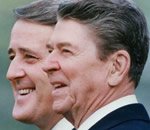
This spirit of Canadian Tory Progressive Conservatism is totally absent from the likes of Mike Harris, who is one of the founders of the Conservative Party of Canada, along with Stephen Harper, Preston Manning, Stockwell Day, now Deputy Prime Minister Peter Mackay, and former Prime Minister Brian Mulroney. Indeed former Prime Minister Brian Mulroney who was an enthusiastic supporter of the right wing U.S. administration of Ronald Reagan, sold-out vital Canadian national interests in the so-called "Free Trade" arrangement, that substantive Tories like Sir John A. had fought against, in order to preserve Canadian social, cultural, economic, and political independence form the United States. The Loyalist Tory vision of Canada as an alternative to America's culture of violence and materialism
The spirit of the Canadian Tory Progressive Conservatism, was originally inspired by Loyalists who fled what they saw as the culture of violence, and commercial materialism which still prevails in the United States. It may be up to a new generation Tory Progressive Conservatives to save Canada. It remains to be seen whether Tory 'loyalists' in Canada will be sufficiently inspired by their own great tradition as unifyers in Canada. Indeed, in the face of a Liberal party in disarray, and Jack Layton of the today's venal NDP, demonstrating that he can be easily bought out by superficial pronouncements for "Child Care" in Harper's Throne Speech in early April 2006, the future of Canada may reside in convictions of Tory 'loyalists' who are unapologetic, and true to their nationalistic pro-Canada traditions, like Sir John A. It may be up to these substantive Tories, to save Canada from the destructive entourage of Stephen Harper pretend Tory impostors who like "wolves in sheep clothing" seek to destroy what is left of Canada. Mr. Harper's American style-conservatives are seeking to speed-up the destruction of Canada that had already been occurring under the governments of Mr. Mulroney, Mr. Chrétien, and Mr. Martin.  |
|
|
|
|
||||||||||||||||||||||||||||||||||||||||||||||||||||
|
Copyright © 2007 The Canadian. All rights reserved. | |
|
| |||||||||||||||||||||||||||||||||||||||||||||||||||||||
 |
|||||||||||||||||||||||||||||||||||||||||||||||||||||||||||