|
|
|
|
|
|
|||||||||||||
|
|
|
|||||||||||||
|
|
|
|
| |
Bush, Harper and Chaos in the World by Rodrigue Tremblay, Université de Montréal
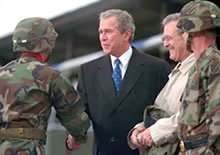
Coincidence or not, things started to go bad internationally soon after George W. Bush squeezed into power in January 2001, with the help of a one-member majority of the U.S. Supreme Court. Days after his inauguration, the new president began uttering incendiary statements, seemingly designed to provoke the Muslim world, but also to bully America's allies. Contrary to previous American presidents who tried to maintain at least the appearance of neutrality in the Israeli-Palestinian conflict, Bush chose instead to put his foot in his mouth by proclaiming his overt partiality: "We're going to correct the imbalances from the previous administration on the Mideast conflict. We're going to tilt it back toward Israel. And we're going to be consistent." Then Bush declared his contempt for international treaties and for international law, joking smart-aleckly that his lawyer, future Attorney General Alberto Gonzales "didn't bring that up to me." Moreover, he proceeded to cancel unilaterally decades-old treaties and conventions. Indeed, the list of international treaties-which are "the law of the land" in the U. S. according to the U. S. Constitution (Art. VI, para. 2) and the U.S. Supreme Court-that George W. Bush has unilaterally disregarded, cancelled or violated, is very long. They include: the 1972 Anti-Ballistic Missile (ABM) Treaty with Russia; the 1997 Kyoto treaty on global warming; the 1972 Biological and Toxin Weapons Convention; the 1997 Land Mine Treaty; the 1982 UN Convention on the Law of the Sea; the 2000 Cartagena Protocol on Biosafety to the UN Convention on Biological Diversity; the Geneva conventions of Aug. 12, 1949; the 1969 Vienna Convention on the Law of Treaties; the 2001 UN Agreement to Curb the International Flow of Illicit Small Arms; the 1998 International Criminal Court (ICC) Treaty; the 1996 Comprehensive [Nuclear] Test Ban Treaty; the 2001 International Plan for Cleaner Energy; the 1968 Nuclear Non-Proliferation Treaty; the 1945 Nuremberg Tribunal Charter against wars of aggression, etc. To what extent the al Qaeda attacks of 9/11 were in response to Bush's provocations, we will probably never know. One thing is certain, however, and it is that they surely did not help.
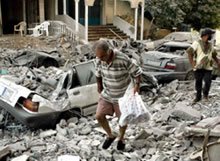
In the case of Iraq, it did not bother risk-taker George W. Bush that invading a country to bring about a regime change is per se an illegal act under international law. Instead, Bush's advisors had the responsibility of finding an "excuse" for war and for "fixing the facts" around the already decided policy of war. We now know that when Bush said that war was a policy of "last resort", he was lying. Now the new American colony in the Middle East is in ruins and in chaos, and death squads are killing people at will. Iraq is also poorer, with its production of oil down to about 1.5 million barrels a day, almost a million barrels below where it was before the American invasion of March 2003. There has also been a notable social regression in Iraq, with Iraqi women being subjected to the strict interpretation of the harsh Islamic law, the Sharia. Under U.S. occupation, Iraq is a de facto Islamic sharia state. Bush II also demonstrated how irremediably caught up he is in the tangled neocon web when he 'authorized' Israel's Ehud Olmert to indiscriminately bomb the defenseless country of Lebanon, whose population is 3.8 million. The entire world has witnessed how Israeli offensive military forces dropped tons of American-made bombs on Beirut and on Lebanese villages.
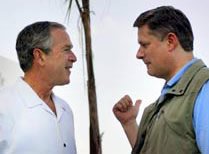
Considering that eight Canadian citizens died in Lebanon under Israeli-American planes and American-made bombs, what was Prime Minister Stephen Harper thinking when he declared that Israel's response to the kidnapping of two of its soldiers was "measured"? -'Measured' compared to what? More than 350 civilians killed, including Canadians, more than 1,000 people wounded, and half a million persons displaced, and $2 billion of damage to the infrastructures of a poor country. What has Canada to gain in supporting such a carnage? The promise of exporting more softwood and more oil to the U. S.? Should Canada's sovereignty and reputation in the world be traded that way? Canadians need a fundamental debate on such questions, before the minority Conservative government sells out completely to the Bush administration.
Even though everybody agrees that Stephen Harper is no Lester B. Pearson, he should nevertheless be wise enough not to get too cosy with what many consider to be the worst government that the United States ever had. History will record that, most of the time, the Bush-Cheney administration has displayed a rude single-minded arrogance in dealing with other countries. As a consequence of its confrontational and intransigent approach, the Bush team has alienated traditional allies and foes alike.This is an administration that ignores or does not care for history, for the Islamic culture, for international law, for the fundamental principle of national sovereignty and for the most elementary humanistic principles of morality. - The world will pay dearly for such incompetence, callousness and shortsightedness. About the author:
Rodrigue Tremblay is professor emeritus of economics at the University of Montreal. He is the author of the book 'The New American Empire'.
|
|
|
|
|
|||||||||||||||||||||||||||||||
|
Copyright © 2007 The Canadian. All rights reserved. | |
|
| ||||||||||||||||||||||||||||||||||
 |
||||||||||||||||||||||||||||||||||||||