|
| |
Stephen Harper's "Quisling" government pursues further talks for U.S. take-over of Canada
Media organization elites cover-up the biggest scandal in Canadian history
by Don Nordin
| |
 |
| |
|
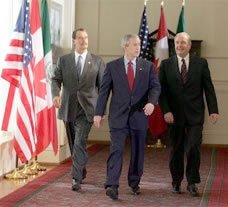
Paul Martin [on the far right] after shaking hands
with U.S. President Bush [centre] having
apparently sold-out Canada to the United States in
Crawford, Texas without any constitutionally required
national debate on March 23, 2005 via a so-called
"Security and Prosperity Partnership of North America".
Now, the U.S. has effective control over the Canadian
armed forces, and has been also given the right to
land U.S. troops in Canadian soil for made-up reasons,
like the alleged "Weapons of Mass Destruction" which
led to U.S. troops in Iraq.
The prime purpose of the current Prime Minister Harper
government is to finish the sell-off of Canada to
fascistic interests in the United States. It is
notable that both Mr. Martin and Mr. Harper had
hypocritically campaigned on the affirmation of
Canadian sovereignty during the Federal Election
campaign in January 2006.
|
|
What would you think if it was announced that Canada
was to cease as an independent country as early as
2007? Would it matter to you? Would you want to know
who was responsible? What would you do?
Well, during the last week there have been
announcements from at least two sources that Canada
will soon cease to exist as a sovereign country.
The first notice I received was in the form of an Aug.
18 email from Connie Fogal, leader of the Canadian
Action Party. The email includes a bulletin from
the Fraser Institute entitled, "The Case for the
Amero: The Institutions of a North American Monetary
Union." A statement near the end of the bulletin
reads, "On the day the North American Monetary Union
is created--perhaps on January 1, 2010--Canada, the
United States, and Mexico will replace their national
currencies with the Amero. On that day, all
American dollar notes and coins will be exchanged at
the rate of one US dollar for one Amero."
Then much worst news came. On August 30 I received,
indirectly from an email correspondent, an article
from 'Vivelecanada.ca' entitled, "Timeline of the
Progress Towards a North American Union". At the end
of the timeline it projected that the North American
Union would be created in 2007, three
years before the projection of the Fraser Institute!
You might ask how we got into a situation where our
country would be dismantled without our consent.
Well, from World Net Daily we read that "the White
House has established working groups, under the North
American Free Trade Agreement office in the Department
of Commerce, to implement the Security and Prosperity
Partnership (also called the North American Union)
signed by President Bush, Mexican President Vicente
Fox and then Canadian Prime Minister Paul Martin in
Waco, Texas, March 23, 2005". This was done without
authorization of the U.S. Congress or any level of
government in all three countries as far as I am able
to ascertain.
Where is all this heading?
We are heading into a One World neo-fascistic
government and a One World economy where sovereign
countries are being systematically destroyed. It's
>called the New World Order and it's been in the works
for decades. At the moment, George W. Bush is the
figurehead leader in front of a neo-conservative
(fascist) ruling elite which is the driving force
behind the NOW agenda. It is an agenda by and for
the ruling elites. The middle class, the only
collective power that has the strength to fight back
against this agenda, if they could ever unite in
purpose, is being systematically destroyed. If the
trend continues, the vast majority of workers will be
driven down to the lowest level.
Don't look to Prime Minister Stephen Harper to "Stand
up for Canada" as the they indicated during the last
federal election campaign; and fight against the
take-over of Canada via a U.S. imperial "North
American Union and to save our sovereignty. He is
solidly behind President George W. Bush. It is even
said that NDP leader, Jack Layton, has formed an
alliance with Stephen Harper - see Jacques Lemieux's
article in The Canadian in which he makes
his case and concludes, "A working alliance between
Mr. Harper and Mr. Layton is the only thing that can
explain why Mr. Layton has chosen not to apparently
rally Canadians against the clearly reactionary agenda
of Mr. Harper."
So who's fighting for Canada?
There is only one party that has a solid sovereigntist
agenda - the Canadian Action Party. David Orchard is
also trying to recruit followers in an attempt to turn
the Liberal party into a sovereigntist party. But
these political efforts, even if one succeeds, will be
too late. This is because the North American Union
will already be in place before the next Canadian
national election. Clearly, another strategy is
necessary if we
are to save our country.
Where is the discussion on how to save Canada?
| |
 |
| |
|
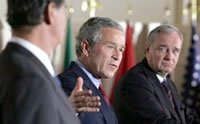
The U.S Embassy in Ottawa, Canada, brazenly
boasts about this sell-out of Canadian national
interests between Mr. Martin and Mr. Bush in Texas. Elites who control Canadian media
organizations have chosen to cover-up this on-going
treasonous scandal, and its both destructive and
oppressive implications for all Canadians.
|
|
The discussion is definitely not in the corporatized
"mainstream media". The mainstream media is an arm
of the same elite that is trying to implement the
North American Union. The discussion will take place
on the internet amongst concerned citizens and
concerned organizations, on the streets and in your
community. It is the people at the grassroots that
have the potential to fire up a meaningful discussion
on this issue. If they don't, we are finished as a
nation.
Finally, what does this mean for people in
Lumby?
In a nutshell, as the nation goes, so will its people.
We will not be impervious to these high level
machinations. Our economy will continue to be
corporatized and those corporations will continue to
merge into larger entities. With the influx of cheap
imported goods, small farmers, businesspeople, and
entrepreneurs will be driven under by being forced to
compete against larger, more powerful corporate
entities.
Unless we wake up fast and begin to unite and pose an
effective fightback, we can say goodbye to Canada and
our prosperous way of life.
Timeline
a.. November 13, 1979: While officially
declaring his candidacy for U.S.
President, Ronald Reagan proposes a "North American
Agreement" which will
produce "a North American continent in which the goods
and people of the three
countries will cross boundaries more freely."
b.. January 1981: U.S. President Ronald Reagan
proposes a North American
common market.
c.. September 4, 1984: Conservative Brian Mulroney is
elected Prime Minister
of Canada after opposing free trade during the
campaign.
d.. September 25, 1984: Canadian Prime Minister Brian
Mulroney meets
President Reagan in Washington and promises closer
relations with the US.
e.. October 9, 1984: The US Congress adopts the Trade
and Tariff Act, an
omnibus trade act that notably extends the powers of
the president to concede
trade benefits and enter into bilateral free trade
agreements. The Act would be
passed on October 30, 1984.
f.. 1985: A Canadian Royal Commission on the economy
chaired by former
Liberal Minister of Finance Donald S. Macdonald issues
a report to the
Government of Canada recommending free trade with the
United States.
g.. St. Patrick's Day, 1985: Prime Minister Brian
Mulroney and President
Ronald Reagan sing "When Irish Eyes Are Smiling"
together to cap off the
"Shamrock Summit", a 24-hour meeting in Quebec City
that opened the door to
future free trade talks between the countries.
Commentator Eric Kierans
observed that "The general impression you get, is that
our prime minister
invited his boss home for dinner." Canadian historian
Jack Granatstein said
that this "public display of sucking up to Reagan may
have been the single most
demeaning moment in the entire political history of
Canada's relations with the
United States."
h.. September 26, 1985: Canadian Prime Minister Brian
Mulroney announces that
Canada will try to reach a free trade agreement with
the US.
i.. December 10, 1985: U.S. President Reagan
officially informs Congress
about his intention to negotiate a free trade
agreement with Canada under the
authority of trade promotion. Referred to as fast
track, trade promotion
authority is an accelerated legislative procedure
which obliges the House of
Representatives and the Senate to decide within 90
days whether or not to
establish a trade trade unit. No amendments are
permitted.
j.. May 1986: Canadian and American negotiators begin
to work out a free
trade deal. The Canadian team is led by former deputy
Minister of Finance Simon
Reisman and the American side by Peter O. Murphy, the
former deputy United
States trade representative in Geneva.
k.. October 3, 1987: The 20-chapter Canada-United
States Free Trade Agreement
(CUSFTA or FTA) is finalized.
l.. November 6, 1987: Signing of a framework agreement
between the US and
Mexico.
m.. January 2, 1988: Prime Minister Mulroney and
President Reagan sign the
FTA.
n.. January 1, 1989: The Canada US Free Trade
Agreement (CUSFTA or FTA) goes
into effect.
o.. June 10, 1990: Presidents Bush (U.S.) and Salinas
(Mexico) announce that
they will begin discussions aimed at liberalizing
trade between their
countries.
p.. August 21, 1990: Mexican President Salinas
officially proposes to the US
president the negotiation of a free trade agreement
between Mexico and the
US.
q.. February 5, 1991: Negotiations between the US and
Mexico aimed at
liberalizing trade between the two countries
officially become trilateral at
the request of the Canadian government under Brian
Mulroney.
r.. April 7 to 10, 1991: Cooperation agreements are
signed between Mexico and
Canada covering taxation, cultural production and
exports.
s.. May 24, 1991: The American Senate endorses the
extension of fast track
authority in order to facilitate the negotiation of
free trade with Mexico.
t.. June 12, 1991: Start of trade negotiations between
Canada, the US and
Mexico.
u.. April 4, 1992: Signing in Mexico by Canada and
Mexico of a protocol
agreement on cooperation projects regarding labour.
v.. August 12, 1992: Signing of an agreement in
principle on NAFTA.
w.. September 17, 1992: Creation of a trilateral
commission responsible for
examining cooperation in the area of the environment.
x.. October 7, 1992: Official signing of NAFTA by
Michael Wilson of Canada
(minister), American ambassador Carla Hills and
Mexican secretary Jaime Serra
Puche, in San Antonio (Texas).
y.. December 17, 1992: Official signing of NAFTA by
Canadian Prime Minister
Brian Mulroney, US president George Bush, and Mexican
president Carlos Salinas
de Gortari, subject to its final approval by the
federal Parliaments of the
three countries.
z.. March 17 and 18, 1993: Start of tripartite
discussions in Washington
aimed at reaching subsidiary agreements covering labor
and the environment.
aa.. September 14, 1993: Official signing of parallel
agreements covering
labor and the environment in the capitals of the three
countries.
ab.. 1993: The Liberal Party under Jean Chretien
promises to renegotiate
NAFTA in its campaign platform, titled "Creating
Opportunity: the Liberal Plan
for Canada" and also known as The Red Book.
ac.. December 1993: Newly elected Canadian Prime
Minister Jean Chretien signs
NAFTA without changes, breaking his promise to
renegotiate NAFTA. U.S.
President Bill Clinton signs NAFTA for the U.S.
ad.. January 1, 1994: NAFTA and the two agreements on
labour and the
environment go into effect, replacing CUSFTA.
ae.. November 16, 1994: Canada and Mexico sign a
cooperation agreement
regarding the peaceful use of nuclear energy.
af.. December 1994: The Summit of the Americas is held
in Miami. The three
signatories of NAFTA officially invite Chile to become
a contractual party of
the agreement. The Free Trade Area of the Americas or
FTAA is initiated.
According to the offical FTAA website, "the Heads of
State and Government of
the 34 democracies in the region agreed to construct a
Free Trade Area of the
Americas, or FTAA, in which barriers to trade and
investment will be
progressively eliminated. They agreed to complete
negotiations towards this
agreement by the year 2005 and to achieve substantial
progress toward building
the FTAA by 2000." See: FTAA
ag.. December 22, 1994: Mexican monetary authorities
decide to let the Peso
float. The US and Canada open a US$6 billion line of
credit for Mexico.
ah.. January 3, 1995: Mexican president Ernesto
Zedillo presents an emergency
plan.
ai.. January 1995: President Clinton announces an aid
plan for Mexico.
aj.. February 9, 1995: Mickey Kantor, the US Foreign
Trade representative,
announces Washington's intention to include the
provisions of NAFTA regarding
labor and the environment in negotiations with Chile.
ak.. February 21, 1995: Signing in Washington of an
agreement regarding the
financial assistance given to Mexico. Mexico in turn
promises to pay Mexican
oil export revenue as a guarantee into an account at
the Federal Reserve in New
York.
al.. February 28, 1995: Mexico announces the increase
of its customs duties
on a number of imports from countries with which it
does not have a free trade
agreement.
am.. March 9, 1995: President Zedillo presents
austerity measures. The plan
envisages a 50% increase in value added taxes, a 10%
reduction of government
expenditure, a 35% increase in gas prices, a 20%
increase in electricity prices
and a 100% increase in transportation prices. The
minimum wage is increased by
10%. The private sector can benefit from government
assistance. The inter-bank
rate that is reduced to 74% will be increased to 109%
on March 15.
an.. March 29, 1995: Statistical data on US foreign
trade confirms the sharp
increase in Mexican exports to the US.
ao.. April 10, 1995: The US dollar reaches its lowest
level in history on the
international market. It depreciated by 50% relative
to the Japanese yen in
only four years.
ap.. June 7, 1995: First meeting of the ministers of
Foreign Trade of Canada
(Roy MacLaren), the US (Mickey Kantor), Mexico
(Herminio Blanco) and Chile
(Eduardo Aninat) to start negotiations.
aq.. December 29, 1995: Chile and Canada commit to
negotiate a bilateral free
trade agreement.
ar.. June 3, 1996: Chile and Canada start negotiating
the reciprocal opening
of markets in Santiago.
as.. November 18, 1996: Signing in Ottawa of the
Canada-Chile free trade
agreement by Jean Chrétien, Prime Minister of Canada
and Eduardo Frei,
President of Chile. The agreement frees 80% of trade
between the two countries.
It is the first free trade agreement signed between
Chile and a member of the G
7.
at.. July 4, 1997: The Canada-Chile free trade
agreement comes into effect.
au.. 1997: The US presidency proposes applying NAFTA
parity to Caribbean
countries.
av.. April 17, 1998: Signing in Santiago, Chile of the
free trade agreement
between Chile and Mexico by President Ernesto Zedillo
Ponce de León of Mexico,
and President Eduardo Frei of Chile.
aw.. August 1, 1999: The Chile-Mexico free trade
agreement comes into effect.
ax.. September, 1999: The Canadian right-wing think
tank the Fraser Institute
publishes a paper by Herbert G. Grubel titled "The
Case for the Amero: The
Economics and Politics of a North American Monetary
Union". In the paper Grubel
argues that a common currency is not inevitable but it
is desirable. See: The
Case for the Amero
ay.. July 2, 2000: Vicente Fox Quesada of the National
Action Party (PAN), is
elected president of Mexico, thus ending the reign of
the Revolutionary
Institutional Party (RIP) that had held power for 71
years. Mr. Fox is sworn in
on 1 December 2000.
az.. July 4, 2000: Mexican president Vicente Fox
proposes a 20 to 30 year
timeline for the creation of a common North American
market. President Fox's
"20/20 vision" as it is commonly called, includes the
following: a customs
union, a common external tariff, greater coordination
of policies, common
monetary policies, free flow of labor, and fiscal
transfers for the development
of poor Mexican regions. With the model of the
European Fund in mind, President
Fox suggests that US$10 to 30 billion be invested in
NAFTA to support
underdeveloped regions. The fund could be administered
by an international
financial institution such as the Inter-American
Development Bank.
ba.. November 27, 2000: Trade negotiations resume
between the US and Chile
for Chile's possible entry into NAFTA.
bb.. 2001: Robert Pastor's 2001 book "Toward a North
American Community" is
published. The book calls for the creation of a North
American Union (NAU).
bc.. April 2001: Canadian Prime Minister Jean Chretien
and US President
George W. Bush sign the Declaration of Quebec City at
the third Summit of the
Americas: "This is a 'commitment to hemispheric
integration". See: Declaration
of Quebec City
bd.. September 11, 2001: A series of coordinated
suicide terrorist attacks
upon the United States, predominantly targeting
civilians, are carried out on
Tuesday, September 11, 2001. Two planes (United
Airlines Flight 175 and
American Airlines Flight 11) crashed into the World
Trade Center in New York
City, one plane into each tower (One and Two). Both
towers collapsed within two
hours. The pilot of the third team crashed a plane
into the Pentagon in
Arlington County, Virginia. Passengers and members of
the flight crew on the
fourth aircraft attempted to retake control of their
plane from the hijackers;
that plane crashed into a field near the town of
Shanksville in rural Somerset
County, Pennsylvania. Excluding the 19 hijackers, a
confirmed 2,973 people died
and another 24 remain listed as missing as a result of
these attacks. In
response, the Bush administration launches the "war on
terror" and becomes very
concerned with security.
be.. December 2001: New U.S. Ambassador to Canada Paul
Cellucci publicly
advocates "NAFTA-plus". See: The Emergence of a North
American Community?
bf.. December 2001: U.S. Governor Tom Ridge and
Canadian Deputy Prime
Minister John Manley sign the Smart Border Declaration
and Associated 30-Point
Action Plan to Enhance the Security of Our Shared
Border While Facilitating the
Legitimate Flow of People and Goods. The Action Plan
has four pillars: the
secure flow of people, the secure flow of goods,
secure infrastructure, and
information. It includes shared customs data, a safe
third-country agreement,
harmonized commercial processing, etc.
bg.. April 2002: The Canadian right-wing think tank
the C.D. Howe Institute
publishes the first paper in the "Border Papers"
series, which they have
described as "a project on Canada's choices regarding
North American
integration." The Border Papers were published with
the financial backing of
the Donner Canadian Foundation. Generally the border
papers advocate deep
integration between Canada and the U.S., and the first
border paper "Shaping
the Future of the North American Economic Space: A
Framework for Action" by
Wendy Dobson popularized the term "the Big Idea" as
one euphemism for deep
integration. To read the border papers, you can visit
the C.D. Howe Institute
website at www.cdhowe.org. Use the publication search
form (1996 to current,
PDF) and choose "border papers" from the "Serie
contains" drop down menu.
bh.. September 9, 2002: President Bush and Prime
Minister Chrétien meet to
discuss progress on the Smart Border Action Plan and
ask that they be updated
regularly on the work being done to harmonize our
common border.
bi.. December 5, 2002: The text of the Safe Third
Country Agreement is signed
by officials of Canada and the United States as part
of the Smart Border Action
Plan. See the final text here: Final Text of the Safe
Third Country Agreement
Refugee support groups on both sides of the
Canadian-U.S. border criticize the
new agreement dealing with refugees for stipulating
that refugees must seek
asylum in whichever of the two countries they reach
first. Critics say that
preventing individuals who first set foot in the U.S.
from making a claim in
Canada will increase cases of human smuggling, and
that other refugees will be
forced to live without any kind of legal status in the
U.S. See for example: 10
Reasons Why Safe Third Country is a Bad Deal
bj.. September 11, 2002: The National Post publishes
an article by Alan
Gotlieb, the chairman of the Donner Canadian
Foundation and Canada's ambassador
to the United States from 1981 to 1989, titled "Why
not a grand bargain with
the U.S.?" In the article, Gotlieb asks "Rather than
eschewing further
integration with the United States, shouldn't we be
building on NAFTA to create
new rules, new tribunals, new institutions to secure
our trade? Wouldn't this
'legal integration' be superior to ad hoc responses
and largely ineffective
lobbying to prevent harm from Congressional
protectionist sorties? Wouldn't our
economic security be enhanced by establishing a single
North American
competitive market without anti-dumping and
countervail rules? Are there not
elements of a grand bargain to be struck, combining
North American economic,
defence and security arrangements within a common
perimeter?" See: Why not a
grand bargain with the U.S.?
bk.. December 6, 2002: The White House issues an
update on the progress of
the Smart Border Action Plan. See: U.S. Canada Smart
Border 30 Point Action
Plan Update
bl.. December, 2002: US Secretary Colin Powell signs
an agreement between the
United States and Canada to establish a new
bi-national planning group at the
North American Aerospace Defense Command (NORAD)
headquarters in Colorado
Springs. The new bi-national planning group is
expected to release a report
recommending how the militaries of U.S. and Canada can
"work together more
effectively to counter land-based and maritime
threats." See: U.S. and Canada
Sign Bi-National Agreement on Military Planning
bm.. January 2003: The Canadian Council of Chief
Executives headed by Tom
D'Aquino (also a member of the trinational Task Force
on the Future of North
America) launches the North American Security and
Prosperity Initiative (NASPI)
in January 2003 in response to an alleged "need for a
comprehensive North
American strategy integrating economic and security
issues". NASPI has five
main elements, which include: Reinventing borders,
Maximizing regulatory
efficiencies, Negotiation of a comprehensive resource
security pact,
Reinvigorating the North American defence alliance,
and Creating a new
institutional framework.
bn.. January 2004: NAFTA celebrates its tenth
anniversary with controversy,
as it is both praised and criticized.
bo.. January/February 2004: The Council on Foreign
Relations publishes Robert
Pastor's paper "North America's Second Decade", which
advocates further North
American integration. Read it at: North America's
Second Decade
bp.. April 2004: The Canadian Council of Chief
Exectuives (CCCE) publishes a
major discussion paper titled "New Frontiers: Building
a 21st Century Canada-
United States Partnership in North America". Some of
the paper's 15
recommendations expand on the NASPI framework in areas
such as tariff
harmonization, rules of origin, trade remedies, energy
strategy, core defence
priorities and the need to strengthen Canada-United
States institutions,
including the North American Aerospace Defence Command
(NORAD). Other
recommendations focus on the process for developing
and executing a
comprehensive strategy, including the need for greater
coordination across
government departments, between federal and provincial
governments and between
the public and private sectors.
bq.. October 2004: The Canada-Mexico Partnership (CMP)
is launched during the
visit of President Vicente Fox to Ottawa. See:
Canada-Mexico Partnership
(CMP)
br.. November 1, 2004: The Independent Task Force on
the Future of North
America is formed. The task force is a trilateral task
force charged with
developing a "roadmap" to promote North American
security and advance the well-
being of citizens of all three countries. The task
force is chaired by former
Liberal Deputy Prime Minister John Manley. It is
sponsored by the Council on
Foreign Relations (CFR) in association with the
Canadian Council of Chief
Executives (CCCE) and the Consejo Mexicano de Asuntos
Internacionales.
bs.. December 29, 2004: The Safe Third Country
Agreement comes into force.
See: Safe Third Country Agreement Comes Into Force
Today
bt.. March 2005: The Independent Task Force on the
Future of North America
releases "Creating a North American Community -
Chairmen's Statement". Three
former high-ranking government officials from Canada,
Mexico, and the United
States call for a North American economic and security
community by 2010 to
address shared security threats, challenges to
competitiveness, and interest in
broad-based development across the three countries.
See: Creating a North
American Community Chairmen's Statement
bu.. March 23, 2005: The leaders of Canada, the United
States and Mexico sign
the Security and Prosperity Partnership (SPP) of North
America at the
trilateral summit in Waco, Texas. Canada is signed on
by Prime Minister Paul
Martin. See: www.spp.gov.
bv.. March 24, 2005: The 40 Point Smart Regulation
Plan is launched as part
of the SPP agreement. It is a far-reaching plan to
introduce huge changes to
Canada's regulatory system in order to eliminate some
regulations and harmonize
other regulations with the U.S. Reg Alcock, President
of the Treasury Board and
Minister responsible for the Canadian Wheat Board,
launches the Government of
Canada's implementation plan for Smart Regulation at a
Newsmaker Breakfast at
the National Press Club. For the original plan and
updates see: Smart
Regulation: Report on Actions and Plans
bw.. March 2005: Agreement to build the Texas NAFTA
Superhighway: "A
'Comprehensive Development Agreement' [is] signed by
the Texas Department of
Transportation (TxDOT) to build the 'TTC-35 High
Priority Corridor' parallel to
Interstate 35. The contracting party involved a
limited partnership formed
between Cintra Concesiones de Infraestructuras de
Transporte, S.A., a
publically listed company headquartered in Spain,
owned by the Madrid-based
Groupo Ferrovial, and a San Antonio-based construction
company, Zachry
Construction Corp." Texas Segment of NAFTA Super
Highway Nears Construction,
Jerome R. Corsi, June 2006, www.Humaneventsonline.com
The proposed NAFTA
superhighway will be a 10 lane super highway four
football fields wide that
will travel through the heart of the U.S. along
Interstate 35, from the Mexican
border at Laredo, Tex., to the Canadian border north
of Duluth. Minn. The
"Trans-Texas Corridor" or TTC will be the first leg of
the NAFTA
superhighway.
bx.. April 2005: U.S. Senate Bill 853 is introduced by
Senator Richard G.
Lugar (IN) and six cosponsors. "The North American
Security Cooperative Act
(NASCA) is touted as a bill to protect the American
public from terrorists by
creating the North American Union. The North American
Union consists of three
countries, U.S., Canada, and Mexico, with open
borders, something that is
proposed to be in effect by 2010. Thus, it would
ensure the fulfillment of the
Security and Prosperity Partnership of North America."
NASCA Rips America,
April 2005, www.Freemarketnews.com
by.. May 2005: The Council on Foreign Relations Press
publishes the report of
the Independent Task Force on the Future of North
America, titled "Building a
North American Community" (task force report 53). See:
Building a North
American Community
bz.. June 2005: A follow-up SPP meeting is held in
Ottawa, Canada.
ca.. June 2005: A U.S. Senate Republican Policy
Committee policy paper is
released: "The CFR did not mention the Central America
Free Trade Agreement
(CAFTA), but it is obvious that it is part of the
scheme. This was made clear
by the Senate Republican Policy Committee policy paper
released in June 2005.
It argued that Congress should pass CAFTA S The Senate
Republican policy paper
argued that CAFTA 'will promote democratic
governance.'But there is nothing
democratic about CAFTA's many pages of grants of vague
authority to foreign
tribunals on which foreign judges can force us to
change our domestic laws to
be 'no more burdensome than necessary'on foreign
trade." CFR's Plan to
Integrate the U.S., Mexico and Canada, July 2005,
www.Eagleforum.org
cb.. June 9, 2005: CNN's Lou Dobbs, reporting on Dr.
Robert Pastor's
congressional testimony as one of the six co-chairmen
of the Council on Foreign
Relations (CFR) Independent Task Force on North
America, began his evening
broadcast with this announcement: "Good evening,
everybody. Tonight, an
astonishing proposal to expand our borders to
incorporate Mexico and Canada and
simultaneously further diminish U.S. sovereignty. Have
our political elites
gone mad?"
cc.. July 2005: The Central American Free Trade
Agreement (CAFTA) passes in
the U.S. the House of Representatives by a 217-215
vote.
cd.. January 2006: Conservative Stephen Harper is
elected Prime Minister of
Canada with a minority government.
ce.. March 31, 2006: At the Summit of the Americas in
Cancun, Canada (under
new Prime Minister Stephen Harper) along with the U.S.
and Mexico release the
Leaders' Joint Statement. The statement presents six
action points to insure
that the North American Union be in place by 2007.
These action points include:
1) Establishment of a Trilateral Regulatory
Cooperative Framework 2)
Establishment of the North American Competitiveness
Council (NACC) 3) Provision
for North American Emergency Management 4) Provision
for Avian and Human
Pandemic Influenza Management 5) Development of North
American Energy Security
6) Assure Smart, Secure Borders North American Borders
Read the full statement
at: Leaders' Joint Statement
cf.. April 2006: A draft environmental impact
statement on the proposed first
leg of the NAFT superhighway, the "Trans-Texas
Corridor" or TTC, is
completed.
cg.. June 2006: Tom Tancredo, R-Colorado. demands
superstate accounting from
the Bush administration: "Responding to a
Worldnetdaily.com report, Tom
Tancredo is demanding the Bush administration fully
disclose the activities of
an office implementing a trilateral agreement with
Mexico and Canada that
apparently could lead to a North American union,
despite having no
authorization from Congress." Tancredo Confronts
'Super-State' Effort, June
2006, www.Worldnetdaily.com
ch.. July 2006: Public hearings on the proposed NAFTA
superhighway begin in
the U.S.
ci.. COMING IN 2007: Construction is set to begin on
the "NAFTA
superhighway".
cj.. COMING IN 2007: The creation of the North
American Union (NAU).
Main Sources:
- Vive le Canada.ca, FAQ, Sovereignty vs Deep
Integration
- North American Forum on Integration, NAFTA Timeline
- Free Market News Network Corp, N. AM. UNION TIMELINE
- Wikipedia, various entries, Wikipedia.org

|
|
|
|
|