|
|
|
|
|
|
|||||||||||||
|
|
|
|||||||||||||
|
|
|
|
| |
Global warming shocks climbers Compiled by Paul Chen
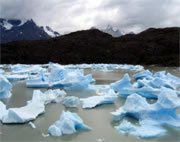
Mountaineers are bringing back first-hand accounts of vanishing glaciers, melting ice routes, crumbling rock formations, and flood-prone lakes where glaciers once rose. The observations are transforming a growing number of alpine and ice climbers, some of whom have scientific training, into eyewitnesses of global warming. Increasingly, they are deciding not to leave it to scientists to tell the entire story. "I personally have done a bunch of ice climbs around the world that no longer exist," said Yvon Chouinard, a renowned climber and surfer and founder of Patagonia, Inc., an outdoor clothing and gear company that champions the environment. "I mean, I was aghast at the change." Chouinard pointed to recent trips where the ice had all but disappeared on the famous Diamond Couloir of 16,897-foot (5,150-meter) Mount Kenya, and snow was absent at low elevations on 4,409-foot (1,344-meter) Ben Nevis, Britain's highest peak, in the Highlands of northwest Scotland. He sees a role for climbers in debating climate change, even if their chronicles are unscientific. Alpine climbers are worrying about the loss of classic routes and potential new lines up mountains that are melting, from the Cascades in the Pacific Northwest and the Alps in Europe to the Andes in South America and the Himalaya in Asia. Their anecdotes often reflect what science is finding, but with stories and pictures from places where most scientists aren't able to reach. "As climbers we see these places, we go all over the world," Mark Bowen, a climber and physicist who wrote a book on climate and mountains, told the American Alpine Club at its annual meeting last week in Bend. "We're in touch with the natural world like few people are. We can see the changes better than most people can," he said. Already, Switzerland's Matterhorn had to be closed to some climbing at times because of recent summer rockfall attributed to global warming and its Great Aletsch Glacier, urope's largest, as retreated a couple miles from its peak of 14 miles (about 22.5 kilometres) in length in 1860. The Swiss Alps' icy soil that glues its rock faces together is thawing, causing instability. The glacier from which Edmund Hillary and Tenzing Norgay made their first ascent of 29,035-foot (8,850-metre) Mount Everest in 1953 has retreated so much that mountaineers now walk hours longer to reach it. A milelong (1,600-metre-long) lake replaced the glacier at 20,305-foot (6,189-metre) Island Peak in Nepal's Everest region. Japanese mountaineer and explorer Tomatsu Nakamura, editor of the Japanese Alpine News, said climbers are seeing more melting and less snow and ice in the mountains of the eastern Himalaya, Tibet and Bhutan, home to many of the highest unclimbed peaks in the world. Since the 1940s, when geologist Maynard Miller began conducting research on Alaska's vast Juneau Icefield, he has seen how global warming has affected glaciers studied in the longest continuous research program of any icefield system. "We're going to be in one heck of a mess, I can guarantee that. We have mucked up the world's climate," said Miller, who was part of the 1963 expedition that got the first Americans to the summit of Mount Everest. "Everything is changing, minute after minute, nothing is the same," he said. "Glaciers are extraordinarily sensitive indicators of climate change." Make comments about this article in The Canadian Blog.
|
|
|
|
|
|||||||||||||
|
Copyright © 2007 The Canadian. All rights reserved. | |
|
| ||||||||||||||||
 |
||||||||||||||||||||