|
|
|
|
|
|
|||||||||||||
|
|
|
|||||||||||||
|
|
|
|
| |
France must re-kindle a progressive socialist spirit when choosing a new President French Elections 2007: European Union and Political Mal-contents, Part 2 by Professor Dr. Emmanuel Omoh Esiemokhai, French Columnist
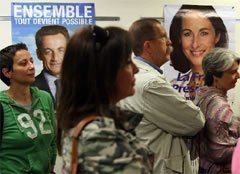
On Sunday May 6, 2007, French voters will troupe to the pools for an electoral battle royal. The people will vote for one of the two leading candidates, the Socialist leader, Madame Segolen Royal and Monsieur Nikolas Sarkozy. This is my further commentary on French Elections 2007 in The Canadian, that is a follow-up to the first instalment, which was published recently. I am now surer in my judgment but the decision of the French people will be paramount. The French ought to seriously consider the following ideas thrown up by the ideals of French Socialists and the World Citizens Organisation, based in France, of which I have been a member since 1968. 1. That French Society must retain its uniqueness, its refinement and humaneness. 2. That French Society in this "globalising" world, must progress only under a full socialist consciousness, that promotes the flowering of popular movements towards societal advancement. 3. That legislation should propel social relations toward fostering progressive social change in French society and in the World, rather than being primarily developed to serve the Big Business interests of member countries in the EU. 4. The electoral arrangement for the transfer of authority in France should be both socialist and fundamentally democratic. 5. That experience has shown, that French Socialists tend better protect the social and other rights of the French people, in contrast with right wing rivals. 6. That France's vital interests lie outside the European Union. So, it will be unwise for France to be purely Eurocentric. Its interior vital national interests should also be nurtured. This is perhaps, why the British government has exercised utmost restraint in European matters. These expositions compel the thought that the new direction of French society and politics must evolve a new socialist doctrine of law and state. This is because the orthodox Euro-centric approach, which tends to legislate behaviour, and promotes European group dynamics seem to have become anachronistic and unhelpful. The reason for this is the fact that the European integration process is based on inadequate philosophical and theoretical safeguards. The European Union (EU) has become overly focused on the austere commercial priorities of European Big Business interests competing with their American Big Business counterparts for the "global economic pie", at the expense of the advancement of the vital human rights of a "European citizenry". In the capitalistocratic milieu of European integration, the environment which Europeans rely on for their quality-of-survival, continues to be destroyed at an alarming rate, France ought to reconcile divergent views prevalent in French society and evaluate them from the standpoint of an outlook in a "globalising world". The new French government under a new President as the Head of State, will succeed if it correlates French attitudes with the most fundamental and fully reliable objective laws of progressive-minded social development. This is important in a world in which unipolarism has introduced strifes, war-mongering, constant related threats, nuclear proliferation and other indubitable wrongs prevalent in our unipolar world. The current unipolar context of international affairs is driven by the pursuit to consolidate a global Empire by elites in the United States, as the world's only military Superpower. The Socialists in France, the Communists and other progressive political movement formations must strive to win. In defiance of the fact that right wing reaction is holding the world in its octopus grip, socialists in Venezuela, China, Bolivia, Chile, Russia, Cuba, and Brazil, have, in recent history, moved confidently and in full determination to advance their peoples fortunes. Socialism in France in the aftermath of winning or losing in the French Presidential elections, needs to appreciate the "lessons in socialism" provided by these socialist aspiring societies. Socialism in France correspondingly cannot become content with a rhetorical context of Tony Blair's "New Labour Socialism". The Tony Blair government's "impostor socialism" operationally sacrifices vital British national interests, to transnational Big Business interests of the EU and corporate America. Under the impact of the French revolution, social problems have been analysed by progressive socialist movements, thinkers and political parties in a "radical" context. Major issues concerning the organization of the modern sovereign states centre upon the well-grounded thesis that the goal of modern society is to sanctify, to a large extent, the "equal emancipation of all men and women from exploitation; defend common social property as the source of national wealth and ensure planned development of its economy that raise the quality-of-living of working people. My message goes out to European idealists that the existing European Parliament, the Commission and other European political bodies could be strengthened through democratization and transparency. Europeans could then be governed by rules, regulations and norms without excessive constitutionalism. The "law of democracy" has yet to take fully take hold in Europe. The Big Business interested financed electioneering processes in some European member states, discourage hopes that popular legitimacy can be guaranteed in a manner which serves all Europeans in an equitable manner. In the last ten years, experience has yielded abundant evidence that the right to exercise the discretion to vote and for whom, in developing states and even in the so-called model states, have been weakened by corruption and money power under the influence of "global capitalism" in the voting and electioneering campaigns. Law, cannot regulate fully, the party political process that often succumbs to greed under "global capitalism", but can only pronounce upon identified violations of the electoral law. In Europe and America, the law has proved inadequate to control campaign-finance. For example, in the French elections, conservative politicians, who are industrialists, put their money to feather the nest of the candidate, who will better defend their Big Business interests. The pursuit of the interests by capitalists, weakens democracy, by creating a context in which politics serves the interests of elites, rather than all members of a society. The global campaign for democracy has impacted on the people's consciousness and they now understand why they must not be on-lookers, lest some Hitlerite character takes charge! I am more aware that conventional European political philosophy and arrogance, tend to exclude ex-territorial opinion and personages. What I am pointing out in the French elections is that to mould all sorts of States in Europe and elsewhere into one, without due consideration and respect for the many individualized and differentiated characteristics of each State, stemming from each state's distinct history, distinct geographical distribution of population and distinct political heritage is to trivialize a complex political problem. I think that the French NO! in 2005, was based on a cool calculation and reflection of what constitutes French national interests. However, pro-EU idealists have canvassed that the gulf between the new European States and the old ones can be bridged, perhaps, in the next twenty years. This finding receives inferential support from the fact that National Rules, Regulations and Laws now contain supra-national and international provisions and proclamations. They hope that this would narrow the eccentric circles of European integration, which they see as narrowing, but, I donot. They do not seem to appreciate the political and institutional consequences of widening the European Union. Bart Kerremans elaborated on this in volume 4 of his book, State of the European Union. Those, who have followed French history, do remember that it was the >b>Masonic elite of France, who controlled the slave trade and had trading posts in the slave-trading ports of Charleston and Newport. They regarded the slaves as Fanz Fanon's "wretched of the earth". Sarkozy was less charitable. A French President, who holds the lower strata of the French people, he aspires to govern, in low esteem, will undoubtedly not hesitate to send the National Guard after them, should they manifest any discontent. To have blamed the 2nd French Revolutionaries for the tumult in October-November 2005, is to beg the issue. There is a popular saying which V. I. Lenin was very fond of, and I quote, "when a government can no longer govern except in the old way and the people, can no longer live according to the old way, a revolutionary situation," he said, would exist. In France, a transformatory episode is evolving! From the ashes of the discontent of mid-October to mid November 2005, which was an ill-wind that blow no-man any good, France will emerge under the new dispensation, stronger; more compassionate and will still rank highest in its respect for human dignity, promoting all that is "MANIFIQUE, ROYALE and PROPRE".
The immigrant should not be associated with every crime and prejudicely assumed to not a single virtue. Honore de Balzac observed the habit of the French elite when he concluded that "any where you see wealth, there is always an element of crime." He did not have the immigrants in mind. Monsieur Sarkozy wants to enforce "law and order". This is the ideal underlying every legal system which seeks to protect the property rights of capitalists, while ignoring the basic human, social, economic, political and cultural related rights of people. What do you think? I think that there is need for the social conditioning of those idle, unemployed, secret groups, such as those meeting in the shadowy street corners of the main cities of France. This will prevent them from acts reminiscent of the Masonic brotherhood, and insulate any future damage, to the solidarity among the French people. On a lighter note, I drank my first glass of Muskat Champagne at Hotel ROYALE, in Paris in 1963. I will raise another glass full, the next time I visit. About the author:
Professor Dr. Emmanuel Omoh Esiemokhai, teaches International Law, at the School of Law, Shandong University of Science & Technology, Qingdao, China. Make comments about this article in The Canadian Blog.
|
|
|
|
|
|||||||||||||||||
|
Copyright © 2007 The Canadian. All rights reserved. | |
|
| ||||||||||||||||||||
 |
||||||||||||||||||||||||