|
|
|
|
|
|
|||||||||||||
|
|
|
|||||||||||||
|
|
|
|
| |
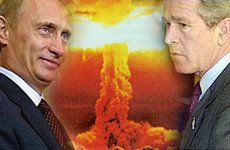
U.S. and Russian tensions grow over Iran against hopes for world peace Bush administration 'cult of war' is on an apparent course of self-delusionary Nuclear Armageddon by Traci Lawson
Canadians, Americans, and other citizens of North Atlantic Treaty Organization (NATO) countries appear to have been deceived into thinking that prospects of a U.S. military assault against Iran, is not much to worry about. After all, according to the apparent disseminated propaganda, Iran is basically a primitive country, just out of the Stone Age, that is isolated in the world. This is clearly not the case. Have you ever noticed that American and other Western media avoid taking panoramic camera shots, when reporting from Iran? That is apparently because these media agents, don't want to show you the modern skyline of Iran, that has been developed from billions of dollars in oil investments with buildings ever more modern than most U.S. cities. Much of the U.S. mass-media, has made itself the apparent tool of a globally catastrophic agenda of categorical mass-deception, that could be conceived to constitute a "Media Crime against Humanity". Iran has a much more sophisticated military than Iraq, and it is further backed by the Russians and the Chinese. Iraq had the benefit of no such alliance, because Saddam Hussein had largely isolated himself. The Government of Iran by contrast, had formidable support, to back up an already well disciplined military, with the most sophisticated Russian and Chinese-developed military technologies and training. The Shanghai Treaty Organization (SCO) is Russia's and China's answer to NATO. The SCO is a parallel defence organization. NATO would be triggered to retaliate against Russia, if Russia, for example decided to attack France that is a member of NATO. Iran is a member of the SCO. Correspondingly, if the U.S. decided to attack Iran with nuclear weapons as reported by various reliable sources including American Pulitzer Prize winning investigative journalist Seymour Hersh to the Canadian-based Centre for Research on Globalization, then Russia and China would be legally obligated to reply with their own nuclear attack against the U.S. itself, and its allies. It appears that the Bush administration is high on their nuclear weapons in a similar way that someone who takes LSD becomes high, to the potential point of self-delusion, which will lead it to pursue a course of prospective irrationality. The U.S. Bush administration, and its media allies, appear to be pursuing a course to justify to the American people nothing short of nuclear self-annihilation and Armageddon. In other words, PURE MADNESS. Americans could wake up one day, and find themselves in a world where billions of people have within minutes and hours, lost their lives, with psychotic elites seeking to pick up the crumbs of victory, amidst unspeakable human suffering, in what is left of an essentially destroyed planet. You could be one day, driving your kids to school, thinking of the growth of your various stock investments, and when you needed to do the laundry, or some grocery shopping, not even knowing that the U.S. Bush administration has launched an attack against Iran. Within minutes, a Russian and Chinese Eurasian SCO military alliance response would be legally required to be on its way, within minutes, bringing your relatively prosperous community into the total chaos of a nuclear winter, global epidemics, starvation, diseases, a broadening descent into a culture of violence. In the apparent mentality associated with the Bush administration, this would be the acceptable "price to pay" to then launch what the Russian News Agency reports is a planned totalitarian society, LINK. U.S. activists and investigative journalists like Alex Jones, have suggested that such a totalitarian society would be controlled by a megalomaniacal U.S. military industrial complex, that seeks to create a "warrior-based society", where only the "fittest will survive", in the context of proto-fascistic Social Darwinistic ideology. The following are excerpts of the article titled, "The Sino-Russian Alliance: Challenging America's Ambitions in Eurasia", by Mahdi Darius Nazemroaya, that was published 23 September 2007, LINK. What American leaders and officials called the “New World Order” is what the Chinese and Russians consider a “Unipolar World.” This is the vision or hallucination, depending on perspective, that has bridged the Sino-Russian divide between Beijing and Moscow. China and Russia are well aware of the fact that they are targets of the Anglo-American alliance. Their mutual fears of encirclement have brought them together. It is no accident that in the same year that NATO bombarded Yugoslavia, President Jiang Zemin of China and President Boris Yeltsin of Russia made an anticipated joint declaration at a historic summit in December of 1999 that revealed that China and the Russian Federation would join hands to resist the “New World Order.” The seeds for this Sino-Russian declaration were in fact laid in 1996 when both sides declared that they opposed the global imposition of single-state hegemony. On July 24, 2001, less than two months before September 11, 2001, China and Russia signed the Treaty of Good-Neighbourliness and Friendly Cooperation. The latter is a softly worded mutual defence pact against the U.S., NATO, and the U.S. sponsored Asian military network which was surrounding China. [1] The military pact of the Shanghai Treaty Organization (SCO) also follows the same softly worded format. It is also worth noting that Article 12 of the 2001 Sino-Russian bilateral treaty stipulates that China and Russia will work together to maintain the global strategic balance, “observation of the basic agreements relevant to the safeguard and maintenance of strategic stability,” and “promote the process of nuclear disarmament.” [2] This seems to be an insinuation about a nuclear threat posed from the United States. Standing in the Way of America and Britain: A “Chinese-Russian-Iranian Coalition” As a result of the Anglo-American drive to encircle and ultimately dismantle China and Russia, Moscow and Beijing have joined ranks and the SCO has slowly evolved and emerged in the heart of Eurasia as a powerful international body. The main objectives of the SCO are defensive in nature. The economic objectives of the SCO are to integrate and unite Eurasian economies against the economic and financial onslaught and manipulation from the “Trilateral” of North America, Western Europe, and Japan, which controls significant portions of the global economy. The SCO charter was also created, using Western national security jargon, to combat “terrorism, separatism, and extremism.” Terrorist activities, separatist movements, and extremist movements in Russia, China, and Central Asia are all forces traditionally nurtured, funded, armed, and covertly supported by the British and the U.S. governments. Several separatist and extremist groups that have destabilized SCO members even have offices in London. Iran, India, Pakistan, and Mongolia are all SCO observer members. The observer status of Iran in the SCO is misleading. Iran is a de facto member. The observer status is intended to hide the nature of trilateral cooperation between Iran, Russia, and China so that the SCO cannot be labelled and demonized as an anti-American or anti-Western military grouping. The stated interests of China and Russia are to ensure the continuity of a “Multi-Polar World.” Zbigniew Brzezinski prefigured in his 1997 book entitled The Grand Chessboard: American Primacy and the Geostrategic Imperatives and warned against the creation or “emergence of a hostile [Eurasian-based] coalition that could eventually seek to challenge America’s primacy.” [3] He also called this potential Eurasian coalition an “‘antihegemonic’ alliance” that would be formed from a “Chinese-Russian-Iranian coalition” with China as its linchpin. [4] This is the SCO and several Eurasian groups that are connected to the SCO. In 1993, Mr. Brzezinski wrote “In assessing China’s future options, one has to consider also the possibility that an economically successful and politically self-confident China — but one which feels excluded from the global system and which decides to become both the advocate and the leader of the deprived states of the world — may decide to pose not only an articulate doctrinal but also a powerful geopolitical challenge to the dominant trilateral world [a reference to the economic front formed by North America, Western Europe, and Japan].” [5] Mr. Brzezinski warns that Beijing’s answer to challenging the global status quo would be the creation of a Chinese-Russian-Iranian coalition: “For Chinese strategists, confronting the trilateral coalition of America and Europe and Japan, the most effective geopolitical counter might well be to try and fashion a triple alliance of its own, linking China with Iran in the Persian Gulf/Middle East region and with Russia in the area of the former Soviet Union [and Eastern Europe].” [6] Brzezinski goes on to say that the Chinese-Russian-Iranian coalition, which he moreover calls an “antiestablishmentarian [anti-establishmentarian] coalition,” could be a potent magnet for other states [e.g., Venezuela] dissatisfied with the [global] status quo.” [7] Furthermore, Brzezinski warned in 1997 that “The most immediate task [for the U.S.] is to make certain that no state or combination of states gains the capacity to expel the United States from Eurasia or even to diminish significantly its decisive arbitration role.” [8] It may be that his warnings were forgotten, because the U.S. has been repealed from Central Asia and U.S. forces have been evicted from Uzbekistan and Tajikistan. “Velvet Revolutions” Backfire in Central Asia Central Asia was the scene of several British-sponsored and American-sponsored attempts at regime change. The latter were characterised by velvet revolutions similar to the Orange Revolution in Ukraine and the Rose Revolution in Georgia. These velvet revolutions financed by the U.S. failed in Central Asia, aside from Kyrgyzstan where there had been partial success with the so-called Tulip Revolution. As a result the U.S. government has suffered major geo-strategic setbacks in Central Asia. All of Central Asia’s leaders have distanced themselves from America. Russia and Iran have also secured energy deals in the region. America’s efforts, over several decades, to exert a hegemonic role in Central Asia seem to have been reversed overnight. The U.S. sponsored velvet revolutions have backfired. Relations between Uzbekistan and the U.S. were especially hard hit. Uzbekistan is under the authoritarian rule of President Islam Karamov. Starting in the second half of the 1990s President Karamov was enticed into bringing Uzbekistan into the fold of the Anglo-American alliance and NATO. When there was an attempt on President Karamov’s life, he suspected the Kremlin because of his independent policy stance. This is what led Uzbekistan to leave CSTO. But Islam Karamov, years later, changed his mind as to who was attempting to get rid of him. According to Zbigniew Brzezinski, Uzbekistan represented a major obstacle to any renewed Russian control of Central Asia and was virtually invulnerable to Russian pressure; this is why it was important to secure Uzbekistan as an American protectorate in Central Asia. Uzbekistan also has the largest military force in Central Asia. In 1998, Uzbekistan held war games with NATO troops in Uzbekistan. Uzbekistan was becoming heavily militarized in the same manner as Georgia was in the Caucasus. The U.S. gave Uzbekistan huge amounts of financial aid to challenge the Kremlin in Central Asia and also provided training to Uzbek forces. With the launching of the “Global War on Terror,” in 2001, Uzbekistan, an Anglo-American ally, immediately offered bases and military facilities to the U.S. in Karshi-Khanabad. The leadership of Uzbekistan already knew the direction the “Global War on Terror” would take. To the irritation of the Bush Jr. Administration, the Uzbek President formulated a policy of self-reliance. The honeymoon between Uzbekistan and the Anglo-American alliance ended when Washington D.C. and London contemplated removing Islam Karamov from power. He was a little too independent for their comfort and taste. Their attempts at removing the Uzbek President failed, leading eventually to a shift in geo-political alliances. The tragic events of Andijan on May 13, 2005 were the breaking point between Uzbekistan and the Anglo-American alliance. The people of Andijan were incited into confronting the Uzbek authorities, which resulted in a heavy security clampdown on the protesters and a loss of lives. Armed groups were reported to have been involved. In the U.S., Britain, and the E.U., the media reports focused narrowly on human rights violations without mentioning the covert role of the Anglo-American alliance. Uzbekistan held Britain and the U.S. responsible accusing them of inciting rebellion. M. K. Bhadrakumar, the former Indian ambassador to Uzbekistan (1995-1998), revealed that the Hezbut Tahrir (HT) was one of the parties blamed for stirring the crowd in Andijan by the Uzbek government. [9] The group was already destabilizing Uzbekistan and using violent tactics. The headquarters of this group happens to be in London and they enjoy the support of the British government. London is a hub for many similar organizations that further Anglo-American interests in various countries, including Iran and Sudan, through destabilization campaigns. Uzbekistan even started clamping down on foreign non-governmental organizations (NGOs) because of the tragic events of Andijan. The Anglo-American alliance had played its cards wrong in Central Asia. Uzbekistan officially left the GUUAM Group, a NATO-U.S. sponsored anti-Russian body. GUUAM once again became the GUAM (Georgia, Ukraine, Azerbaijan and Moldava) Group on May 24, 2005. On July 29, 2005 the U.S. military was ordered to leave Uzbekistan within a six-month period. [10] Literally, the Americans were told they were no longer welcome in Uzbekistan and Central Asia. Russia, China, and the SCO added their voices to the demands. The U.S. cleared its airbase in Uzbekistan by November, 2005. Uzbekistan rejoined the CSTO alliance on June 26, 2006 and realigned itself, once again, with Moscow. The Uzbek President also became a vocal advocate, along with Iran, for pushing the U.S. totally out of Central Asia. [11] Unlike Uzbekistan, Kyrgyzstan continued to allow the U.S. to use Manas Air Base, but with restrictions and in an uncertain atmosphere. The Kyrgyz government also would make it clear that no U.S. operations could target Iran from Kyrgyzstan. Has the March to War been Interrupted? Despite talks behind closed doors with Damascus and Tehran, Washington is nonetheless arming its clients in the Middle East. Israel is in an advanced state of military preparedness for a war on Syria. Unlike France and Germany, Anglo-American ambitions pertaining to Iran and Syria are not one of cooperation. The ultimate objective is political and economic subordination. Moreover, either as a friend or foe, America cannot tolerate Iran within its present borders. The balkanization of Iran, like that of Iraq and Russia, is a major long-term Anglo-American goal. What lies ahead is never known. While there is smoke on the horizon, the U.S.-NATO-Israeli military agenda will not necessarily result in the implementation of war as planned. A “Chinese-Russian-Iranian coalition” — which forms the basis of a global counter-alliance — is emerging. America and Britain rather than opting for outright war, may choose to reel in Iran and Syria through macro-economic manipulation and velvet revolutions. War directed against Iran and Syria, however, cannot be ruled out. There are real war preparations on the ground in the Middle East and Central Asia. A war against Iran and Syria would have far-reaching worldwide implications. About the Centre for Research on Globalization writer: Mahdi Darius Nazemroaya is an independent writer based in Ottawa specialising on the Middle East and Central Asia. He is a Research Associate of the Centre for Research on Globalization (CRG). Endonotes [1] Treaty of Good-Neighborliness and Friendly Cooperation Between the People’s Republic of China and the Russian Federation, signed and entered into force July 16, 2001, P.R. of China-Russian Federation, Ministry of Foreign Affairs of the People’s Republic of China., LINK. [2] Ibid. [3] Zbigniew Brzezinski, The Grand Chessboard: American Primacy and Its Geostrategic Imperatives (NYC, New York: HarperCollins Publishers, 1997), p.198. [4] Ibid., pp. 115-116, 170, 205-206. Note: Brzezinski also refers to a Chinese-Russian-Iranian coalition as a “counteralliance” (p.116). [5] Zbigniew Brzezinski, Out of Control: Global Turmoil on the Eve of the 21st Century (NYC, New York: Charles Scribner’s Sons Macmillan Publishing Company, 1993), p.198. [6] Ibid. [7] Ibid. [8] Brzezinski, The Grand Chessboard, Op. cit., p.198. [9] M. K. Bhadrakumar, The lessons from Ferghana, Asia Times, May 18, 2005. [10] Nick Paton Walsh, Uzbekistan kicks US out of military base, The Guardian (U.K.), August 1, 2005, LINK [11] Vladimir Radyuhin, Uzbekistan rejoins defence pact, The Hindu, June 26, 2006, LINK.
Become a Member: Would you like to see other similar articles and critical commentaries in The Canadian National Newspaper? Then, show your support. Make a member-pledge donation, in support of the Membership Drive of the Pro-Democracy Media Foundation. The Canadian can only continue to publish investigative articles on the "War on Terrorism", with the donations from members of the public in Canada, the U.S., and abroad. Consider making a donation of $20.00, $30.00, $50.00, $75.00 or more. Donors are eligible to receive our first collector's print edition in mail. Alternatively, you can send us a note to be placed on our special email list of members. The Canadian is a socially progressive and not-for-profit national newspaper, with an international readership. We provide an alternative to the for-profit commercial focused media, which often censors vital information and perspective of potential interest to the diverse Canadian public, and other peoples internationally.
|
|
|
|
|
||||||||||||||||
|
Copyright © 2007 The Canadian. All rights reserved. | |
|
| |||||||||||||||||||
 |
|||||||||||||||||||||||
The Canadian is a non-for-profit National Newspaper with an international readership.