|
|
|
|
|
|
|||||||||||||
|
|
|
|||||||||||||
|
|
|
|
| |
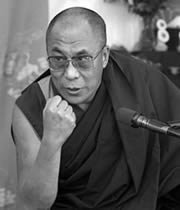
A Small Quarrel With and Homage To The XIV Dalai Lama: If the Society is to Aim is to Foster Mind-Guided Survival by Horace R. Carby-Samuels
His Holiness the XIV Dalai Lama is a remarkable human being, whom I have been privileged to admire very very much, as a result of his writings, his on air communication; and as a result of my awareness of his presence in the human community, and of what he seeks to do. Notably, His Holiness appears to have at least one characteristic, which makes him different from other religious proselytisers that it has been my opportunity to see, to hear, and to encounter, over the duration of my life to date. It seems to me that His Holiness has cultivated his mind so as to make the support of, and working for “peace on earth, and goodwill to all people”, what is essentially to him, a way of orienting and of executing his own living. The result is that to this writer, that approach by his Holiness, appears to be not merely a promotional front-end slogan in behalf of the pious seduction of people and of material resources. Meanwhile, in contrast, it also appears to this writer, that among the purveyors of other prevailing organized religions, substantively, the statement “goodwill to all people”, means to “people” who share in the particular “official” doctrine of that religious representative. Additionally, to these utterers, that statement also seems to be no more than venal sloganizing, so as to justify or to cloak their importuning of influence and of resources, in behalf of their particular religious fiefdom. I have high respect for the in-depth philosophical studies and explorations of His Holiness, and particularly about which he elaborated in his recent (2005) book; The Universe in a Single Atom: The Convergence of Science and Spirituality. However, I am about to use my “untrained” “intuition”, to express some long held reservations that I have had, about a few parts of the communicated messages from His Holiness. For example, on reading my recent essay, “The Fellowship of Mind: Where We Should be Headed”, (which was also recently published on line in the Canadian Newspaper, LINK), a rather clear-minded colleague of long standing, remarked that it was only in the presentation of the Dalai Lama, (on matters regarding the confluence of consciousness and sentience as they related to mind -- actually as per page 126 of the latest book from His Holiness, The Universe in a Single Atom: The Convergence of Science and Spirituality) -- that he could find any material, which corresponded to my allusion (in that essay), regarding the presence of a prevailing Existential Conwillowsence. I had indicated that this Existential Conwillowsence feature, represents an over-arching, (and implicitly accessible) bio-electrical sentience grid, which envelops (in its ambience and its flow), the phenomena of mind; and that thereby, may potentially mediate the correlations and the universal instruction relationships, that exist between mind and brain. However, on reading that stated book, it appears that the culture of survival, to which “The Fellowship of Mind” essay alluded, also addressed, (as my colleague had said), a parallel but different domain from that on which His Holiness was concentrating, (when he was elaborating on the potential for reconciling the reality-discovery techniques in the respective emphases of Buddhist and scientific ways of looking on how the world in which we live is comprised). In particular, it appears to me that probably as a result of his deep Buddhist commitment to the liberation-potential of meditation, as well as to the ecstasy of deep meditation, His Holiness was focussed on a reflections context of reality discovery, rather than on an operationsone of reality accommodation. In the process, His Holiness appeared to largely view mind, brain, and consciousness, as being (to all intents and purposes), a “proper” intersection of sets. Therefore, he did not impute (as I had done), that there exists a potential functional and operating separability, of the nexus that comprises the mind and the brain. Let me also state that “The Fellowship of Mind” essay, had not directly addressed the matter of consciousness; whereas, that topic was one to which His Holiness had extensively addressed himself. Meanwhile, relying on the reference context of the Existential Conwillowsence, I would argue that, what is being spoken of as consciousness, is, metaphorically speaking, analogous to a “vine”on the “tree”, or to a “boat” on the “ocean” of THE BIO-ELECTRICAL SENTIENCE GRID, that The Existential Conwillowsence accommodates. In spite of these textual differences, it is my delight at hearing about the perceived close correspondence of my operations-centred presentation, with the reflections-centred one of the Dalai Lama, (which my colleague had deduced), that has led me to want also, to put forward herein, some important living and survival-related differences between the two different approaches. There are particular differences between what I am presenting, and what his Holiness has emphasized, that have also instigated me to put forward here, a somewhat pointed (existentially based) quarrel, that I have had for some time with TWO particular articulations and submissions of His Holiness, (as they relate to people - who are living in the Western world that I know of). Specifically, His Holiness imputed that, pursuing/securing happiness, as well as the avoidance of suffering, comprises the substantive existential path to which humans as sentient beings, seek to have access. However, I would argue that the message which His Holiness is communicating (in respect of these two critical features, “happiness”, and “suffering”), have not properly crossed the inference bridge, between the Buddhist tradition and the Western one. The result is that the substantive message of His Holiness becomes lost. I first saw that communicated message by His Holiness, when I read his book, The Art of Happiness. Meanwhile, I also now note that, His Holiness made corresponding statements (about the veracity of this existential guidance tome), in the recent publication by him: The Universe in a Single Atom: The Convergence of Science and Spirituality. In particular, my “quarrel” with the imputation of His Holiness, arose out of the choice of the word “happiness”, (which was used as the pivot of the substantive message in his texts regarding The Art of Happiness). It appears, however, that when His Holiness states that all people are in search of “happiness”, and that they are also about pursuing the avoidance of suffering, one will necessarily have to deduce that, as a Buddhist Priest, the pursuit of those objectives is what he sees living as being all about. My argument is that, (notwithstanding the background religious tradition from which those utterances by His Holiness came), in my view, as (an essential primitivist who is also) someone that has been socialized in Western society, (and in how it “engineers” consciousness and the survival targets that individuals form), a little pause is necessary. That is because there are important reservations which one must bring to the imputation of this “Buddhist priest”, regarding what are the substantive existential targets of humans in their living operations. At first, I had attributed the source of my unease, at the intrinsic existential message from His Holiness, (that was being communicated); as being due to some of the conundrums that arise as translation problems. I had concluded that these arose when the argument(s) of His Holiness were shifted from his native Tibetan language, to the prevailing vernacular of “street” English. Meanwhile, it is true that in the text of his Art of Happiness book, His Holiness was at pains to indicate that his message, as to what comprises the type of “happiness” about which he is speaking, is comprehensive and subtle. However, in this age of the superficial focus, and of the short attention span of individuals; I have reservations about what proportion of the Western readers of his books or of his listeners, is likely to take the time to absorb the substantive caveats in his Buddhist focus, on that “happiness” word?. At the same time, I have no doubt that his co-author, as well as his translators and also his publisher, wanted an intuitively familiar, catchy, or appealing word, with which the readership of the Art of Happiness book would readily identify. In contrast, I argue that by virtue of the technical and the operational focus of the Western-trained mind, among the bulk of his Western audience, with his settling on that street English “happiness” word, the substantive existential/living-centred message which His Holiness was communicating, becomes lost. I therefore submit that, in terms of survival-centred considerations, the existential, as well as the (societally operational), and therefore the living-centred PRICE, for settling his message on that “catchy” word, “happiness”, is too high. For example, many people in today’s society, take mood-altering drugs, because they expect that taking the particular drug of choice, will make them feel “happy”. Meanwhile, in capitalist-managed societies, the commercial banks and the large corporations, are “happy” with the enhancement of financial and of financial-equivalent market profits (which they can secure from the exploitation of the people and of the resources of the planet). Additionally, the management cadre, and the financial investors in these capitalist agencies, are correspondingly indifferent to the impact of their (once removed) operations on the material environment of our survival; on the access of individuals to a healthy living-supportive environment and to health-support; or on the proliferation of homelessness and destitution among large sectors of the (associated) public. Finally, in the current prevailing era, of “The ‘War’ on Terrorism”, the new gestapo and its political masters, who framed this “war”, and that happen to be operating/instrumentalizing under the name of “Homeland Security” (in its respective labels and incarnations), is very “happy” to tread on the civil-liberties of persons, in order to establish governance under the new fascism. Accordingly, in contrast, I submit that the term sublime living”, captures better than the word “happiness”, the messages that His Holiness wanted to communicate about, (at the time when he was offered the word “happiness” as a substitute, if not as a synonym). I argue that “living”, (as a mind-body operation), was the terrain that His Holiness (as a Buddhist priest), was substantively addressing. It also seems to me that, reminding humans of the graspable promise of access to sublime living, is what the life of His Holiness, and his message is about. It is not about the achievement of any type of “emotional” “high”. There is also an additional epistemological trap, that arises as a Western “bridging” failure, when His Holiness states that (the matter of) the avoidance of suffering, is another existential target of humans. Interestingly, it is also notable that in his last book (The Universe in a Single Atom), His Holiness elaborated that the concept, and that the features, which pivot on the term “emotions”, comport differently in Western as compared to Buddhist society. And therein hangs the other tale, regarding the stimulation that “The Fellowship of Mind” essay sought to bring; and regarding how the message by His Holiness as they apply to mind-body relationships, may be more effectively applied to survival considerations in Western society. Notably, for example, in Western capitalist society, the subtle generation and cultivation of “suffering”, RATHER THAN of empathy and goodwill, is a critical pivotal feature to its articulation and to how it perpetuates itself. People, who are (explicitly and implicitly) societally conditioned to exercise and to foster greed, and envy, (as features which will motivate them to make more purchases in the “market”), survive in an operating capitalist political-economic “plan”. That “plan” is aimed to lead people to generate from their activities, the holy of holies, in the form of financial, and financial-equivalent profit streams. In particular, in the capitalist orchestrated society, there is a promoted conditioning of individuals, which primes them to acquire on the “market”, new trinkets and objects of display. Individuals are also conditioned to see some respective acquisitions of other persons as being brand new personal “needs” that they must also satisfy. These primed features are then joined with the shortages of real survival-centred necessities by the bulk of the population. Together, all of these relationships then cause the bulk of the affected humans to essentially exist in a state of sustained psychological “suffering”. On the other hand, people like His Holiness, who seek to foster a world where, informed understanding, empathy, mutuality, and time-use opportunities which contribute to a higher quality-of-living (as the expression of a higher level of humanity), will also experience “suffering” when the management norms of the society, fail to foster those particular living-centred objectives. It was therefore against the background of an awareness of this underlying prevailing management-supported existential short-circuiting, in behalf of fostering suffering, that this writer presented the essay which articulated the more comprehensive sentience-linked management principle that was stated in terms of (working) “Toward A Fellowship of Mind: Where We Should be Headed”. The associated proposal in that essay, envisaged that a viable political-economic-operations context could be formed, toward the delivery of a society which is dedicated to FOSTERING A SUBLIME EXISTENCE among humans. However, the submission in that essay was operations, rather than reflections oriented. It therefore also recognized that the associated political management rules in an existentially oriented society, would also need to be structured against the generation of exploitation, and against fostering emotional as well as physical suffering. The “Fellowship of Mind” essay, therefore also asserted that, this latter type of existential orientation by the political (economic) directorates in respective societies, is the direction in which the inhabitants of this planet should be headed. That argument was put forward, because the writer also submits that such a political-economic operations management commitment (in behalf of fostering mutuality, empathy, and informed effort management among humans) must be initiated, because Western society is not substantively a reflections-oriented one. Furthermore, that initiation of an existentially-focussed operations-oriented political-economic administrative process must be executed, if the organic sustenance and reality of our biosphere is to be salvaged, and sustained; and if prevailing systematic attempts TO SHORT-OUT the confluence, between the existential conwillowsence, and the reality of our survival on planet earth, are to be successfully fought off.
Become a Member: Would you like to see other similar articles and critical commentaries in The Canadian National Newspaper? Then, show your support. Make a member-pledge donation, in support of the Membership Drive of the Pro-Democracy Media Foundation. The Canadian can only continue to publish investigative articles in such areas, with the donations from members of the public in Canada, the U.S., and abroad. Consider making a donation of $50.00, $75.00, $100.00, $200.00 or more. Donors are eligible to receive our first collector's print edition in mail. Alternatively, you can send us a note to be placed on our special email list of members. Member-donors can also suggest articles or commentaries to be published in The Canadian. The Canadian is a socially progressive and not-for-profit national newspaper, with an international readership. We provide an alternative to the for-profit commercial focused media, which often censors vital information and perspective of potential interest to the diverse Canadian public, and other peoples internationally.
|
|
|
|
|
|||||||||||||||||
|
Copyright © 2007 The Canadian. All rights reserved. | |
|
| ||||||||||||||||||||
 |
||||||||||||||||||||||||
The Canadian is a non-for-profit National Newspaper with an international readership.