|
|
|
|
|
|
|||||||||||||
|
|
|
|||||||||||||
|
|
|
|
| |
Environmental destruction and Biotechnology: Could genetically modified crops be killing bees? by John McDonald, Beekeeper and Researcher
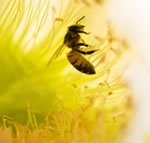
With reports coming in about a scourge affecting honeybees, researchers are launching a drive to find the cause of the destruction. The reasons for rapid colony collapse are not clear. Old diseases, parasites and new diseases are being looked at. Over the past 100 or so years, beekeepers have experienced colony losses from bacterial agents (foulbrood), mites (varroa and tracheal) and other parasites and pathogens. Beekeepers have dealt with these problems by using antibiotics, miticides or integrated pest management. While losses, particularly in over-wintering, are a chronic condition, most beekeepers have learned to limit their losses by staying on top of new advice from entomologists. Unlike the more common problems, this new die-off has been virtually instantaneous throughout the country, not spreading at the slower pace of conventional classical disease. As an interested beekeeper with some background in biology, I think it might be fruitful to investigate the role of genetically modified or transgenic farm crops. Although we are assured by nearly every bit of research that these manipulations of the crop genome are safe for both human consumption and the environment, looking more closely at what is involved here might raise questions about those assumptions. The most commonly transplanted segment of transgenic DNA involves genes from a well-known bacterium, bacillus thuringiensis (Bt), which has been used for decades by farmers and gardeners to control butterflies that damage cole crops such as cabbage and broccoli. Instead of the bacterial solution being sprayed on the plant, where it is eaten by the target insect, the genes that contain the insecticidal traits are incorporated into the genome of the farm crop. As the transformed plant grows, these Bt genes are replicated along with the plant genes so that each cell contains its own poison pill that kills the target insect. In the case of field corn, these insects are stem- and root-borers, lepidopterans (butterflies) that, in their larval stage, dine on some region of the corn plant, ingesting the bacterial gene, which eventually causes a crystallization effect in the guts of the borer larvae, thus killing them. What is not generally known to the public is that Bt variants are available that also target coleopterans (beetles) and dipterids (flies and mosquitoes). We are assured that the bee family, hymenopterans, is not affected. That there is Bt in beehives is not a question. Beekeepers spray Bt under hive lids sometimes to control the wax moth, an insect whose larval forms produce messy webs on honey. Canadian beekeepers have detected the disappearance of the wax moth in untreated hives, apparently a result of worker bees foraging in fields of transgenic canola plants. Bees forage heavily on corn flowers to obtain pollen for the rearing of young broods, and these pollen grains also contain the Bt gene of the parent plant, because they are present in the cells from which pollen forms. Is it not possible that while there is no lethal effect directly to the new bees, there might be some sublethal effect, such as immune suppression, acting as a slow killer? The planting of transgenic corn and soybean has increased exponentially, according to statistics from farm states. Tens of millions of acres of transgenic crops are allowing Bt genes to move off crop fields. A quick and easy way to get an approximate answer would be to make a comparison of colony losses of bees from regions where no genetically modified crops are grown, and to put test hives in areas where modern farming practices are so distant from the hives that the foraging worker bees would have no exposure to them. Given that nearly every bite of food that we eat has a pollinator, the seriousness of this emerging problem could dwarf all previous food disruptions. About the writer: John McDonald is a beekeeper in Pennsylvania. He welcomes comments or questions about the bee problem at mactheknife70@hotmail.com. Author's Postscript: The e-mail responses to my original article whether genetically modified crops be killing honeybees that had been published in the San Francisco Chronicle, was universally positive from laypeople and beekeepers. Most researchers, however, rejected the idea out of hand. I concluded the article with the suggestion that matching colonies should be sited in farm and non-farm regions in order to determine whether, indeed, agricultural practices were the basis for the die-off. (The new die-off has been virtually instantaneous throughout the country, not spreading at the slower pace of conventional classic diseases.) When it appeared that others weren't interested in this experiment, I undertook to do my own investigation at my own expense. Because my own bees had died the previous winter, it was necessary to establish new colonies. I established eight colonies in new wooden hives in order to prevent disease transfer from the old hives in case there was a pathogen remaining. The new colonies arrived late in May because of cold weather at the nursery where they are grown and required the feeding of sugar syrup continually until the hives were in their experimental locations on July 6. Two locations were chosen to fill the need for farm and non-farm sites: one here in Centre County, Pa., in a valley with rolling farmland; the other in Forest County, Pa., adjoining the Allegheny National Forest, an area with no agriculture within foraging range of honeybees. I chose the date of placement to avoid any possible exposure of the bees to Centre County corn pollen. Corn flower tasseling started on July 19. At both sites the flowers of goldenrod provided ample pasturage, with the honey flow commencing in the middle of August and tapering off by the second week in October. Medium-depth empty honey storage supers (a super is the part of the beehive used to collect honey) were put on the hives at this time in addition to the three brood chambers already there. By the simple expedient of lifting the hives from behind, progress could be roughly monitored. This monitoring showed that the hives of the farmland bees, while numerous, were not gaining weight. Meanwhile, the non-farm colonies steadily gained weight. This part of the experiment was terminated Oct. 14 with the removal of the honey storage supers, with these results: The farmland bees had not even started to work in the honey supers and will require extensive feeding before winter sets in. The non-farm bee colonies produced, in total, nearly 200 pounds of extra honey in addition to about 150 pounds per hive stored in the over-wintering brood supers. These colonies will be left in place to see whether the die-off of last season is repeated. These results should encourage new research to determine what factor or factors are present in farm country to cause such a discrepancy in honey production. Editor's note: Read John McDonald's well researched article is an attempt to show that there is enough evidence to warrant investigating the role that genetically modified crops might have played in the large bee die-off observed the previous fall and winter. He also suggests that the role of genetically modified crops be investigated as a possible cause of the collapse.
Become a Member: Would you like to see other similar articles and critical commentaries in The Canadian National Newspaper? Then, show your support. Make a member-pledge donation, in support of the Membership Drive of the Pro-Democracy Media Foundation. The Canadian can only continue to publish investigative articles in such areas, with the donations from members of the public in Canada, the U.S., and abroad. Consider making a donation of $50.00, $75.00, $100.00, $200.00 or more. Donors are eligible to receive our first collector's print edition in mail. Alternatively, you can send us a note to be placed on our special email list of members. Member-donors can also suggest articles or commentaries to be published in The Canadian. The Canadian is a socially progressive and not-for-profit national newspaper, with an international readership. We provide an alternative to the for-profit commercial focused media, which often censors vital information and perspective of potential interest to the diverse Canadian public, and other peoples internationally. |
|
|
|
|
||||||||||||||||
|
Copyright © 2007 The Canadian. All rights reserved. | |
|
| |||||||||||||||||||
 |
|||||||||||||||||||||||
The Canadian is a non-for-profit National Newspaper with an international readership.