|
|
|
|
|
|
|||||||||||||
|
|
|
|||||||||||||
|
|
|
|
| |

Canada's Kyoto plan under Martin: you pay, industry pollutes by The Canadian Special Correspondent
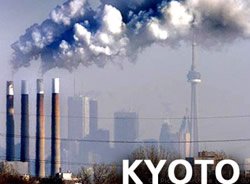
On April 13, 2005, the federal government released its long-awaited Kyoto Plan, known as "Project Green: Moving Forward on Climate Change". This is the government's fourth climate plan since 1995, but previous plans have failed mainly due to reliance on voluntary measures that were largely ignored by big business. Although it is still possible to meet our commitments under the Kyoto Protocol, the current plan has a number of very serious weaknesses, and it may be too little and too late. When Canada ratified the Kyoto Protocol in December 2002, it agreed to reduce its greenhouse gas emissions by 6 percent below the 1990 levels by 2008-2012, i.e. to 570 Mt (megatonnes, or million tonnes) per year of carbon dioxide equivalent from the 1990 level of 609 Mt.
However, greenhouse gas emissions were not reduced - by 2002 (when Canada formally ratified the Kyoto Protocol) they had actually increased to 731 Mt - almost 20 percent above the 1990 level. Emissions are now 24% higher, and if they continue as usual, they will likely be 840 million tonnes per year by 2010, mid-way through the Kyoto Commitment period of 2008-2012 - more than 30% above our target. This leaves a 270 million tonne/yr gap between the likely emissions and our legally binding Kyoto target of 570 Mt The primary problem is that big business, responsible for 50% of the greenhouse gas pollution in Canada, is being let off the hook with a minimal reduction of only 36 Mt per year by 2010. These large industrial polluters in oil and gas, manufacturing, and electricity sectors will be producing about 135 tonnes per year by 2010. Because big business is not doing its share of greenhouse gas reductions, very high targets have been assigned to several large government programs at enormous cost to taxpayers. The Climate Fund will finance emission reductions at home and abroad at a cost of $4-5 billion for potential reductions of 75-115 Mt/yr. While effective reductions are possible, there's a lot of uncertainty about the programs (reflected in the variable target) and how fast they can be delivered. The Partnership Fund provides federal funds ($2-3 billion) for deals with the provinces aimed at 55-85 Mt/yr reductions. Unfortunately these deals will include so-called "clean coal" technologies which will inevitably increase climate problems. Very few details are provided about programs under either the Climate or Partnership funds. The government has also failed to attach any timelines or medium term goals for pollution reductions, so we don't have any yardstick to measure the success or failure of the plan as we go forward year by year. About 80 of the 270 Mt gap (almost one third) is expected to come from buying foreign emission credits. If other programs fail to deliver, this amount will rise. While climate change is a global problem, Canada should strive to have emission reductions take place within Canada. In February it was announced that the next international climate change conference (the 11th meeting of the parties to Climate Change Convention) will be held in Montreal in November. This puts an even greater onus on the Canadian government to fulfil its Kyoto commitments and to make further reductions after 2012. In order to avoid truly catastrophic climate change impacts, Canada will have to go far beyond its Kyoto Commitment. A further 25% reduction will be needed by 2020. This will take real political leadership - something that has been in very short supply to date.  |
|
|
|
|
||||||||||||||||||||||||||
|
Copyright © 2007 The Canadian. All rights reserved. | |
|
| |||||||||||||||||||||||||||||
 |
|||||||||||||||||||||||||||||||||