|
|
|
|
|
|
|||||||||||||
|
|
|
|||||||||||||
|
|
|
|
| |

Canada complicit in Sudanese Genocide Compiled by The Canadian staff The Paul Martin government is failing to provide vital leadership against preventing genocide in Darfur, Sudan, in the fulfillment of Canada's national identity as a multicultural society, which has had historically a vital role in international peace-keeping. Canada appears to be content to let the horrific genocide of Rwanda repeat itself in Sudan. The Paul Martin government appears to be content to follow the Americans into protecting their perceived strategic interests in Afghanistan, while ignoring the human suffering of Africans, who do not have capital resources like oil, that are useful to capitalistocrats. The United Nations has been unable to prevent the crisis in Darfur, in western Sudan: the UN itself has described the situation as the world's greatest humanitarian crisis.
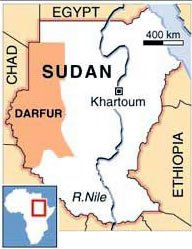
The crisis in Darfur erupted early in 2003. African rebels took up arms against the government for what they saw as decades of state neglect and discrimination against them. Along with claims of government neglect, there also is an economic side to the conflict. The country's mostly-non-Arab farmers compete with the mostly-Arab, nomadic herdsmen over access to land and water resources. The conflict has taken place mostly in a western region of the country known as Darfur. As an April 2005 article in The Economist explains, "...For a year-and-a-half now, Sudan's Arab-dominated government has been ethnically cleansing this vast western region, by arming, encouraging, and giving air support to mostly Arab militias who kill, rape, and rob black Africans." The government insisted it was simply crushing the rebellion. Meanwhile, the conflict has claimed hundreds of thousands of lives, many as a result of hunger and disease, and driven two million people from their homes. And, the UN has warned that, by late 2006, up to four million people may be affected by food shortages. UN Secretary-General Kofi Annan has repeatedly called on the Security Council to take "urgent action" to end the massacre of civilians in the Darfur region. His plea in February 2005 came after a UN-appointed commission called for international trials for those responsible for the atrocities. Mr. Annan supported that recommendation. He said that those accused in the report, which spread the blame among the government, the government-backed militias known as janjaweed, and the region's rebels, be prosecuted. He also suggested that council members consider imposing sanctions on the country. Sudan questioned the legality of the ICC's (International Criminal Court) involvement in the country's conflict in Darfur. ICC can pursue cases only where the host country cannot or will not do the job itself. The Sudanese government said it wanted to deal with those who have committed crimes itself, but critics say Sudan simply wants to protect the suspects from criminal responsibility. Louise Arbour, the former Supreme Court of Canada judge who is now the UN's High Commissioner for Human Rights, said the government had not kept its promise to stop the fighting. She added that the UN inquiry commission found little evidence that accused war criminals were being tried in Sudanese courts. Ms. Arbour also urged the 15-member council to refer war-crimes cases to the ICC.
By March 2005, the UN estimated that 10,000 people a month were dying of malnutrition and disease. A Globe and Mail report pointed out that after four Security Council resolutions, a UN Commission of Inquiry, an international observer mission, and several failed rounds of peace talks, no significant steps had been taken to disarm the militias. And, no action had been taken against the government of Sudan, which armed the militias. At the same time, relief organizations have moved into the region and government restrictions, which had blocked aid workers and supplies, were lifted. But some say the aid still wasn't getting through to the hundreds of thousands of people who need it; many of the camps are without water, fuel, and protection from violence. A senior vice-president at the Brussels-based research organization International Crisis Group (ICG), Mark Schneider, spoke to The Globe and Mail. He said, "The human atrocities that have taken place - the killings, torture, rapes, bombing of unarmed civilian communities - should drive the world community, not just to step-by-step action but to determined action to disarm and to halt it." ICG calls for such measures as freezing the overseas assets of companies controlled by the ruling party, a travel ban on key officials, a no-fly zone over Darfur, an expanded arms embargo, and a boost to at least 10,000 in the African Union monitoring force, from fewer than 2,000. In April 2005, the Security Council finally decided to act, handing over a list of 51 prime suspects, drawn up by the commission, to the ICC. The suspects were said to include Sudanese officials, members of state-sponsored militias, and Darfuri rebels. It was the beginning of a formal investigation into allegations of war crimes in the two-year conflict. Dozens of court officials have started to prepare for what has been described as the largest and most important investigation to be handled by the ICC since it was established in July 2002. However, beyond muttering about how dreadful the violence is, critics say the world's leaders seem content to stand by and watch. But, what's in it for them? Those few countries with the military muscle to do something have little or no incentive to get involved and pay the political price of sons and daughters coming home in body bags. Two international experts in Canada say our country needs to do more. Paul Heinbecker, is director of the Laurier Centre for Global Relations, Governance, and Policy, in Waterloo, Ontario, and Lloyd Axworthy, is president and vice-chancellor of the University of Winnipeg, and former minister of foreign affairs for Canada. They both say Prime Minister Paul Martin needs "to challenge the international community, particularly its richest states, to do the right thing..." In an article in The Globe and Mail in June 2005, they suggested that Mr. Martin should authorize Canada's ambassador to the UN, Allan Rock, "who has been a rare leader on this issue at the UN," to ask for an open meeting of the Security Council. This meeting should help the people of Darfur, and "be accompanied to the council table by one of the countless survivors of Darfur who have lost everyone and everything dear to them." They also say he should "offer 1,500 Canadian troops; challenge Western and other countries with capable military forces to help the African Union; (and) challenge the Africans to make the protection of people their top priority." The authors conclude that, "It is late, but not too late, for Canada to make a difference to those still surviving in Darfur." Recommended Readings: Please consult the book 'Capitalism is Not Democracy', ISBN: 1894934636, 2005, or Quantuum Economics, ISBN: 1894839609, 2003, in order to further explore the institutional context of 'capitalistocracy', in the prevailing economic system.  |
|
|
|
|
|||||||||||||
|
Copyright © 2007 The Canadian. All rights reserved. | |
|
| ||||||||||||||||
 |
||||||||||||||||||||