|
|
|
|
|
|
|||||||||||||
|
|
|
|||||||||||||
|
|
|
|
| |

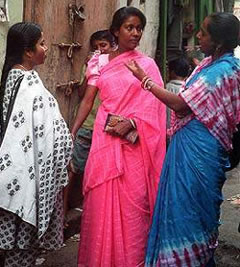
Prostitutes' Rights Demonstration in South Asia Compiled by the Canadian South Asian staff In a Reuter story titled, "South Asia's prostitutes gather to press rights," by Rupam Banerjee, submitted from Calcutta on April 30th, Banerjee reports that," More than 1,000 South Asian prostitutes gathered on Tuesday at a conference to discuss AIDS prevention and ways to legalise their business. The prostitutes, from India and neighbouring Nepal and Bangladesh, also staged a protest march from Calcutta's red light district to demand protection from what they called police harassment." Banerjee interviewed prostitutes associated with this protest. One woman, Malati Dassaid spoke of working very long hours and spending nights in damp jails because she had not paid "protection money" to policemen who demanded bribes.
"We want the right to regulate our own lives both within the profession and outside," Das shouted as she led the march. "They (police) often humiliate us and torture us," said Sandhya Mukherjee, the secretary of the Mahila Samanwaya Committee (MSC), or women's cooperative committee, a voluntary organization formed by prostitutes at Sonagachi. Banerjee reported that the march was also attended by social workers also attended the conference, which prostitutes described as a path-breaking event. In addition to grass roots participation, the meeting was backed and inaugurated by Prasanta Sur, Health Minister in West Bengal's communist state government. According to Banerjee, "The prostitutes marched from Sonagachi, the100-year-old district that is the center of Calcutta's sex industry, to College Street in the heart of the West Bengal capital." Children accompanied some women on the march. Banerjee characterized the children as 'illegitimate.' Banerjee reports that the march "brought Calcutta's snarling traffic to a grinding halt." Prostitutes' rights and trafficking
One issue in a debate among international women's organizations about trafficking emerged in the context of the this demonstration. The prostitutes' rights perspective opposes and warns of anti-trafficking proponents who recommend stricter enforcement of current anti-trafficking laws. Systems based on such laws, enforced by immigrations officials, grant extraordinary powers to the police and immigration officials. This has been historically problematic. According to Banerjee, " The sex workers demanded the scrapping of an Indian law against "immoral traffic" that stops them soliciting customers." This perspective is central in the prostitutes' rights stand against exploitation of prostitutes and women. Prostitutes' rights advocates from many countries propose several alternatives including the enforcement of laws against abuse, kidnapping, etc. enforced against all those who abuse prostitutes, including traffickers. Self-regulation Banerjee states that, "They called for the establishment up of an independent governing board as the first step towards self-regulation..." [Editor's note: This demand is mirrored in similar documents created by prostitutes' groups in the United States (San Francisco Task Force on Prostitution) and Australia (South Australia's Brindahl Bill by the Committee to Decriminalise Prostitution).] The prostitutes in Calcutta also called for a self-regulatory council. Such local councils (comprised of workers, legal and health advocates) may do much to address corruption, to protect those who are beginning to work as prostitutes. This is an alternative to current police control of prostitutes mentioned above. "Hundreds of girls from poor families in Bangladesh, Nepal and in India's poor rural areas are forced into prostitution, often at a very young age," Banerjee reports. Banjeree portrayed the social workers as 'urging' "prostitutes to ensure customers used contraceptives to prevent Acquired Immuno-Deficiency Syndrome (AIDS)." Banerjee added that, "Many Indian men who visit prostitutes are reluctant to wear condoms, which they say reduce sexual pleasure."  |
|
|
|
|
|||||||||||||
|
Copyright © 2007 The Canadian. All rights reserved. | |
|
| ||||||||||||||||
 |
||||||||||||||||||||