|
|
|
|
|
|
|||||||||||||
|
|
|
|||||||||||||
|
|
|
|
| |

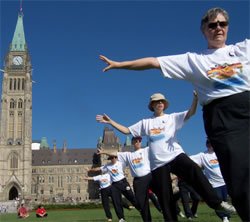
Physical Fitness Tips: Introduction to Tai Chi Compiled by The Canada Sports staff Developed hundreds of years ago by the Taoist monks of China, Tai-Chi is a series of basic movements that can keep one youthful and rejuvenate the entire body. Because Tai-Chi is an exercise that is performed in a slow, easy manner, and is not strenuous on the heart, it can be practiced by anyone, young or old. Just 20 minutes a day over a period of time can do wonders for a person. Tai-Chi has 108 basic movements that involve the use of every part of the body. The pattern of flowing movement, involving hands, elbows, fists, legs, shoulders, head, buttocks, feet, toes, eyes, etc., are all brought into it. There is no risk; practicing Tai-Chi promises only renewed vitality and, according to research, a longer life. In China, where there is great respect for the practice of Tai-Chi, it is claimed that it has lowered high blood pressure, and alleviated joint diseases. Tai-Chi's history was jealously guarded as a secret by the Chinese elite, and because of this, when the Communists took over the Chinese mainland, they viewed it with suspicion. So at first, they discouraged Tai-Chi, but later they had second thoughts, because they began to recognize Tai-Chi's therapeutic value, and began to encourage its regular practice by the common people. These days, Tai-Chi is very much a part of the regular routine of millions of Chinese people. And the Russians became so impressed with it after a visit to China, that they carried back the practice to their country.
Among the Chinese, in the United States, Tai-Chi had been practiced secretly, but it didn't catch on in with the rest of that country until the 1960's. At first, Tai-Chi schools that opened here, were mainly in the East and West Coasts. But as the benefits of Tai-Chi were touted about, Tai-Chi schools began to spread across the country. And now, Tai-Chi, along with acupuncture is getting attention even from the medical community, as thousands of Americans are discovering it. Tai-Chi, because it does not strain the heart, is believed to be very beneficial to cardiac patients. And Tai-Chi is not only valuable physiologically, but psychologically as well. That's because Tai-Chi is designed to have a calming effect on the mind and nervous system. It is an exercise that encompasses both mind and body. It has been shown conclusively that Tai-Chi has a tranquilizing effect on the emotions. Ten minute Tai-Chi breaks benefit the stressed executive, the busy housewife, the anxious employee. They all can gain a better frame of mind that can help them cope with life's pressures, and as a result, possibly avoid ulcers or a nervous breakdown. The first thing a beginner of Tai-Chi has to learn is to completely relax. This can be difficult for many people. But once you learn how to do it, relaxing facial muscles, eyes, shoulders, stomach, thighs, etc., and follow the pattern of movements with a light, calm mind, the sensation you will experience is that of almost floating. The movements of Tai-Chi encourage relaxation. So, to do the exercises properly, the body must move as a unit, and over a long period of time, this helps as person attain a psychological shield to combat stress, which is one of the main causes of disease. If interested in learning more about the Tai-Chi movements, your library might have books that show the actual movements.  |
|
|
|
||||||||||||
|
Copyright © 2007 The Canadian. All rights reserved. | |
|
| ||||||||||||||
 |
||||||||||||||||||