
Ottawa’s Judge Sylvia Corthorn shows the need for TV cameras in Canada's courtrooms
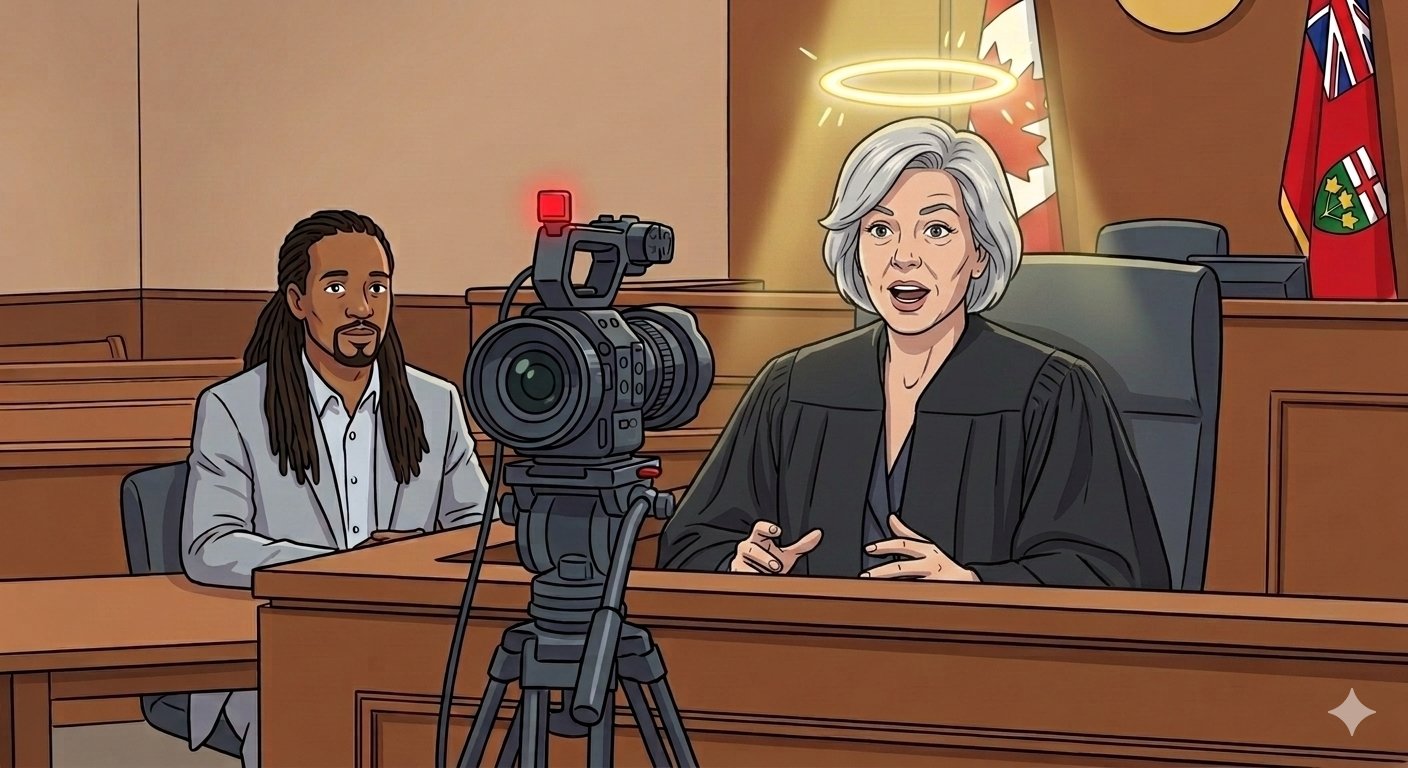



OTTAWA - Canada’s justice system operates under a foundational legal pillar known as the "open court principle." Formulated over centuries of common-law tradition and reaffirmed by the Supreme Court of Canada, this principle dictates that justice must not only be done, but must be seen to be done. In theory, any member of the public can walk off the street, pass through security, sit in a gallery, and witness democracy’s most solemn civic exercise: the administration of the law. This visibility is supposed to be the ultimate safeguard against arbitrary power, ensuring that judges, prosecutors, and lawyers remain accountable to the citizenry they serve.
In practice, however, this celebrated principle has become an obsolete illusion. Modern physical courtrooms have limited seating, and the vast majority of everyday citizens cannot afford to spend their working hours sitting in a gallery to observe how judges and lawyers conduct themselves. For the average working Canadian, a trip to a courthouse to observe a trial means taking unpaid time off, securing childcare, and navigating transit or parking—a logistical impossibility for most. Because the physical gallery is inaccessible, the public relies on the media to act as its eyes and ears. Yet, in Ontario, Section 136 of the Courts of Justice Act strictly criminalizes the recording, transmitting, or broadcasting of these proceedings, creating a digital wall that keeps the inner workings of our legal system hidden from the public eye.
The standard arguments supporting this ban—advanced by the legal establishment for decades—focus on preserving a fair trial, preventing media "sensationalism," and stopping lawyers from "grandstanding." We are told these rules protect the dignity of the court and the psychological well-being of participants. But for many marginalized, everyday Canadians who are regarded as being on the less powerful side of a legal dispute, these explanations ring hollow. Instead of protecting fairness, total institutional secrecy creates an environment where a lack of public accountability can lead to profound, unmonitored injustices for political or institutional reasons. By keeping cameras out, the system ensures that the actual conduct of its officials remains obscured, allowing corporate-owned or "legacy" media to sanitize the narrative and concoct a staged construct of fairness based entirely on heavily edited press releases and final, polished written judgments.
The devastating real-world consequences of this digital blackout are vividly illustrated by the tragic case of the late Dezrin Carby-Samuels and her family’s protracted, agonizing legal battles in Ottawa. During those proceedings, serious concerns were raised regarding the actions and decisions of Justice Sylvia Corthorn. Raymond Carby-Samuels stood entirely alone as the only family member fighting for his mother's well-being and dignity. Navigating the system as a self-represented litigant against institutional forces is already an uphill battle, but the barriers erected in that courtroom were insurmountable. While attempting to advocate for his mother, Raymond faced immense hurdles, including being boldly denied his chosen legal counsel who had travelled all the way from Toronto to Ottawa to represent him. Furthermore, the court openly suppressed critical evidence, including apparent signature forgery that went unexamined by the mechanisms of the court. In a system entirely shielded from public view, a veritable laundry list of such procedural atrocities can occur without consequence.
Arguably, Dezrin Carby-Samuels would still be alive today if a live television feed had been available for Canadians to witness the courtroom shenanigans perpetrated by Judge Corthorn, which ultimately resulted in the premature death of Mrs. Carby-Samuels. Public scrutiny has a clarifying, sanitizing effect on power. Human behaviour changes when it is observed. Would any judicial officer openly oppress evidence, disregard contested signatures, or deny a vulnerable party their legal representation if they knew a live television feed was broadcasting their actions in high definition to thousands of citizens across the country? Of course not. The presence of a camera forces institutional actors to adhere strictly to the rules of natural justice, because the entire world is watching. When the cameras are off, however, unethical judges can run their courtrooms like show trials or kangaroo courts in private. They can make arbitrary rulings, silence self-represented litigants, and ignore critical evidence, safe in the knowledge that no one outside the room will ever know. Every now and then, the court leaks out a single carefully managed decision for public relations purposes, which diametrically opposes 99 percent of the decisions they undertake in the daily, unmonitored activities of the courtroom.
The legal establishment frequently argues that cameras turn the serious business of justice into a circus, pointing to high-profile American trials as cautionary tales. But this argument is a strawman designed to protect judicial comfort at the expense of public accountability. The solution is not to compromise the legitimate privacy of vulnerable witnesses or victims. In circumstances in which both sides of a legal dispute agree that cameras would compromise safety or a fair trial, or when sensitive testimony from children or victims of violence is involved, protections should absolutely remain available on a case-by-case basis. This is exactly how the balancing test is utilized in many United States jurisdictions, where judges weigh the public's right to know against the specific privacy needs of the participants.
However, as a general rule, the public's right to see its justice system in action must be broadened for the same reasons that most trials are theoretically open to the public to attend in person. If a citizen has the legal right to sit in the room, they should have the technological right to view it from their home. Technology should expand access to rights, not restrict them. The current environment of repressed media access has enabled quasi-criminal cabals of crooked lawyers, some of whom are eventually transformed into unethical judges, to carry out systematic breaches of civil rights and natural justice entirely out of sight.
It is time for Ontario to introduce "Dezrin’s Law" to overturn the absolute, archaic restrictions of Section 136 of the Courts of Justice Act. In its place, Canada should establish a dedicated, publicly accessible, 24-hour court broadcast channel, regulated and approved by the CRTC. Rather than relying on American legal programming or sensationalized Hollywood dramas to understand how the law works, Canadians deserve to see exactly how their own local courts operate. They need to see how judges treat self-represented litigants, how evidence is evaluated, and how laws passed in Parliament are actually applied to everyday people.
A substantive amount of marginalized and vulnerable Canadians would benefit immensely if they had the power to turn the television camera lights on when up against well-paid law firms and unethical judges who have notions of a fair trial as the last thing on their minds. True judicial accountability cannot exist in the dark, and written transcripts—which are expensive, slow to produce, and strip away all tone, body language, and judicial conduct—are an inadequate substitute for visual truth. Granting everyday citizens the power to broadcast these proceedings will serve as a vital, democratic check against institutional overreach. It is time to dismantle the protective walls of secrecy around the judiciary, pass Dezrin’s Law, and allow Canadians to finally take back their justice system from the callous and wicked activities of unaccountable officials.

Comments
There are 0 comments on this post