
Carney should use Toronto summit to attract investors for a Canadian automobile company
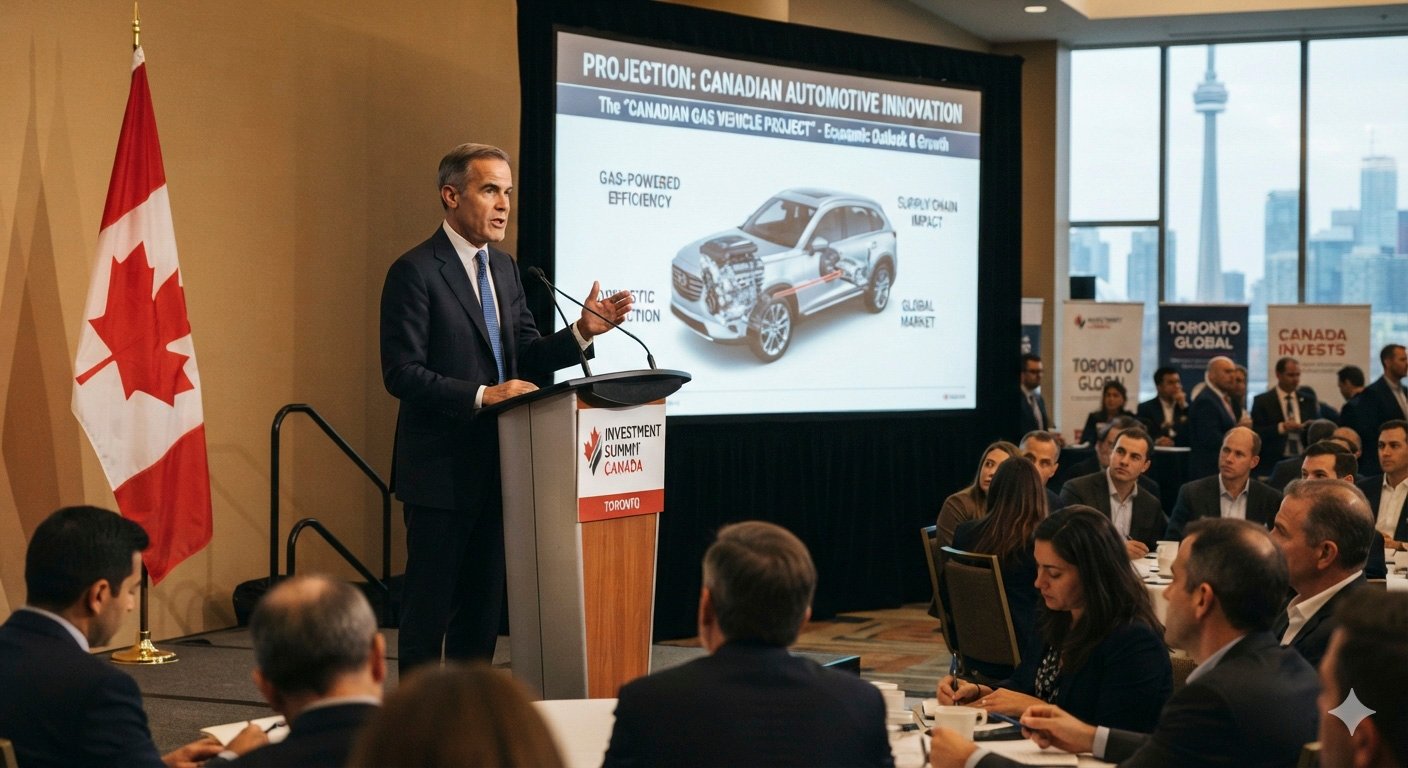

As global financiers, sovereign wealth fund managers, and private equity titans descend on Toronto for the highly anticipated Canada Investment Summit, the air is thick with the scent of raw potential. The federal government, under the economic stewardship of Prime Minister Mark Carney, has rolled out a massive prospectus detailing 167 projects designed to reshape the nation’s infrastructure. The pages are heavy with pipelines, critical mineral mines, and ambitious nuclear build-outs. It is an impressive menu of resource extraction, yet it exposes a glaring, historic blind spot in our national economic strategy.
We are still selling the logs instead of building the house.
Amid the frantic negotiations over American tariff exemptions and the fragile defensive posturing that defines our current trade policy, a provocative critique has emerged from the sidelines of the automotive world. Writing for Driving.ca, automotive journalist David Booth published an open letter to the Prime Minister, arguing that Canada is missing a generational opportunity. Booth’s core thesis is simple yet radical: instead of perpetually playing defense in a brutal, unpredictable trade war with the United States, the Carney government should use the summit to pitch global investors on an entirely made-in-Canada automobile company.
To many Bay Street traditionalists, the idea sounds like a romantic, expensive pipe dream. They will point to the ghost of the Bricklin SV-1 or the graveyard of independent electric vehicle startups as proof that building a domestic car company is a fool’s errand. But in an era defined by economic nationalism, fractured supply chains, and the rapid decoupling of global superpowers, building a homegrown automaker is no longer just an ambitious industrial policy—it is a matter of economic sovereignty. Mr. Carney needs to aggressively move away from pitching Canada as a passive basket of natural resources for foreign private equity to hollow out. A strategy that genuinely prioritizes Canadian sovereignty must move past treating the country as a convenient zone for mineral extraction. True economic independence demands that we transition into a sovereign industrial superpower, and that transition would be profoundly accelerated by Canada establishing its own independent automobile manufacturing capacity.
Repatriating the automotive supply chain
Crucially, such a move would represent a profound geopolitical shift: it would essentially seek to repatriate the integrated "North American" automobile industry into Canadian hands. For decades, the Auto Pact and later the USMCA fused our manufacturing sector to Detroit, creating a single cross-border machine. But that machine is broken. Under a protectionist White House, Canada can no longer afford to leave its primary manufacturing ecosystem exposed to Donald Trump’s volatile, unpredictable tariff decisions.
Every tweet or executive order threatening a 25 percent baseline tariff puts hundreds of thousands of Ontario assembly and parts-manufacturing jobs in the crosshairs. Waiting on bended knee for Washington to grant a temporary exemption is not a jobs strategy; it is economic hostage-taking. By backing a domestic automaker, Canada would repatriate corporate control and decision-making authority back to Toronto and Windsor. We would shield Canadian autoworkers from American political volatility by ensuring that the factories, the supply chains, and the investment capital answering the calls are entirely Canadian, insulating our workforce from the whims of a foreign leader.
The trap of the branch-plant economy
For more than a century, Canada’s automotive sector has thrived on a specific, comfortable arrangement: the branch-plant model. Under the framework of the original Auto Pact and its subsequent iterations in the NAFTA and USMCA eras, southern Ontario became a premier assembly hub for foreign multinationals. We built Ford crossovers in Oakville, GM pickups in Oshawa, Stellantis minivans in Windsor, and Toyota crossovers in Woodstock.
This model brought middle-class prosperity, but it came at a steep psychological and structural cost. Canada became an economy of tenants, not landlords.
When the corporate boardrooms in Detroit, Tokyo, or Stuttgart face a global downturn or a shift in regulatory pressure, the Canadian "subsidiary" plants are inherently vulnerable. Decisions to cancel vehicle lines, lay off workers, or shutter facilities are made thousands of miles away by executives whose primary loyalty is to their home countries and domestic shareholders. We saw this pain vividly during GM's temporary restructuring of Oshawa, and we see it today as global automakers struggle to navigate the volatile transition to electrification.
Furthermore, a branch-plant economy captures only a fraction of the value chain. While Canadian autoworkers are highly skilled and routinely win global quality awards, the high-value intellectual property—the advanced software engineering, the proprietary battery chemistry, the corporate profits, and the strategic design—remains anchored abroad. By failing to seed a domestic automotive brand, Canada has effectively outsourced its industrial imagination.
The underlying structural pieces are already here
The standard rebuttal to a domestic car company is that Canada lacks the industrial muscle to build a complex consumer vehicle from scratch. This argument ignores the quiet reality of Canada’s manufacturing sector. We do not lack the capability; we lack the audacity.
Consider the crown jewel of Canada’s industrial landscape: Magna International. Headquartered in Aurora, Ontario, Magna is not just a parts supplier; it is one of the most sophisticated contract vehicle manufacturers on earth. Through its Magna Steyr facility in Graz, Austria, the company has spent decades engineering and assembling premium vehicles for global luxury brands like BMW, Mercedes-Benz, and Jaguar. Magna possesses the turnkey capability to design, engineer, and build an entire automobile from the ground up.
Simultaneously, Canada’s transit manufacturing footprint remains formidable. Despite past corporate restructurings, facility assets like the Alstom manufacturing plant in Thunder Bay possess deep institutional knowledge in high-capacity, advanced heavy transport manufacturing. When you combine Magna’s engineering prowess, Alstom's heavy manufacturing infrastructure, and the massive tech ecosystems thriving in Waterloo and Toronto, the ingredients for a modern, software-defined vehicle platform are already sitting on the counter. What is missing is the catalytic capital and a unified national vision to stitch these components together. This is precisely where the Canada Investment Summit should step in to attract far-sighted global investors.
The Swedish blueprint: Industrial superpower vs. resource basket
To those who argue that Canada’s population—now sitting at 41 million—is simply too small to support a sovereign automotive brand, the geography of northern Europe offers a stark refutation. Sweden, a nation with a population of just 10.5 million (and less than eight million when its automotive sector was peaking), managed to build not one, but two globally recognized automotive powerhouses in Volvo and Saab.
The Swedish blueprint was rooted in a deliberate choice to reject a purely extraction-based identity. Instead of merely exporting its rich reserves of iron ore, Sweden chose to transform that raw metal into the safest, most structurally resilient vehicles on earth.
Mr. Carney should have leaned heavily into Sweden’s historical playbook for the Toronto investment summit. By forging strategic bilateral partnerships or actively recruiting Swedish industrial veterans, Canada could have imported the precise institutional know-how required to seed a domestic advanced manufacturing ecosystem. Crucially, this effort should not be limited to passenger cars. Given Canada’s sprawling geography and heavy industrial footprint, a massive, unmet opportunity lies in commercial transport. Leaning into the legacy of Volvo Trucks, Canada has a clear pathway to build its own sovereign heavy-machinery and commercial fleet industry. A domestic truck and utility brand would serve as a powerful economic multiplier, insulating Canada’s transit, freight, and resource sectors from foreign supply disruptions while establishing true manufacturing depth.
| Country | Approximate Population | Automotive Strategy | Core Economic Identity |
|---|---|---|---|
| Sweden | 10.5 Million | High-value sovereign brands (Volvo, Saab) | Advanced Industrial Exporter |
| Canada | 41.1 Million | Foreign branch-plant assembly & extraction | Resource and Mining Hub |
Moving beyond resource extraction
The Carney government’s investment prospectus leans heavily into Canada's traditional identity as a resource powerhouse. There is undeniable logic to this: the world needs our copper, our nickel, our lithium, and our clean energy to fuel the green transition.
However, an economic strategy that stops at extraction risks relegating Canada to a sophisticated version of a colonial resource economy. If we mine lithium in northern Ontario, ship it abroad to be processed into battery cells, send those cells to the U.S. to be integrated into an American EV, and then buy that vehicle back at a premium, we are repeating the exact same value-destructive patterns that have plagued our economy for generations.
A made-in-Canada car company would act as an anchor customer for our own critical minerals and green energy infrastructure. It would create a closed-loop domestic ecosystem where Canadian lithium, refined with clean Canadian nuclear energy, powers a Canadian-built vehicle designed by Canadian software engineers. This is how you build true economic resilience and project the image of an industrial superpower on the global stage.
| Strategic Metric | The Current Branch-Plant Model | The Homegrown Canadian Model |
|---|---|---|
| Corporate Head Office | Located in Detroit, Tokyo, or Stuttgart | Retained domestically in Canada |
| IP & Software Ownership | Foreign-owned, licensed back to Canada | Created and monetized in Canada |
| Supply Chain Control | Vulnerable to foreign executive decisions | Anchored to domestic resource corridors |
| Trade War Resilience | High exposure to foreign tariff penalties | Highly insulated, sovereign control |
Navigating the new trade realities
The urgency of this shift is underscored by the shifting tectonic plates of global trade. The era of frictionless, rules-based globalization is over. It has been replaced by a transactional world of tariffs, border carbon adjustments, and geopolitical alignment blocks.
Canada’s traditional strategy of lobbying Washington for minor exemptions whenever protectionist sentiments flare up is reaching its expiration date. Relying entirely on the goodwill of our southern neighbor to sustain our largest manufacturing sector is a precarious strategy.
A domestic automotive brand would give Canada an independent piece on the global economic chessboard. It would allow our trade negotiators to operate from a position of structural strength, rather than perpetual anxiety. Instead of merely begging to be included in foreign supply chains, we would be inviting international capital to participate in ours.
A call for industrial imagination
Achieving this vision requires moving past the risk-averse, incremental mindset that often paralyzes Canadian public policy. It requires the kind of bold industrial imagination that built the Canadian Pacific Railway or established the original frameworks of the Automotive Products Trade Agreement in 1965.
Mr. Carney was brought into government precisely because of his reputation as a big-picture thinker capable of navigating complex global capital markets. He understands better than anyone that capital flows toward clear, ambitious, and structurally sound visions.
As the Toronto summit progresses and the delegates negotiate in our financial capital, the government must look beyond the immediate wins of mine openings and pipeline expansions. If Canada is to thrive in the complex economic landscape of the mid-21st century, it cannot remain a passive assembler of other nations' innovations. It is time to dust off our industrial pride, leverage our world-class engineering talent, and actively recruit global investment to build a vehicle that proudly bears a made-in-Canada badge.

Comments
There are 0 comments on this post