
Gatineau Mayor faces backlash over surging legal spending amid road safety crisis
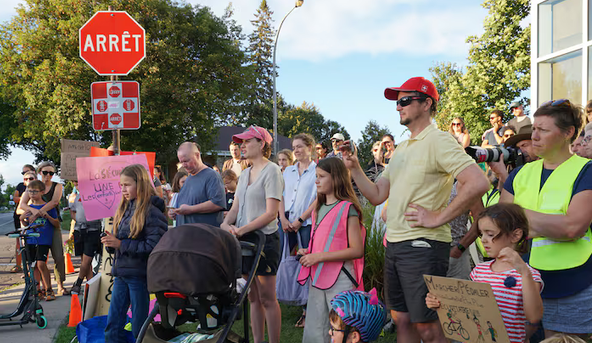

GATINEAU, QC — The white paint of a freshly drawn ghost sign on the asphalt at the intersection of rue Gamelin and boulevard Moussette has barely begun to fade, but the political lines drawn in its wake are hardening by the day. Following the tragic death of a pedestrian at the busy four-way stop, a growing coalition of Gatineau residents, urban safety advocates, and local organizers have taken to the streets, demanding that the municipal administration pivot from bureaucratic inertia to concrete infrastructure investment. Yet, as the community mourns, the tragedy has catalyzed a broader, more systemic frustration over how Canada’s nineteenth-largest city chooses to spend its money.
For months, community advocates have pointed to a glaring paradox in Gatineau’s governance. While requests for basic traffic calming measures, pedestrian crossings, and structural road re-engineering are routinely met with administrative delays or claims of fiscal restraint, significant public funds continue to flow out of City Hall to fund protracted, high-stakes legal battles. At the centre of this fiscal tug-of-war is a growing public outcry over the city’s decision to retain the prominent Montreal-based corporate law firm Fasken Martineau DuMoulin to litigate the long-running human rights and regulatory dispute, Carby-Samuels v. Ville de Gatineau.
To critics, the optics are devastating. On one hand, a grieving neighbourhood is told that the budget for comprehensive road safety overhaul must undergo extensive study, cost-benefit analyses, and multi-year planning cycles. On the other hand, the municipal administration appears to possess an endless reserve of taxpayer funds when it comes to defending its record in court against a human rights claimant whose case has drawn endorsement from provincial oversight bodies. The contrast has prompted a bitter debate over municipal priorities, systemic bias, and what many locals describe as a fundamental disconnect between the executive leadership’s legal ambitions and the immediate, life-or-death needs of its constituents.
The intersection at Gamelin and Moussette has long been flagged by locals as an accident waiting to happen. Serving as a feeder route for commuters, cyclists, and families navigating the edge of Gatineau Park, the crossing relies entirely on standard stop signs—a measure that residents argue is wholly inadequate for the volume and speed of modern traffic. In the days following the recent fatality, makeshift memorials of flowers and handwritten notes were quickly joined by protest placards. Activists argue that the city's refusal to install permanent traffic lights or pedestrian priority signals reflects a historical negligence toward vulnerable road users.
Municipal authorities have historically defended their infrastructure rollout by pointing to a complex web of budgetary allocations, structural deficits, and a provincial funding framework that leaves municipalities carrying the heavy financial burden of urban maintenance. Urban planning departments argue that capital expenditure must be balanced carefully across all sectors, from wastewater management to public transit extensions. However, this argument has lost its potency among a public increasingly aware of the city’s discretionary legal spending.
The Carby-Samuels case has become a lightning rod for this frustration. What began as a localized dispute involving a human rights claim against municipal entities has snowballed into a symbol of institutional resistance. The claimant, whose position has been bolstered by reviews from Quebec agency frameworks, alleges deep-seated systemic issues within the municipality's administrative and enforcement apparatus. Rather than seeking a mediated settlement or pursuing internal reform, the City of Gatineau opted to bring in high-powered external counsel from Montreal.
The decision to hire Fasken, one of Canada’s elite corporate law firms, comes with a heavy financial burden. While the city has kept the exact running tally of its legal fees close to its chest, municipal opposition figures and legal observers note that retaining top-tier litigation teams for multi-year disputes inevitably drains an enormous amount of resources from public coffers. Critics argue that this represents a form of political prosecution—an aggressive, adversarial strategy designed to exhaust the resources of an independent claimant rather than address the underlying issues of equity and safety raised by the case.
This spending pattern raises profound ethical questions about the role of municipal government. When a city administration prioritizes shielding itself from legal accountability over securing the physical safety of its streets, the social contract between the state and the citizen begins to fray. For the residents of Gatineau’s impacted neighbourhoods, the message feels clear: there is always money available to fight a legal battle, but rarely enough to prevent a tragedy.
Advocates argue that the vast funds currently earmarked for corporate law firms could easily cover the cost of modernizing dozens of dangerous intersections across the city. Traffic lights, raised crosswalks, protected bike lanes, and automated speed enforcement are not luxury items; they are the basic baseline of a functional twenty-first-century urban ecosystem. Yet, under the current administration, these projects are frequently deferred or downsized, leaving communities to rely on luck and defensive walking tactics.
The controversy also touches on deeper anxieties regarding systemic bias and institutional racism within municipal structures, including the local police force. Activists linking the road safety crisis to the Carby-Samuels dispute point out that both issues stem from a shared failure of institutional accountability. Whether it is an unwillingness to confront systemic bias within city enforcement or an unwillingness to take accountability for dangerous street designs, the underlying mechanism remains the same: a defensive bureaucracy that prioritizes self-preservation over public well-being.
As municipal council meetings grow increasingly contentious, the pressure on the mayor's office continues to mount. A growing faction of councillors is calling for a comprehensive audit of the city's external legal expenditures, demanding transparency on just how much taxpayer money has been diverted to firms like Fasken to litigate human rights disputes. Simultaneously, community groups are organizing localized actions, pledging to keep the memory of the Gamelin intersection tragedy alive until concrete changes are made.
The City of Gatineau stands at a critical crossroads. It can continue down its current path, treating municipal governance as an exercise in risk management and aggressive legal defence, or it can listen to the growing chorus of voices demanding a return to core civic duties. Until the city aligns its financial expenditures with the lived realities and safety of its residents, the ghost signs on its roads will remain a stark reminder of a government whose priorities are dangerously misplaced.

Comments
There are 0 comments on this post