
Canada suffers from an NDP deficit - Carney and Poilievre are not to blame





For decades, the standard playbook of federal politics in Ottawa operated like a predictable, well-calibrated pendulum. On one side stood the proponents of market efficiency, fiscal restraint, and corporate pragmatism. On the other stood the champions of state-driven economic stewardship. But underlying this familiar oscillation was a third, indispensable force: a sharp, unapologetic social-democratic counterweight that served as the nation's moral baseline. It was a voice that did not merely squabble over the technical minutiae of tax credits or infrastructure loan guarantees, but fundamentally challenged who our economy was built to serve.
Today, that pendulum is broken. As Canada navigates a profound epochal shift—defined by fracturing global alliances, an aggressive and unpredictable United States, worsening domestic socioeconomic dislocation, and a public healthcare system on life support—the New Democratic Party (NDP) has fallen silent. Where there should be a robust, sovereign-nationalist defence of ordinary workers and public institutions, there is a vacuum.
The public dialogue is dominated entirely by a two-horse race: the globalist managerialism of the Carney government and the populist, grievance-driven conservatism of Pierre Poilievre.
Yet, the resulting "NDP deficit" is not a crisis engineered by its rivals. Neither Prime Minister Mark Carney nor Conservative Leader Pierre Poilievre is responsible for the systematic hollow-out of Canada's left. The modern NDP’s descent into irrelevance as a sovereign force is a crisis entirely of its own making—the consequence of an institutional coup that replaced a legacy of moral conscience with bureaucratic gatekeeping and continental elite capture.
The Foundations of the Moral Conscience
To understand the magnitude of what has been lost, one must look back to the foundational ethos of the democratic left in Canada. The Co-operative Commonwealth Federation (CCF) and its successor, the NDP, were not forged in corporate boardrooms or public relations workshops. They emerged from the dust of the Prairies and the sweat of industrial shops, driven by a profound ethical conviction rooted in the Social Gospel movement.
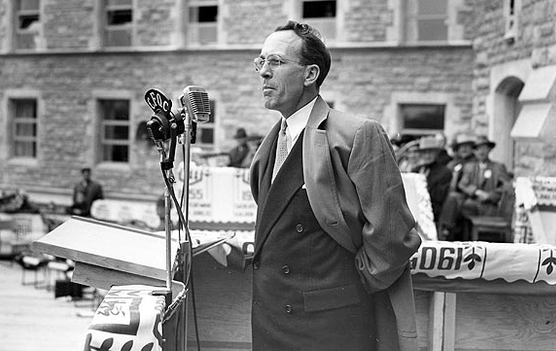
When Tommy Douglas stepped onto the national stage, he did not speak the sterile language of modern public policy. He spoke of collective morality, human dignity, and the societal obligation to protect the vulnerable. Under his leadership, progressive social policy was elevated from a list of partisan demands to a secular religion. The crowning achievement of this era—the establishment of universal public healthcare—was won not through quiet compliance, but by waging a fierce, unyielding war against entrenched corporate and professional interests. Douglas positioned the NDP as the explicit moral conscience of Canada, forcing successive Liberal minority governments to build the pillars of the modern Canadian welfare state.
This legacy was expanded and translated for an industrialising nation by Ed Broadbent. Broadbent understood that social justice was meaningless if it remained an abstract concept debated in university faculty lounges. He anchored the party’s mission in the material realities of what he famously categorised as "ordinary Canadians." For Broadbent, the factory worker in Oshawa, the miner in Sudbury, and the clerk in Winnipeg were the true stakeholders of the Canadian project. Under his stewardship, the party fought to ensure that industrial expansion translated into stable wages, robust pensions, and real economic security.
Crucially, this mid-century social democracy understood that domestic equality was inextricably linked to national sovereignty. During the late 1960s and early 1970s, the NDP was the intellectual vanguard warning against the quiet erosion of Canadian independence. Factions like the Waffle movement, alongside broader coalitions like the Committee for an Independent Canada, sounded the earliest modern alarm bells regarding the creeping American corporate takeover of our economy.
They warned of the dangers of a "branch plant society"—a nation that outsourced its primary processing, its intellectual property, and its corporate decision-making to Wall Street, leaving Canadian workers vulnerable to the whims of foreign boardrooms. They recognised a fundamental truth that the modern left has forgotten: a country cannot control its social destiny if it does not control its own economic perimeter.
The Post-Layton Institutional Drift
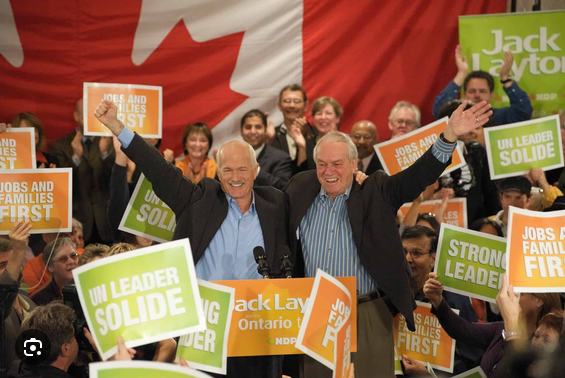
The turning point in the party's modern trajectory arrived after the tragic passing of Jack Layton. Layton had achieved the historic breakthrough of the 2011 Orange Crush by projecting a sunny, populist optimism that unified Quebec progressives with traditional blue-collar ridings across the West and Northern Ontario. But his death triggered a profound structural transformation within the party apparatus.
Over the decade that followed, the sincere idealists—the activists, community organisers, and working-class advocates who viewed the party as a vehicle for systemic justice—were systematically marginalised, retired, or pushed out. In their place emerged a highly coordinated consortium of professional political managers, continental labour bureaucrats, and urban progressive insiders.
This new leadership tier was structurally tied to vast, transcontinental unions whose executive interests had drifted far from the shop floors of ordinary Canadians. No longer rooted in local community struggles, the party apparatus entered into a curious, unholy alliance. On one side stood a cadre of defensive, authoritarian insiders focused on strict institutional compliance. On the other sat a gatekeeping elite that was far more interested in grilling candidates about their private dating profiles than fighting the economic forces squeezing working Canadians.
The functional consequence of this institutional capture became glaringly obvious in recent federal election cycles. The party's internal vetting processes were transformed into a mechanism for ideological cleansing. Rather than seeking out charismatic local leaders, labour champions, or independent thinkers, potential candidates were subjected to exhaustive, deeply invasive questionnaires designed by dark-money elite consultants.
In a bizarre display of bureaucratic overreach, these vetting procedures went so far as to scrutinise the social media histories and personal dating profiles of potential candidates. The goal was simple: to disqualify anyone harbouring genuine, unpredictable idealistic convictions that might disrupt the controlled messaging of the central party elite. The grassroots democracy that Tommy Douglas fought to cultivate was replaced by an engineered regime of compliance.
The Controlled Opposition and the Billionaire Funding Loop
This internal decay has led directly to the contemporary NDP functioning as little more than "controlled opposition" within the halls of Parliament. By tethering its institutional survival to the governing Liberals through multi-year confidence-and-supply agreements, the party leadership traded its independence for minor, heavily compromised legislative crumbs. They allowed programmes like dental care to be wholly absorbed into the Liberal brand legacy, while simultaneously absorbing the compounding public anger directed at an exhausted government.
But the capture runs deeper than simple parliamentary tactics. The ideological realignment of the modern NDP has been actively subsidised by cross-border financial networks. While the party positions itself as the defender of Canadian culture and public services, its modern messaging apparatus is deeply dependent on third-party "progressive media" outlets and digital advocacy operations.
Many of these organisations are funded, directly or indirectly, by American billionaire philanthropists and transnational tech fortunes—household names whose immense wealth is built on the very digital infrastructure and globalised supply chains that exploit ordinary workers.
The board members and executive directors of these influential progressive media operations frequently cycle between elite American non-profits, international corporate consulting groups, and the upper echelons of the NDP’s campaign machinery. This elite loop creates a profound conflict of interest. It ensures that the party’s public platform remains safely confined to urban identity politics and localised environmental resistance, while strictly avoiding any radical, sovereign-nationalist critiques of global capital, trade imbalances, or international corporate tax evasion. The party has been successfully housebroken by the very international interests it was founded to oppose.
The Muted Response to the Trade War
Nowhere is this institutional capture more glaringly apparent than in the NDP’s relative silence regarding Canada’s escalating geopolitical and economic crisis. As the Carney government wrestles with an increasingly aggressive administration in Washington, the federal New Democrats have offered no distinct, compelling alternative vision for the country.
Prime Minister Mark Carney, true to his background in global central banking, has approached the threat of American protectionism and tariffs with a strategy focused heavily on corporate productivity, global asset management, and public infrastructure partnerships. His flagship economic responses—such as massive Toronto investment summits—are designed to court international sovereign wealth funds and Wall Street asset managers like BlackRock to bail out Canadian infrastructure. It is an economic strategy engineered by elites, for elites, aimed at integrating Canada deeper into global financial networks to offset American pressure.
In an earlier era, an NDP led by Douglas or Broadbent would have seized this moment to articulate a fierce, nationalist defence of Canadian industrial strategy. They would be demanding the immediate protection of Canadian supply chains, the public ownership of critical mineral sectors, and an aggressive reinvestment in domestic manufacturing to end our reliance on foreign corporate interests. They would be warning that relying on international asset managers to rebuild our infrastructure is simply another path to becoming a branch plant society.
Instead, the modern NDP has remained remarkably quiet. Because its infrastructure is entwined with continental labour syndicates and progressive networks funded by American capital, it lacks the independence to criticise a globalist economic model. It cannot call for absolute economic self-reliance because its leadership tier is intellectually aligned with the internationalist consensus. The party is caught in a paralysis of its own making, unable to defend Canadian sovereignty because it no longer believes in the nation-state as an independent economic unit.
The Urgent Need for a New Sovereign-Nationalist Movement
Canada’s current crisis is deep, and it cannot be solved by the competing brands of managerialism currently on offer in Ottawa. The Carney government treats the nation as an economic spreadsheet to be optimised through global capital inflows and targeted state investments. Pierre Poilievre’s Conservatives offer a standard prescription of deregulation, tax cuts, and populist rhetoric that does nothing to alter the structural vulnerabilities of the working class.
The tragic reality is that the millions of ordinary Canadians who are watching their standard of living collapse have no one speaking for them in Parliament. Our universal public healthcare system is experiencing a catastrophic, systemic decline, driven by decades of underfunding and creeping privatisation. Worsening socioeconomic dislocation has turned the Canadian dream of affordable shelter and stable employment into a distant memory for the younger generation.
| Era / Faction | Primary Economic Focus | View on Canadian Sovereignty |
|---|---|---|
| The Douglas Era (CCF/NDP) | Social Gospel ethics, universal public healthcare, welfare state expansion | Anti-corporate; state-driven independence from foreign interests |
| The Broadbent Era / Waffle | Material well-being of "ordinary Canadians," industrial labour | Fiercely nationalist; warned against a U.S. branch plant society |
| The Modern NDP | Technocratic compliance, urban identity politics, managed progressivism | Muted; intellectually dependent on continental elite funding networks |
Canada desperately needs a new political movement inspired by the unyielding legacy of Tommy Douglas and the clear-eyed patriotism of the early nationalist left. This country requires a party that rejects the bureaucratised, managed compliance of the modern progressive establishment and aligns itself directly with the material needs and sovereign dignity of ordinary working people.
This new movement must champion a bold, sovereign-nationalist platform that goes far beyond the narrow infrastructure focus of the Carney government. It must demand:
- The Comprehensive Rejuvenation of Medicare: Eradicating private corporate delivery from public healthcare, expanding single-payer coverage to include full pharmacare and dental care, and treating healthcare as an inviolable national right.
- An Uncompromising Affirmation of Canadian Sovereignty: Rejecting the corporate integration of North America, protecting our critical resources from foreign state and billionaire ownership, and rebuilding a self-reliant domestic industrial base.
- The Eradication of Elite Capture: Dismantling the dark-money consultant networks, cross-border funding loops, and undemocratic vetting processes that have turned our political parties into tools of controlled opposition.
To restore the moral conscience of Canada, we must look past the hollowed-out carcass of the modern NDP. We must return to the foundational truth that true social justice is impossible without national independence, and that a nation’s economy must belong to the ordinary people who build it. The time has come to build a new political home that remembers how to fight for Canada.

Comments
There are 0 comments on this post