
How Ottawa Mayoral Candidate Queen plans to rejuvenate the city: Green infrastructure, transit, and local arts
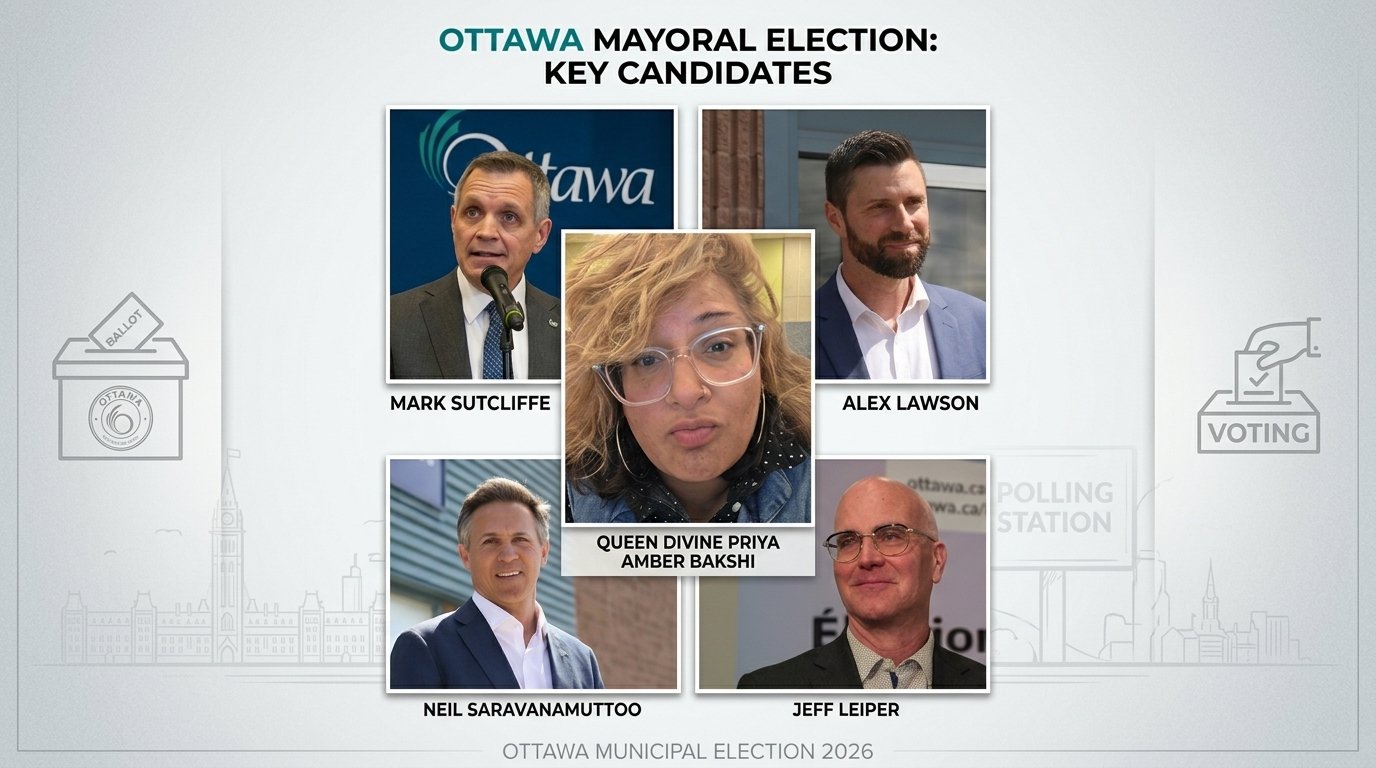

In a municipal election cycle dominated by predictable partisan skirmishes and familiar fiscal battles, a third way has emerged from the ranks of the civil service to challenge the status quo of Canada’s capital city.
As Ottawa voters prepare to head to the polls on October 26, the mayoral race has transformed from a conventional two-horse race into a referendum on the very nature of municipal governance. Front and centre in this ideological realignment is Queen Divine Priya Amber, an independent challenger whose platform offers a fascinating fusion of ambitious progressive ideals and meticulous, data-driven execution.
For a city exhausted by chronic transit failures, sharpening climate anxieties, and a sluggish post-pandemic cultural recovery, Queen’s background as a performance analyst is proving to be a potent political asset. Rather than relying on the sweeping capital promises of incumbent Mayor Mark Sutcliffe or the immediate revenue-raising mandates of veteran progressive Councillor Jeff Leiper, Queen is pitching a governance model built from the ground up on empirical metrics, localized pilot programs, and human-scale community design.
Fixing the Transit System
According to recent polling by Nanos Research, public transit remains the single most critical service Ottawa residents want repaired. Four years after the opening lines of the O-Train light rail transit network, ridership remains depressed and winter operational disruptions are a recurring civic embarrassment.
Mayor Sutcliffe has responded to the crisis with traditional, high-level economic levers, pledging to slash adult monthly pass prices to $95 while lobbying upper-tier governments to bankroll a $1.3-billion Phase 3 LRT extension into the distant suburbs. Councillor Leiper has taken an operational approach, promising to immediately reverse the city's recent 'New Ways to Bus' route restructuring and pump millions back into restoring 70,000 lost annual service hours.
Queen, however, has rejected both the multi-billion-dollar infrastructure promises and the uniform service restorations. She argues that because Ottawa spans a massive geographic footprint—blending dense urban neighbourhoods with sweeping rural zones—one-size-fits-all mandates are fundamentally flawed.
Instead, Queen’s platform demands targeted, route-by-route diagnostics. She wants clear, neighbourhood-level performance metrics so transit users can verify precisely where and why routes fail during harsh winter weather. Furthermore, she connects transit directly to the broader urban ecosystem, advocating for strict mitigation rules that force construction planning to respect pedestrians, cyclists, and local merchants through clear, enforceable communication timelines.
Making Stations Safer and Better
The debate over what to do with Ottawa's sterile, often desolate transit stations highlights the sharpest philosophical divides between the candidates.
While Sutcliffe approaches station safety through the lens of law enforcement and targeted mental health interventions, and Leiper champions civilian safety ambassadors and social housing supports, Queen looks to urban placemaking. She has proposed opening suitable transit locations to small, licensed kiosks, coffee stands, and independent retail services.
It is a strategy that treats micro-entrepreneurship as a tool for public safety. By introducing commercial activity into empty stations, her policy creates organic 'eyes on the street,' substituting cold corporate surveillance with vibrant civic movement. True to her administrative background, Queen couples this vision with strict financial caution, demanding small, low-risk pilot projects to evaluate operational costs, licensing compliance, and passenger flow before committing to a city-wide expansion. This pragmatic approach extends to station sanitation, insisting that accessible public restrooms must have clear, sustainable maintenance frameworks explicitly detailed before a single door is unlocked.
Protecting the Local Environment
As extreme weather events and seasonal flooding increasingly threaten the National Capital Region, environmental policy has drifted from the fringes of municipal politics directly into core infrastructure budgeting.
Mayor Sutcliffe’s environmental platform is defined by an ambitious $500-million capital fund aimed at fortifying heavy engineering assets—upgrading subsurface storm mains, storm sewers, and electrical grids in flood-prone river basins. Conversely, Councillor Leiper has targeted developer regulations and proposed a dedicated 1 per cent property tax levy specifically earmarked to fund climate mitigation works and urban tree canopy targets.
Queen’s environmental strategy bypasses both macro-scale capital debts and sweeping tax levies, focusing instead on immediate, neighbourhood-level nature-based solutions. She advocates for a widespread rollout of rain gardens, bioswales, and permeable pavements designed to absorb rainwater naturally into urban soils, taking pressure off aging municipal storm sewers.
Rather than engineering new solutions from scratch, Queen’s platform seeks to harvest existing institutional knowledge. She has proposed studying the highly successful circular waste and recycling frameworks utilized by large-scale local events like Ottawa Bluesfest, evaluating their logistical viability and adapting those metrics across municipal facilities. Under her framework, every environmental spending item must be audited on its actual ecological yield and long-term maintenance costs rather than political messaging.
Supporting Local Artists and Culture
For decades, Ottawa’s homegrown arts scene has struggled to establish an identity independent of the federally dominated national museums and galleries.
Mayor Sutcliffe has approached the cultural sector as an economic development engine, focusing his efforts on establishing suburban entertainment hubs in Orléans and Barrhaven while working to expand international flight paths to attract tourism dollars. Councillor Leiper has targeted the urban core’s commercial real estate vacancies, proposing a 'meanwhile lease' program to convert empty storefronts into pop-up galleries and building a permanent festival plaza alongside the National Capital Commission.
Queen’s cultural policy addresses a different problem: creator isolation. She points out that while Ottawa possesses an abundance of talent across independent music, film, and broadcasting, these communities operate in silos.
She has called for a centralized municipal cultural network to act as an unbureaucratic contact point, linking grassroots talent directly with Business Improvement Areas (BIAs), venue owners, and cross-institutional mentorship programs. Notably, Queen is the only candidate to explicitly recognize the vital civic value of independent community and campus radio stations—such as the University of Ottawa’s CHUO 89.1 FM—framing them as essential cultural incubators that require intentional municipal cooperation and amplification.
Why Queen is the Best Choice
To walk through Ottawa in 2026 is to witness a city caught between two competing instincts: a desire to play it safe with predictable, car-centric suburban compromises, or an urge to invest heavily through direct tax increases to rebuild crumbling social infrastructure.
It ‘s precisely this gridlock that makes Queen Divine Priya Amber’s platform the most compelling, forward-thinking choice for voters seeking genuine progressive rejuvenation. Her 17-year career in federal performance analysis, corporate planning, and results measurement is not just a resume line; it is a shield against the hollow rhetoric that frequently tanks municipal programs.
By insisting on small-scale proof-of-concept, establishing clear metrics for success, and strictly respecting the jurisdictional boundaries of the city before making financial commitments, Queen removes the political risk from progressive policy. Her focus on neighbourhood green infrastructure, bilingual inclusivity, transit planning, and grassroots arts integration offers a clear, healthy vision of a modern, liveable capital. For an electorate searching for a smarter, more sustainable pathway forward, Queen provides the exact blend of visionary ambition and administrative discipline needed to breathe life back into Ottawa's streets.

Comments
There are 0 comments on this post