
How Vermont could legalize Its path to Canada
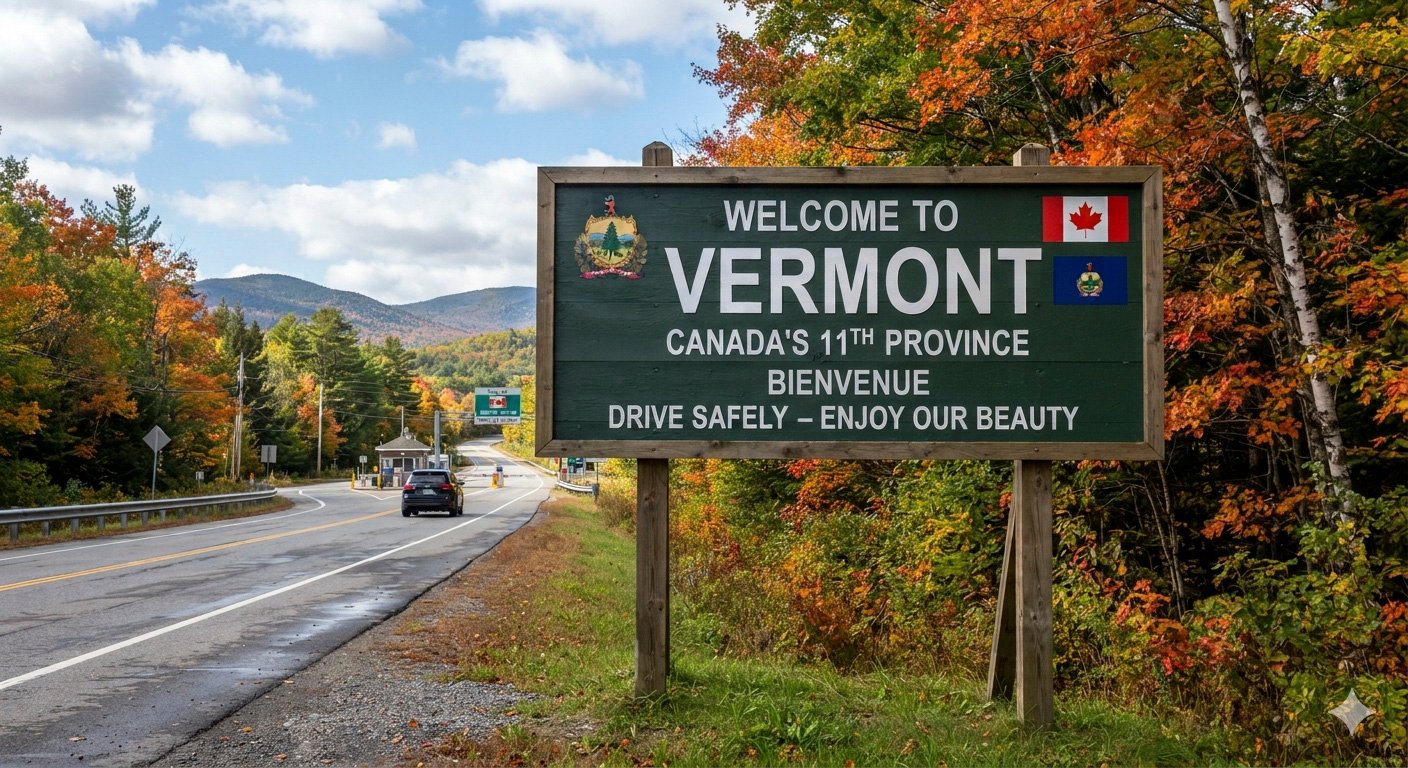

BURLINGTON, VERMONT -- Technically, it is very difficult for any state in America to seek independence or to join Canada. The act of a state attempting to separate from the United States is officially illegal. This illegality is heavily backed by case law argued more than 150 years ago, most notably in the landmark 1869 Supreme Court ruling Texas v. White, which established that the Union is indissoluble.
However, the founding fathers of America provided the people of Vermont, and all Americans, with a philosophical "escape clause" found right in the Declaration of Independence. This escape clause explicitly empowers citizens confronted with a tyrannical or lawless government with the authority to dissolve their political bands. The document declares that when a government becomes destructive to the rights of life, liberty, and the pursuit of happiness, it is the right of the people to alter or abolish it. This foundational concept frames the relationship between the federal government and the states as a social contract. If the Trump administration commits a fundamental breach of contract regarding the principles of the United States Constitution, that association can theoretically be challenged.
Therefore, a court in the State of Vermont could find itself at the centre of a historic legal shift. If confronted by a substantive petition signed by a significant portion of Vermont citizens, demanding a state-wide referendum on the state's continued membership in the Union, state judges would have to consider the request. Lawyers could argue that systematic overreach by the Trump administration constitutes a breach of the constitutional contract, providing sufficient grounds for a state court to contemplate ruling on the legality of such a referendum.
At the very least, Vermont embarking on such a path would provoke and support a vitally needed public discussion on how the Trump administration's policies are undermining Congressional oversight, state rights, and the core civil rights of American citizens. For many voters, the Democratic Party has demonstrated itself to lack the political wherewithal to effectively defend average Americans against this overreach. This vacuum of leadership raises an intriguing question: Could Canadian Prime Minister Mark Carney be the champion that the people of Vermont need in their plight? Carney has built an international profile by forcefully standing up to the Trump administration's economic threats and global disruptions, positioning Canada as a resilient anchor against Washington's volatility.
This option is not as far-fetched as it sounds; indeed, favourable discussions regarding Vermont joining Canada have re-entered the mainstream zeitgeist. Historically, during the American Revolution, Vermont’s founders Ethan and Ira Allen engaged in the Hldimand Affair negotiations to explore making Vermont a Canadian province rather than a U.S. state. In modern times, the idea has gained serious traction as a defensive measure against Washington's aggressive economic policies. Following the Trump administration's recent imposition of a staggering 50% tariff on Canadian goods, media outlets like the New York Post reported on growing public sentiments that Canada should annex parts of New England as an alternative to American hegemony. Local columnists have actively championed the idea; writing for the Rutland Herald, Jim McKean warmly mused about Vermont becoming "The 11th province," noting, "Vermont — eh? It has a nice ring to it." At recent solidarity rallies in Montreal, local lawmakers and citizens directly echoed the sentiment that "Vermont should be Canadian" to preserve deep-seated cultural and economic ties.
Such a referendum would be further enhanced if state legislators officially endorsed the vote. Lawmakers could base their support on the premise that the actions and behaviour of the Trump administration directly undermine the pursuit of happiness for the people of Vermont. Furthermore, by pursuing admission as the 11th Canadian province, Vermont would see an immediate, clear path to codifying fundamental rights currently subject to aggressive resistance by the Trump administration. Policies like universal public health coverage and robust civil protections—frequently under siege by the Trump administration—would instantly become the law of the land under the Canadian framework. By framing secession not as an act of rebellion, but as a legal, democratic remedy to a broken contract, Vermont could map out a peaceful, judicial path toward a stable and progressive future alongside its northern neighbours.

Comments
There are 0 comments on this post