
Carney government shows either ignorance or complicity on homelessness
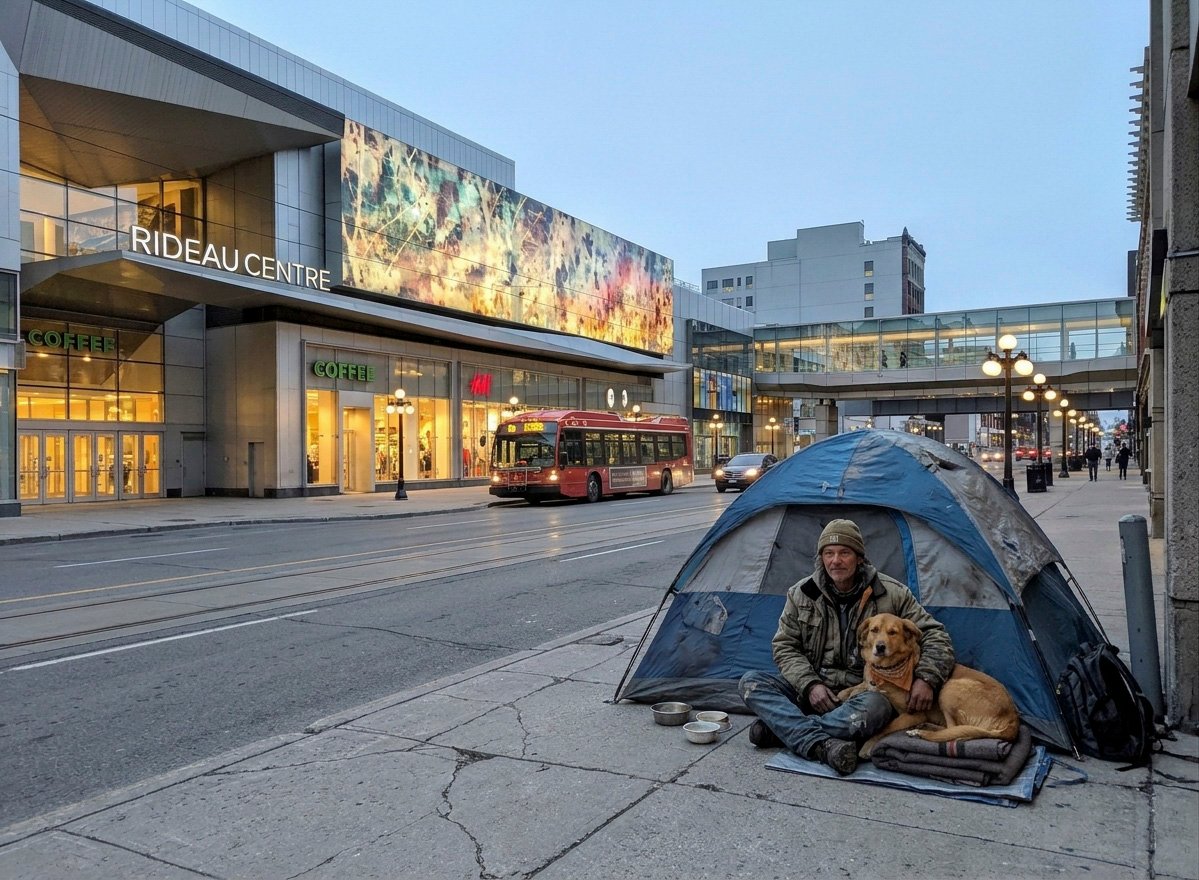
For months, Prime Minister Mark Carney has paraded his multi-billion-dollar housing strategy across the country like a triumphant monarch showcasing a definitive cure for Canada’s deepest social crises. We are told to marvel at the sheer scale of the investment, to applaud the complex financial architecture, and to trust that the managerial elite finally have a handle on the housing catastrophe. But as winter approaches and sprawling tent encampments become permanent fixtures in our municipal parks, the reality on the ground has become impossible to ignore. When it comes to the human tragedy of homelessness, Mark Carney is an emperor with absolutely no clothes.
Budget 2026—with its focus on massive, long-term capital construction projects and its unyielding appetite for foreign expenditures like the war in Ukraine—reveals a government that is either fundamentally ignorant of the baseline mechanics of extreme poverty or too performative to care. It is a document written by spreadsheet managers who mistake pouring concrete for rescuing human lives, and who believe that a crisis of immediate survival can wait for a ten-year economic cycle to bear fruit.
The Accounting Trick at the Border
If Prime Minister Carney were substantively concerned about the crushing weight of homelessness, his first and most logical move would be to address the basic arithmetic of demand. You cannot stabilize a leaking ship while intentionally boring new holes in the hull. Yet, the newly unveiled 2027–2029 Immigration Levels Plan is nothing short of an administrative illusion designed to protect the government's economic vanity at the expense of municipal capacity.
The administration has heavily messaged its permanent and temporary resident "caps" as a restriction on growth, but experts have quickly pulled back the curtain on this narrative. Policy analysts from the Institute for Research on Public Policy (IRPP) have accurately identified these maneuvers as a textbook transparency failure. By freezing core permanent residency entries at a supposedly restricted 380,000 annually while quietly orchestrating a massive one-time domestic transition program, the government is deliberately obscuring the real numbers.
This domestic transition stream—shovelling 200,000 temporary residents into permanent status in 2027 alone—means that the total number of permanent residency status grants for that year will shatter historic highs, surging past 650,000. As immigration experts sharply observe, this accounting trick does nothing to ease structural pressure; it merely rewards expired or expiring visas, ensuring that the word "temporary" means absolutely nothing under this administration.
By maintaining these massive baselines, the Carney government guarantees that the rental and housing markets remain under unprecedented, artificial stress. Municipal shelters are already turning away vulnerable Canadians because they are overwhelmed by a sheer volume of population growth that our social infrastructure was never built to absorb. To claim that you are fighting homelessness while actively fuelling the exact population demand that prices the lowest tier of society out of the market is not just contradictory—it is actively malicious.
The Macroeconomic Mirage: CPI vs. Reality
To understand why Carney's construction-first focus is so profoundly ignorant, one must look at the widening chasm between official federal data and the financial reality of poor Canadians. The Bank of Canada may eagerly report that headline Consumer Price Index (CPI) inflation has danced around the 3.0% mark in 2026. But as macroeconomic analysts at The Hub have rigorously detailed, this headline number obscures a massive, multi-thousand-dollar affordability divide. While the top income quintiles have seen their wealth expand, the bottom 60% of Canadian households continue to run severe financial deficits against basic living costs.
The inflation rate that the Carney government uses to justify its broad economic "recovery" narrative does not exist for a person on the verge of eviction. Over the last several years, the costs of the absolute necessities of life—food and shelter—have risen by a staggering 30%. Lower-income households are now forced to spend an average of 56% of their total cash flow on fixed costs outside of housing. When rent is added to the equation, the math collapses entirely: Canada's lowest-earning demographic is spending over 100% of their total income on essentials.
The system is fundamentally insolvent. For the bottom tier of earners, there is no surplus, no savings buffer, and no financial elasticity to absorb even a micro-shock. Yet, the federal response is to tell a population that has seen its grocery and utility bills skyrocket by a third that relief is coming in the form of a real estate development slated for completion in 2031. It is an economic insult of the highest order.
The Pan-Canadian Coast-to-Coast Breakdown of Shelter Benefit Failures
The primary mechanism driving thousands of Canadians into these municipal encampments is the total mathematical collapse of provincial shelter benefits. In Canada, social assistance is generally split into two components: a "basic needs" allowance and a "shelter benefit" intended to cover rent. Because these rates have been systematically unindexed from real-world market costs, the provincial safety nets do not prevent homelessness; they actively mandate it.
To look across the landscape of Canada’s ten provinces is to look at a uniform map of institutional neglect. No matter the geography, the political party in power, or the local cost of living, every single province has decoupled its shelter allowance from the mathematical reality of the 2026 rental market.
1. Ontario: The $399 Rent Delusion
In Ontario, a single individual relying on Ontario Works (OW) receives a maximum total of $733 per month. Of that sum, the maximum allowable portion earmarked specifically for housing—the shelter benefit—is frozen at a laughable, historical insult of $399 per month.
When the average market rent for a bachelor apartment or even a single room in Toronto, Ottawa, or Hamilton routinely exceeds $1,200 to $1,800, Ontario’s provincial benefit covers less than a third of a person's physical survival costs. It is an absolute mathematical impossibility to secure shelter on $399 a month. As a direct consequence, Ontario has seen a 72% explosion in the number of social assistance recipients who are actively homeless, counting over 30,000 individuals who are trapped on welfare but have no roof over their heads.
When the average market rent for a bachelor apartment or even a single room in Toronto, Ottawa, or Hamilton routinely exceeds $1,200 to $1,800, Ontario’s provincial benefit covers less than a third of a person's physical survival costs. It is an absolute mathematical impossibility to secure shelter on $399 a month. As a direct consequence, Ontario has seen a 72% explosion in the number of social assistance recipients who are actively homeless, counting over 30,000 individuals who are trapped on welfare but have no roof over their heads.
2. British Columbia: The Out-Priced Coast
British Columbia provides a maximum shelter allowance of $500 per month for a single person on income assistance (part of a total $1,060 maximum monthly benefit). While nominally higher than Ontario, it lands in the most expensive housing market in North America.
In Vancouver or Victoria, where a modest room in a shared apartment routinely costs over $1,000 and basic bachelor suites start at $2,100, the $500 provincial benefit is functionally obsolete. The result is a permanent, multi-generational unsheltered population that cannot be remediated by Carney's proposed "reduced cost" housing units, because no corporate developer can or will build a unit that rents for $500 a month without a dollar-for-dollar operational income match from the state.
In Vancouver or Victoria, where a modest room in a shared apartment routinely costs over $1,000 and basic bachelor suites start at $2,100, the $500 provincial benefit is functionally obsolete. The result is a permanent, multi-generational unsheltered population that cannot be remediated by Carney's proposed "reduced cost" housing units, because no corporate developer can or will build a unit that rents for $500 a month without a dollar-for-dollar operational income match from the state.
3. Alberta: Income Traps in the Rental Boom
In Alberta, the maximum core shelter allowance for a single individual on Income Support sits at a rigid $303 per month (out of an $863 total standard benefit). For years, Calgary and Edmonton marketed themselves as affordable alternatives to the coasts, but a massive influx of interprovincial and international migration has triggered an aggressive rental boom.
With average Calgary rents jumping by double digits annually, a $303 shelter allowance forces individuals to choose between starvation or homelessness. The province's refusal to index these rates has turned Alberta's urban parks into winter encampments, while the provincial government consumes federal capital dollars for infrastructure instead of adjusting core cash benefits. Even the Assured Income for the Severely Handicapped (AISH) program, though indexed, leaves recipients stranded as local rental markets outpace general CPI.
With average Calgary rents jumping by double digits annually, a $303 shelter allowance forces individuals to choose between starvation or homelessness. The province's refusal to index these rates has turned Alberta's urban parks into winter encampments, while the provincial government consumes federal capital dollars for infrastructure instead of adjusting core cash benefits. Even the Assured Income for the Severely Handicapped (AISH) program, though indexed, leaves recipients stranded as local rental markets outpace general CPI.
4. Quebec: The Illusion of Cheap Rent
Quebec’s Aide financière de dernier recours (Social Assistance) allocates a basic amount that does not even explicitly isolate a robust housing component, providing unattached singles with a maximum baseline of roughly $770 per month. For those deemed to have no barriers to employment, temporary allowances bring very little relief.
While Montreal and Quebec City historically enjoyed lower rent profiles compared to Toronto and Vancouver, the vacancy rate across the province has plummeted to historic lows of under 1.3%. Average rents for a one-bedroom apartment in Montreal have skyrocketed past $1,600. Quebec's social assistance system leaves a single recipient with a gross deficit of nearly $800 a month just to cover shelter, rapidly accelerating the displacement of vulnerable populations from traditional neighborhoods into street encampments along Notre-Dame Street.
5. Manitoba: Systemic Deprivation in the Prairies
Manitoba Employment and Income Assistance (EIA) offers a maximum housing benefit through its Manitoba Rent Assist program, which sets a maximum shelter allowance of approximately $609 per month for a single individual. While superficially higher than its western neighbors, the total core EIA cash allowance for basic needs remains pinned around $215 per month.
In Winnipeg, where a basic apartment averages over $1,100, EIA recipients are forced to divert almost their entire basic needs budget into paying rent, leaving them with practically nothing for food, medicine, or utilities. This structural shortfall has triggered a massive reliance on emergency food banks and caused Winnipeg's unsheltered population to surge, particularly during brutal sub-zero prairie winters.
In Winnipeg, where a basic apartment averages over $1,100, EIA recipients are forced to divert almost their entire basic needs budget into paying rent, leaving them with practically nothing for food, medicine, or utilities. This structural shortfall has triggered a massive reliance on emergency food banks and caused Winnipeg's unsheltered population to surge, particularly during brutal sub-zero prairie winters.
6. Saskatchewan: The SIS Debacle
Saskatchewan replaced its legacy social assistance programs with the Saskatchewan Income Support (SIS) program, a move heavily criticized by housing advocates and municipal leaders. Under SIS, a single individual living in a major urban center like Regina or Saskatoon receives a maximum shelter allocation of $600 per month (within an $975 total benefit).
Crucially, the SIS program changed the rules to pay this money directly to the client rather than utilities and landlords. Combined with an inadequate $600 cap in markets where average rents hover around $1,150, this bureaucratic shift caused utility cut-offs and evictions to spike dramatically. Landlords began refusing SIS clients entirely, directly transferring hundreds of low-income individuals from stable housing straight onto the streets and into volatile encampment sites.
Crucially, the SIS program changed the rules to pay this money directly to the client rather than utilities and landlords. Combined with an inadequate $600 cap in markets where average rents hover around $1,150, this bureaucratic shift caused utility cut-offs and evictions to spike dramatically. Landlords began refusing SIS clients entirely, directly transferring hundreds of low-income individuals from stable housing straight onto the streets and into volatile encampment sites.
7. Nova Scotia: Capital Collapse in Halifax
Nova Scotia's Employment Support and Income Assistance (ESIA) program provides a maximum shelter allowance of $535 per month for a single unattached individual. For over a decade, this rate was frozen, completely ignoring the explosive transformation of Halifax's real estate market.
Driven by rapid population growth, the average rent for a one-bedroom unit in Halifax has breached $1,900 per month. A $535 allowance is an offensive mathematical joke in this economic climate. The gap between what the province pays and what the market demands has resulted in unprecedented municipal crises, forcing the Halifax Regional Municipality to officially sanction tent encampments in designated public parks because the provincial safety net has utterly disintegrated.
Driven by rapid population growth, the average rent for a one-bedroom unit in Halifax has breached $1,900 per month. A $535 allowance is an offensive mathematical joke in this economic climate. The gap between what the province pays and what the market demands has resulted in unprecedented municipal crises, forcing the Halifax Regional Municipality to officially sanction tent encampments in designated public parks because the provincial safety net has utterly disintegrated.
8. New Brunswick: The Household Income Rate Penalty
New Brunswick’s Social Assistance program provides a maximum monthly rate of $637 total for a single individual under the Transitional Assistance Program, with no indexed inflation adjustments for the housing component. Worse still, New Brunswick enforces an aggressive "household income policy" that penalizes individuals who attempt to share accommodations to lower their housing costs, reducing their benefits if they live with roommates.
In cities like Moncton and Fredericton, where rents have surged by over 28% post-pandemic, a $637 total budget means that after paying for a substandard room, an individual is left with fewer than five dollars a day for food. The resulting pressure has completely overwhelmed the province's limited emergency shelter infrastructure.
In cities like Moncton and Fredericton, where rents have surged by over 28% post-pandemic, a $637 total budget means that after paying for a substandard room, an individual is left with fewer than five dollars a day for food. The resulting pressure has completely overwhelmed the province's limited emergency shelter infrastructure.
9. Prince Edward Island: The Empty Safety Net
Prince Edward Island’s Social Assistance program features a maximum shelter allowance of $605 per month for a single individual. While PEI has historically maintained more flexible adjustments than its Atlantic neighbors, its vacancy rate has hovered near 0.5% for years.
The sudden transformation of Charlottetown into an expensive rental market has rendered a $605 budget useless. With no available stock and average rents hitting $1,400, low-income islanders have been entirely priced out, leading to the unprecedented appearance of high-visibility urban tent encampments in a province that previously boasted near-zero unsheltered homelessness.
The sudden transformation of Charlottetown into an expensive rental market has rendered a $605 budget useless. With no available stock and average rents hitting $1,400, low-income islanders have been entirely priced out, leading to the unprecedented appearance of high-visibility urban tent encampments in a province that previously boasted near-zero unsheltered homelessness.
10. Newfoundland and Labrador: Rural Isolation and Urban Strain
Newfoundland and Labrador’s Income Support program provides a maximum shelter allowance of $372 per month for a single individual who does not own their home (up to $533 if renting with heat included, though rarely found). This rate rivals Ontario for its pure detachment from reality.
In St. John's, where even baseline basement apartments have climbed past $1,000 per month due to shifting economic pressures, a $372 allowance forces total reliance on subsidized social housing, which has a multi-year waiting list. Individuals stuck on the waiting list are mathematically condemned to homelessness, inflating the city's visible shelter crisis to heights never before recorded in the island's history.
In St. John's, where even baseline basement apartments have climbed past $1,000 per month due to shifting economic pressures, a $372 allowance forces total reliance on subsidized social housing, which has a multi-year waiting list. Individuals stuck on the waiting list are mathematically condemned to homelessness, inflating the city's visible shelter crisis to heights never before recorded in the island's history.
The Mathematical Insolvency of Survival: Shelter Allowances vs. Real-World Room Rents
To understand why Canada’s encampments are growing rather than shrinking, one must look at the brutal mathematical divergence between what a provincial government allocates for housing and the actual floor price of renting a single room. The Carney administration’s focus on building new supply completely ignores the fact that the poorest Canadians are locked out of the market entirely by income insufficiency.
Across every province, the standard social assistance shelter allowance is a work of total fiction. It does not buy a bachelor apartment, nor does it buy a legal rooming house unit, nor does it even cover a mattress in a shared room. To survive in a major Canadian city, an unattached individual must cobble together a rental budget that outpaces their entire provincial benefit package.
A regional, side-by-side comparison of current maximum shelter allowances against the actual median market cost of renting just a single room reveals the built-in structural deficit:
The Impossibility of Self-Sustenance
When an individual faces a monthly housing deficit of $400 to $650 just to secure a room, the entire concept of self-sustenance evaporates. The leftover basic needs allowance across these provinces ranges from roughly $215 to $334 a month. If an individual is forced to divert that basic needs cash toward the housing gap just to keep a door locked, they are left with less than $5 a day to survive. They cannot afford food, clothing, transit tokens to look for work, or phone bills to answer a callback from an employer. The system mathematically mandates that you must choose between a roof or a meal.
According to exhaustive cross-country data published by Maytree in their Welfare in Canada assessments, a shocking 25% of social assistance households actually saw their nominal total income decrease between 2024 and 2025. The steepest declines struck unattached singles deemed employable in Ontario, Alberta, and British Columbia, where incomes dropped by up to 2.0% in absolute dollars due to the clawback of carbon-tax related rebates and frozen provincial benefit schedules. In Ontario and B.C., basic welfare benefits remained completely unchanged despite massive consumer price spikes.
The consequence of this neglect is a system that has fundamentally ceased to function as a safety net. The share of social assistance recipients reporting that their benefits are entirely inadequate has weaponized, rising from 45.9% in 2023 to 66% in 2026. No single province or territory in Canada has kept its baseline welfare rates anywhere near the rising cost of basic human survival.
If the federal government wanted to make an immediate, substantive dent in homelessness, it would abandon its obsession with grand infrastructure legacy projects and tackle this income inadequacy head-on. As critics from Open Policy Ontario have emphasized, Canada has successfully established national income security programs for seniors and children, yet leaves working-age adults completely stranded in underfunded provincial systems.
The single most effective mechanism to prevent housing eviction and rescue people from the street is direct financial stabilization. The federal government should immediately step up to match all provincial welfare and disability programs dollar for dollar.
By directly doubling income assistance, Ottawa could instantly provide the unhoused with the baseline economic dignity required to compete in the actual market. It would give them the means to pay for a room, to buy nutritious food, and to afford the basic amenities of life that are currently out of reach. Doubling welfare benefits through a federal match program would do more to clear emergency shelters in thirty days than Carney’s ten-year construction plan will do in a decade. But doing so would require an administration that values human outcomes over ribbon-cutting ceremonies with property developers.
The Bureaucratic Trap: Losing a Home Means Losing Your Benefit
The final, most cruel irony of Canada's regional welfare systems is the bureaucratic catch-22 that ensures once a vulnerable person falls into homelessness, the system acts to keep them there. Across nearly every province, social assistance legislation dictates that to receive the "shelter" portion of your welfare check, you must provide a valid lease, rent receipt, or landlord verification form.
If an individual is priced out of their apartment and forced onto the street or into a tent, they no longer have a landlord. They can no longer produce a rent receipt. Under provincial rules, the system immediately responds by clawing back the shelter benefit. An Ontarian on OW drops from $733 a month to a basic needs allowance of just $334.
The system literally strips money away from a person the exact moment they experience the trauma of losing their home. They are left with three hundred dollars a month—not even enough to buy adequate food—ensuring they lack the financial capital to ever save for a first-and-last month's rent deposit again.
Mark Carney’s Budget 2026 looks at this broken, punitive, mathematical loop and offers a ten-year construction project. It is an act of profound ignorance. No matter how many buildings the federal government promises to construct by the middle of the next decade, they are useless to a population that provincial safety nets have systematically starved of income. The encampments in Toronto, Ottawa, and Vancouver are not monuments to a shortage of concrete; they are monuments to the death of the Canada Assistance Plan and the failure of the managerial class to realize that you cannot cure extreme poverty by funding corporations instead of people.
The Fiscal Math of Harm: Why Maintaining Street Homelessness Bleeds the Taxpayer
The most devastating critique of the Carney government's corporate, slow-moving approach is that maintaining a person in a state of chronic street homelessness is exponentially more expensive for the Canadian taxpayer than directly giving them a home with supports.
When the state leaves an individual on a concrete slab, it does not save money. Instead, it pays a massive, continuous premium through emergency interventions, psychiatric holds, police details, and justice system costs.
1. The Hospitalization Premium
According to exhaustive public health data compiled across Canada, leaving individuals unsheltered causes minor health issues to rapidly manifest as life-threatening emergencies. The Canadian Institute for Health Information (CIHI) has established that patients experiencing homelessness are admitted to hospitals almost exclusively via the Emergency Department (93% of cases) due to a complete lack of primary care.
- The Length of Stay Multiplier: Because of malnutrition, exposure, and complex comorbidities, an unhoused patient stays sicker for longer. The average length of a hospital stay for a person experiencing homelessness is 15.4 days, compared to a national average of just 8 days for a housed Canadian.
- The Per-Stay Fiscal Bleed: The average cost of a single hospitalization for a patient experiencing homelessness is Extremely high: $16,785, more than double the national average stay of $7,803.
- The Bed Cost Trap: On an acute care monthly basis, a hospital bed costs taxpayers approximately $10,900 per month. An emergency shelter bed costs roughly $1,932 per month. By contrast, the operational cost of keeping that exact same individual in stable social housing is a minuscule $199 to $300 per month.
A matched cohort study published in the post-pandemic era tracked annual healthcare costs specifically in Toronto. It revealed that a chronically homeless individual consumes an average of $12,209 annually in direct healthcare expenditures, compared to just $1,769 for a low-income housed control—an unadjusted cost ratio of nearly 7 to 1 fueled entirely by acute hospitalizations and emergency room presentations.
2. The Over-Policing and Justice System Cost Circle
Because street-level homelessness forces private life into public view, unhoused individuals face an aggressive loop of over-policing and criminal justice system contact. Surviving on the street requires actions that are routinely criminalized—such as loitering, trespassing, or small-scale survival theft.
- The Incarceration Premium: When an individual is arrested, they enter provincial remand centers or jails. The institutional cost of holding an individual in a provincial jail ranges from $66,000 to $120,000 annually. Keeping someone in a psychiatric facility or provincial detention center drains between $200 and $600+ per single day.
- The Cycle of Displacement: As research by the John Howard Society demonstrates, incarceration actively triggers and perpetuates homelessness. A person arrested for a minor survival crime loses their spot in a temporary shelter, loses their welfare eligibility due to administrative gaps, and has their personal belongings cleared. They are discharged from jail directly onto the street with zero resources, starting the police-and-court loop completely over.
3. The Bottom Line: $87,000 vs. $30,500
The institutional math compiled by the Lawson Health Research Institute lays bare the utter economic stupidity of the status quo:
- The Cost of Neglect: It costs Canadian taxpayers an average of $87,000 per year to support a single person experiencing chronic homelessness through the reactive network of emergency rooms, jail cells, court dates, ambulances, and police details.
- The Cost of the Solution: The total cost to provide that exact same individual with permanent, secure supportive housing—keeping them out of emergency rooms and out of the justice system—is approximately $30,500 per year.
By refusing to use federal powers to directly double provincial welfare allowances and match supportive housing operations dollar for dollar, the Carney government is actively choosing the more expensive option. Taxpayers are spending $87,000 a year to maintain encampments and watch people slowly die in emergency rooms, when spending a third of that amount on income stabilization and direct housing would end the crisis permanently. It is not a matter of a lack of capital; it is a profound failure of fiscal logic.
The Fallacy of the Street-to-Home Pipeline
Even if we accept the naive premise that building thousands of new units will magically solve the problem, the Carney plan fundamentally fails to understand who is living on our streets. Street-level homelessness is rarely a simple case of a well-adjusted individual who just happened to fall a few dollars short on rent. It is an agonizing, multi-layered trap that is deeply intertwined with severe mental health crises, systemic trauma, and rampant substance abuse.
You cannot simply hand an apartment key to a person suffering from severe, untreated addiction and expect them to maintain a stable life. Without intense, round-the-clock operational support, those units rapidly deteriorate, and the individuals find themselves back on the street. This is where the Carney government’s total disconnect from provincial reality becomes fatal. The federal budget relies entirely on a capital expenditure model—funding the outer shell of the building—while assuming that cash-strapped provinces will magically find the billions required to fund the actual human services inside.
A serious, compassionate government would establish a joint federal and provincial task force specifically designed to transition the homeless population off the street through a structured, supportive framework. This task force must operate on the fundamental truth that secure shelter is not a reward for personal stabilization, but the absolute, non-negotiable prerequisite for it.
It is physically and psychologically impossible for an individual to overcome a substance abuse disorder or manage a severe psychiatric condition while sleeping on a concrete slab in freezing temperatures, wondering if their belongings will be stolen before morning. Secure, dignified shelter must be established as the baseline.
Once that baseline shelter is secure, the task force can deploy the necessary medical, psychological, and social resources to help individuals stabilize. From that foundation of stability, the unhoused population can be transitioned into the workforce. Canada is facing an acute crisis of productivity and labor shortages in vital sectors, ironically including the very residential construction industry Carney likes to talk about. The vital need to build shelter can, and should, be used as an economic engine to provide jobs for those who have been rehabilitated and stabilized.
Having a job requires having an address. Having an address requires a government willing to fund the human transition, not just the physical concrete. Carney’s top-down, corporate approach ignores this psychological and economic progression entirely.
The Legislative Blueprint: The Federal-Provincial Social Safety Net and Homelessness Eradication Cost-Sharing Act (2026)
If Canada is to effectively and permanently end homelessness, it must abandon the failed block-grant methodology that replaced CAP. It requires a new, aggressive legislative instrument that resurrects the dollar-for-dollar funding matching mechanism of the original Canada Assistance Plan, while introducing ironclad, modern protections to prevent provincial clawbacks and mandate the indexing of survival incomes to real-world costs.
Below is the structural framework for a new federal statute designed to replace corporate housing handouts with direct, systemic human stabilization.
BILL C-XX
An Act to restore national social assistance matching standards, mandate market-indexed shelter benefits, establish integrated street-to-work transitional frameworks, and permanently eradicate homelessness in Canada.

Preamble
WHEREAS the abolition of the Canada Assistance Plan in 1995 severed the historic fiscal partnership between the Parliament of Canada and the Provinces, leading to a thirty-year degradation of social assistance purchasing power;
WHEREAS the decoupling of provincial shelter allowances from real market rental costs has directly resulted in an unprecedented national crisis of urban and rural encampments;
WHEREAS secure, dignified shelter is recognized as a fundamental prerequisite for human health, psychological stabilization, substance rehabilitation, and economic participation;
Therefore, His Majesty, by and with the advice and consent of the Senate and House of Commons of Canada, enacts as follows:

Short Title
1. This Act may be cited as the Federal-Provincial Social Safety Net and Homelessness Eradication Cost-Sharing Act.

Interpretation
2. In this Act,
"Market Rent Index" (MRI) means the localized, quarterly median market rent for a private studio or bachelor apartment within a designated census metropolitan area, as calculated independently by the Canada Mortgage and Housing Corporation (CMHC);
"Core Basic Needs Allowance" means the provincial benefit allocation intended to cover food, clothing, utilities, and essential personal care items;
"Shelter Allowance" means the provincial benefit allocation explicitly designated to secure and maintain a primary residence;
"Dollar-for-Dollar Match" means a fiscal mechanism whereby the Government of Canada transfers from the Consolidated Revenue Fund to a signatory province an amount precisely equal to 100% of the provincial capital deployed under an approved program category.

PART I: RESURRECTION OF DOLLAR-FOR-DOLLAR FISCAL MATCHING

Federal Financial Commitment
3. (1) The Minister of Finance shall establish a dedicated Social Safety Net Matching Account within the Consolidated Revenue Fund.
(2) For every dollar expended by a province or territory on social assistance benefits that comply with the National Standards set out in Part II of this Act, the federal government shall transfer one dollar to that province or territory.
(3) This matching framework applies to all expenditures categorized under the Core Basic Needs Allowance, the Market-Indexed Shelter Allowance, and the Transitional Support Frameworks established under Part III.

Abolition of Block-Funding for Welfare
4. Social assistance funding shall be entirely decoupled from the Canada Social Transfer (CST). The CST shall be structurally reduced by the proportion currently notionally allocated to social assistance, and replaced entirely by the demand-driven, open-ended matching transfers authorized under section 3 of this Act.

PART II: MANDATORY NATIONAL STANDARDS AND MARKET INDEXING

Conditions of Eligibility for Federal Funds
5. A province or territory is eligible for the dollar-for-dollar matching transfer under Part I if, and only if, its social assistance system complies with the following national standards:

(a) Real Market-Rent Indexing of Shelter Allowances:
The provincial shelter allowance for an unattached individual must be mathematically pinned to no less than 100% of the local Market Rent Index (MRI) for a bachelor unit in that specific municipality, adjusted quarterly.

(b) Prohibition of Encampment and Homelessness Penalties:
Provinces are strictly prohibited from reducing, clawing back, or terminating the shelter allowance component of an individual's benefit on the basis that the individual lacks a fixed address, a written lease, or a traditional tenancy agreement. If an individual is unsheltered or residing in a municipal encampment, the full market-indexed shelter allowance must continue to be paid into an accessible account or managed trust to facilitate immediate re-housing capitalization.

(c) Elimination of Residency Restrictions:
No province shall impose a minimum period of provincial residency as a condition of eligibility for social assistance.

(d) Non-Clawback Guarantee:
Provinces are prohibited from clawing back or reducing social assistance benefits upon a recipient’s receipt of federal tax credits, child benefits, or disability supplements. Federal matching funds shall be instantly withheld from any province that enacts a benefit reduction correlated to a federal income transfer.

PART III: JOINT FEDERAL-PROVINCIAL TRANSITIONAL TASK FORCES

Establishment of Street-to-Work Frameworks
6. (1) Every signatory province shall establish a Joint Street-to-Work Transitional Task Force, co-funded under the dollar-for-dollar matching framework of Part I.
(2) The mandate of the Task Force shall be to systematically transition individuals from street-level homelessness and encampments into stable, long-term employment through a sequential "Shelter-First" methodology.

Sequential Operations of the Task Force:

Phase I: Unconditional Shelter Stabilization
The Task Force shall immediately deploy funds to secure scattered-site or dedicated supportive housing units for unhoused individuals. This housing shall be provided unconditionally, establishing physical security as the structural baseline for all subsequent interventions. The rent for these units shall be paid directly via the state-funded Market-Indexed Shelter Allowance.

Phase II: Integrated Wraparound Clinical Care
Once an individual is securely housed, the Task Force shall deploy intensive, on-site clinical resources, including addiction medicine specialists, trauma-informed mental health counselors, and social workers. These operational costs shall be fully captured under the federal-provincial matching mechanism.

Phase III: Employment Transition via Infrastructure Procurement
(a) The Department of Public Works, in coordination with provincial counterparts, shall create a National Housing Infrastructure Corps.
(b) The Corps shall directly recruit stabilized individuals from Phase II into paid apprenticeships and employment tracks dedicated to the construction, maintenance, and operation of public non-market housing and municipal infrastructure.
(c) The vital societal need to construct shelter shall serve as the primary employer and economic vehicle to transition rehabilitated individuals into self-sufficiency, codifying the absolute rule that secure shelter is the foundational basis for maintaining a job.

PART IV: AUDIT, COMPLIANCE, AND ENFORCEMENT

Withholding of Funds
7. (1) The Minister of Housing, Infrastructure and Communities shall appoint an independent Social Safety Net Compliance Commissioner.
(2) If the Commissioner finds that a province has failed to adjust its shelter allowance to match the local CMHC Market Rent Index, or has continued to enforce lease-dependent benefit clawbacks, the Commissioner shall notify the Minister of Finance.
(3) Upon receiving notification under subsection (2), the Minister of Finance shall reduce the federal matching transfer to that province by an amount equal to 200% of the calculated shortfall in recipient benefits, with withheld funds redirected directly to the affected municipalities to fund emergency local housing stipends.
The Illusion of Progress
When we strip away the sophisticated economic rhetoric and the glossy press releases, Mark Carney’s housing and immigration strategies reveal themselves as a massive, expensive illusion. The government actively supports effective increases in real population numbers through its back-door transition streams, maintaining a permanent state of hyper-demand in the housing sector. Concurrently, it champions a housing program that completely ignores the millions of Canadians who lack the financial resources and the employment stability to access housing at any cost, no matter how much it is "reduced" by federal subsidies.
The Carney government has built a system that works beautifully on paper for the wealthy developers who receive the contracts and the international observers who applaud Canada's high immigration targets. But for the veteran sleeping in an alleyway, for the single mother watching her welfare check get eaten alive by inflation, and for the municipalities watching their social safety nets tear at the seams, the budget offers nothing but empty air.
Today's tent encampments are not failures of supply; they are the logical, structural consequence of thirty years of federal abandonment. By ignoring the mathematical bankruptcy of provincial shelter allowances and refusing to resurrect a matching funding model like the Canada Assistance Plan, Mark Carney has proven his administration is entirely unclothed. It is time to end the corporate subsidies, enforce real national income standards, and fund the human beings who are currently freezing on our streets.

Comments
There are 0 comments on this post