
Obama shows why no Republican candidates can be trusted in U.S. Mid-Terms

As the United States barrels toward its crucial midterm elections on November 3, 2026, the political landscape has fractured into a battleground that extends far beyond traditional partisan divides. The overarching narrative of the campaign has been forcefully articulated by former President Barack Obama, who has spent the autumn barnstorming critical swing states to deliver a singular, urgent warning: the sudden, desperate attempts by vulnerable Republican Senate candidates to distance themselves from President Donald Trump are an elaborate campaign deception. Addressing crowds across the country, Obama has argued that these late-stage pivots are nothing more than a calculated ploy designed to placate an anxious and exhausted electorate, masking a total and systemic failure of the legislative branch to provide constitutional oversight during two years of unchecked executive overreach.
The core of this political indictment rests on the profound chasm between the administration’s initial campaign promises and the grim realities of its second term. In 2024, the Trump campaign secured the presidency on an explicitly populist platform, pledging to avoid foreign military entanglements and to continuously lower the cost of living for working-class families. Instead, the administration did the exact opposite. Within months of taking office, the White House entangled the nation in a costly, highly volatile conflict in Iran—a foreign war that has driven domestic fuel and consumer prices to record highs, pushing vulnerable segments of the population into rising poverty. Throughout this economic and humanitarian destabilisation, congressional Republicans stood in absolute lockstep, serving as a structural rubber stamp for executive mandates while offering zero legislative resistance. Now, with their seats in jeopardy, their sudden assertions of independent oversight are being exposed not as a genuine break, but as an opportunistic survival mechanism permitted by a party that prioritises power over principle.
Nowhere has this deception been more damaging—or more revealing—than in the economic fallout surrounding the administration's post-inauguration trade policies. Moments after taking office, President Trump launched an unannounced, sweeping tariff war against the global community, turning its crosshairs directly on Canada. This aggressive pivot, which included unprecedented and destabilising rhetorical threats regarding the annexation of Canadian territory, was completely absent from any pre-election commitments. Rather than protecting domestic commerce, external economic data indicates that these aggressive duties quadrupled the effective tariff rate, costing the average American household an estimated $920 annually and severely fracturing critical cross-border manufacturing pipelines, such as Michigan's vital automotive and agricultural commerce with Ontario. Yet, despite the immediate toll on local economies, elected Republicans uniformly failed to hold the executive branch accountable, silently permitting the Office of the Presidency to be utilised to extract billions of dollars under the guise of national security.
This total abdication of institutional responsibility has transformed the midterm map into a severe defensive struggle for the GOP. Opponents argue that voters must judge these candidates not on their hollow rhetorical plans for the future, but strictly on their documented history of full capitulation and their total failure to lead a single measure of meaningful resistance before the midterms arrived. Recent forecasting data from Decision Desk HQ (DDHQ) underscores how deeply voter anger is threatening historically safe conservative strongholds through a series of tactical campaign deceptions.
🗳️ The Deception Analysis Across Pivotal GOP Senate Races
The Deception in Michigan: Mike Rogers and the Automotive Reversal
In one of the cycle's most critical open-seat contests, former congressman Mike Rogers is fighting a close race against Democrat Abdul El-Sayed for the seat vacated by retiring Senator Gary Peters. When Trump launched his post-inauguration tariff war—severely disrupting Michigan's massive automotive and agricultural pipeline with Ontario—Rogers initially aligned completely with the administration's aggressive trade rhetoric, echoing partisan defence of economic protectionism. However, as public anger mounted over the immediate spike in local manufacturing costs, Rogers executed a sharp public reversal, launching campaign messaging explicitly declaring, "Here in Michigan, we know that Canada is not our enemy." Under Obama’s framework, Rogers' sudden defence of Michigan commerce is a calculated deception. He must be judged on his failure to launch a single measure of resistance when the administration first leveraged tariffs to extract billions and threatened Canadian annexation, choosing to break rank only when his poll numbers began to sink. He currently holds a 26% win probability according to the latest DDHQ model.
The Deception in Maine: Susan Collins and the Institutional Buffer
Senator Susan Collins is leaning heavily on her 30-year moderate brand to survive a fierce challenge from Democrat Troy Jackson. Her campaign relies on convincing voters she is an independent check on executive overreach, pointing to her vote with Democrats on a war powers resolution to curb Trump's military authority regarding the unpopular war in Iran. Yet, Obama’s argument positions Collins' strategic distance as an electoral illusion permitted by the broader GOP infrastructure. Throughout the legislative session, she consistently supported the party baseline, failing to mount any systemic or successful effort to block the administration's destructive economic policies or the massive trade penalties levied against Canada. Her occasional defection serves as a deceptive buffer, designed to preserve a critical Senate seat for a party that otherwise acts as a total rubber stamp for executive overreach. She trails with a 39% win probability per DDHQ.
The Deception in Alaska: Dan S. Sullivan and the Energy Double-Standard
Incumbent Senator Dan S. Sullivan is locked in a tight 40% win probability bracket per DDHQ. Sullivan has built his political brand on local energy independence and maximum domestic oil production. However, when the administration enacted a controversial policy to allow diesel imports from Russia—a move critics label as foreign financial extraction—Sullivan faced immediate cross-pressures from a furious local electorate. Rather than joining a bipartisan push to legally curb executive overreach or condemn the administration's policy, Sullivan has attempted to maintain a deceptive campaign balance, praising local deregulation in his speeches while entirely avoiding any real effort to hold the administration accountable for betraying global security. This selective blindness allows him to feign alignment with local interests while protecting the executive ticket, a stance that has left him trailing Democrat Mary Peltola.
The Deception in Texas: Ken Paxton and the Selective Economic Silence
Hardline Republican Ken Paxton, who successfully purged institutional establishment figures during the primaries by running as an uncompromising Trump surrogate, has been forced to abruptly soften his economic rhetoric. As the DDHQ forecast projects Paxton's win probability at just 41% behind Democrat James Talarico (59%), Paxton has executed a tactical shift. On the campaign trail, he has leaned heavily into Trump-aligned immigration rhetoric—a policy framework he fully championed in Washington—while remaining completely silent about the multi-billion dollar costs imposed on Texas businesses by the administration’s post-inauguration global tariffs. Critics view this selective policy messaging as a deliberate deception designed to distract Texas suburbanites from a crushing, tariff-driven cost of living that he failed to combat.
The Deception in Ohio: Jon Husted and the Working-Class Shield
In a hyper-expensive special election to fill the seat vacated by the Vice President, appointed Republican Jon Husted faces intense working-class backlash over fuel costs and inflation. The DDHQ model lists Husted's probability of retaining the seat at 44%, trailing populist Democrat Sherrod Brown's 56%. Tied completely to the national executive ticket, Husted’s campaign cannot openly break from the administration's platform. Instead, his strategy relies on a deceptive shift in focus, pivoting his public messaging entirely toward localised infrastructure and cultural grievances to avoid his record of supporting Trump's broader economic mandates. From Obama's perspective, this selective blindness is a calculated campaign tool to shield the party from economic blame while relying on a massive $232 million cash advantage to cross the finish line.
The Deception in Iowa: Ashley Hinson and the War Policy Retreat
In a highly contested race heavily impacted by agricultural trade disruptions and the domestic inflation resulting from the Iran conflict, Republican candidate Ashley Hinson has broken rank to demand an immediate end to the war. DDHQ data currently rates the race as a dead-heat toss-up, giving Hinson a 45% win probability. However, critics argue this sudden pacifism is a textbook midterm deception. Hinson voted repeatedly to fund the administration’s escalating foreign policy objectives and supported the aggressive trade penalties that decimated local farming exports. Her sudden policy retreat is a desperate effort to escape a voting record that directly contributed to the soaring grocery and fuel costs hammering Iowa families.
The Deception in Kansas: Roger Marshall and the Disavowed Enforcement
Incumbent Republican Roger Marshall has resorted to the extraordinary measure of publicly condemning federal ICE raids within his own state to salvage his campaign. Faced with deep voter discomfort over heavy-handed workplace enforcement and regional agricultural losses from global trade penalties, Marshall holds a narrow 47% win probability against centrist Democrat Adam Hamilton's 53% according to DDHQ. Obama's critique applies directly to this maneuver: Marshall is attempting to disavow the aggressive execution of a mass deportation policy he structurally rubber-stamped in Washington, manufacturing a sudden air of local independence to placate a moderate electorate while preserving a critical seat for the party baseline.
📊 The Existential Referendum
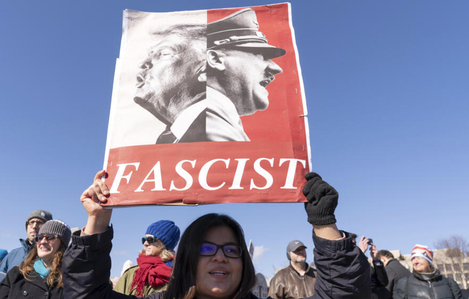
The conclusion of this midterm political critique presents a stark and historic warning about the trajectory of American governance. Opponents argue that Donald Trump has essentially destroyed the traditional Republican Party, erasing core conservative principles like free trade, fiscal restraint, and constitutional checks and balances. In their place, he has constructed a rigid, submissive cult of personality reminiscent of the authoritarian transformations seen in 1930s Europe under Adolf Hitler's Nazi Party.
Political scientists point to this transition as a textbook case of Gleichschaltung—the systematic coordination and forced alignment of all public and political institutions under a singular executive will. Just as traditional conservative factions in the Weimar Republic mistakenly believed they could control or tame the radical movement they allied with, the modern GOP apparatus has been completely swallowed by an autocracy that demands absolute fealty (Kadavergehorsam).
Fuelled by a messianic presentation of leadership, this shift toward domestic executive fascism is intrinsically linked to dangerous foreign adventurism in the Middle East. Under the guise of national security, the mechanisms of the state have been bent toward imperialist resource extraction. These conflicts are designed not to secure democratic ideals, but to project raw American power to forcibly steal natural resources from sovereign nations—a modern manifestation of Lebensraum through economic and military conquest that threatens to drag the global community into a wider war. Consequently, the Trump-aligned Republican Party no longer represents the values of traditional conservatism, but acts merely as the executors of an authoritarian agenda. These midterms have transcended standard partisan politics; they are fundamentally a critical, existential referendum on the preservation of constitutional democracy against the rise of fascism.

Comments
There are 0 comments on this post