
Tar Sands: Exxon Mobil profits, First Nations suffer

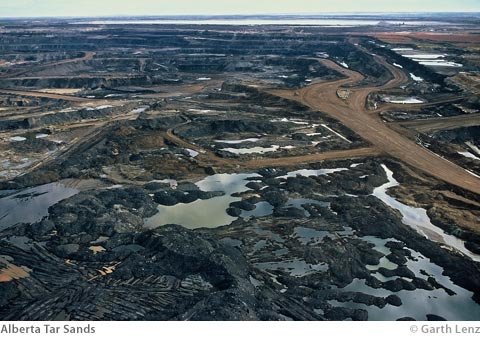



The tar sands mining project in Alberta, Canada, is possibly the largest industrial project in human history and critics claim it could also be the most destructive. The mining procedure for extracting oil from a region referred to as the "tar sands," located north of Edmonton, releases at least three times the CO2 emissions as regular oil production procedures and will likely become North America's single largest industrial contributor to climate change
Most of the oil produced by the project will likely be consumed by the United States, a country that, along with Canada, is already heavily invested, on many levels, in the project.
The project is operated by Imperial Oil, whose parent company, ExxonMobil Canada, has a long-term production goal of more than 300,000 barrels of bitumen (extra heavy oil) per day. To do this, they will require new equipment to be shipped through the United States.
First Nations in Alberta, Saskatchewan and the Northwest Territories have claimed that traditional lands are being destroyed for tar sands exploration and extraction, and First Nations are not being included, or properly compensated for their lost and destroyed lands and water supplies.
Brett Haverstick with the group Friends of the Clearwater, said to Truthout. His group is a nonprofit whose mission states that it works to "defend the Idaho Clearwater Bioregion's wildlands and biodiversity through a forest watch program, litigation, grassroots public involvement, outreach and education."
"The tar sands themselves have been called the most destructive industrial project on the face of the plant for good reason," Stocks, whose group is active on four continents and growing, told Truthout, "The devastation of this mining to the Alberta boreal forest, the Athabasca River, the Athabasca Delta and the communities, both First Nations and not, have been well documented."
Indigenous communities both downstream from the tar sand mines in Canada as well as those along the proposed trucking route of the mining equipment are concerned about threats to their physical health, sacred sites and the health of their land base.
Some First Nations people who live downstream from the tar sands mines in Canada are reporting increased incidence of respiratory and cardiovascular diseases, multiple sclerosis and rare types of cancer due to toxic wastes leaching into the waterway from tailings ponds. Also arsenic, at 33 times the acceptable level, is being found in game meats that First Nations people rely on, as well as some animals being found with tumors and mutations.
The mining of the tar sands, being as much solid as they are liquid, requires great effort. The easiest method is strip mining, though some newer mines heat and dilute the bitumen underground to make it flow easier.
Once removed from the ground, bitumen is too viscous to flow through pipelines as conventional crude does, thus, it is next converted into synthetic oil to aid transport. These processes can use huge quantities of water and require so much electricity that one tar sand mine has considered building a nuclear power plant to power the mine itself.
Internet site reference:
http://www.tarsandswatch.org/aboriginal-rights
http://www.globalresearch.ca/index.php?context=va&aid=19284

Comments
There are 0 comments on this post