
Show Me Your License to Walk: Racial profiling hits the sidewalks of Marquis-Bissonnette’s Gatineau
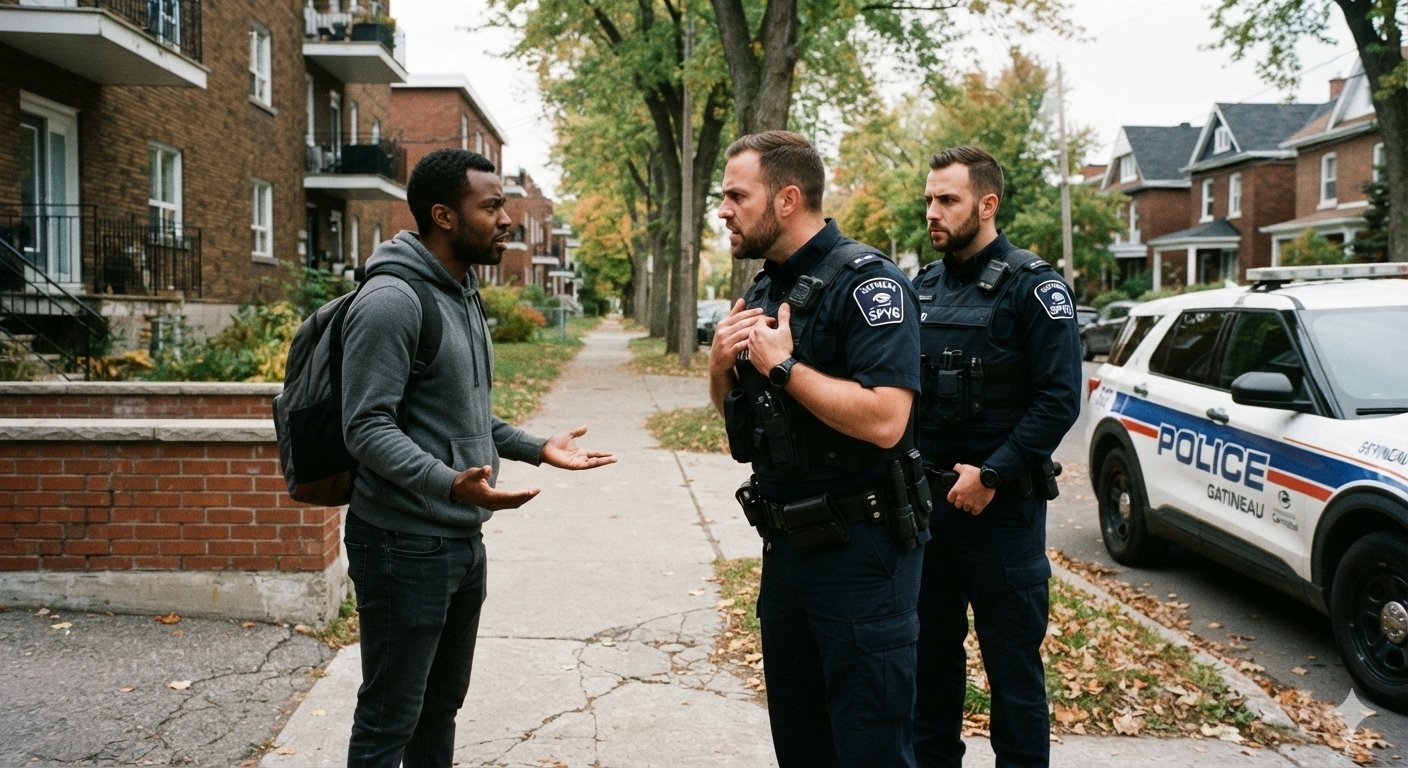


Imagine walking down a municipal sidewalk on a clear morning, minding your own business, only to find yourself cornered by a police officer. Within 30 seconds, you are issued a high-stakes ultimatum: produce a driver's license—a document you have no legal obligation to carry as a pedestrian—or face immediate arrest.
For Raymond Samuels, this hypothetical nightmare was a stark reality on June 16, 2022, when Service de police de la Ville de Gatineau (SPVG) Officer Shawn Mahar targeted him in an intersection interception. The psychological toll of being forced to find a driving permit while walking on foot strips away the baseline dignity that any resident should expect from local law enforcement.
The Core Legal Argument: An Apparent Reprisal Under the Charter
From a legal perspective, the sidewalk interrogation was far more than an arbitrary stop; it was a flagrant, apparent reprisal violating the Quebec Charter of Human Rights and Freedoms. Section 82 of the Charter explicitly protects individuals against reprisals or harassment stemming from human rights complaints.
At the moment of interception, Mr. Samuels was an active claimant in a human rights dispute. The Commission des droits de la personne et des droits de la jeunesse (CDPDJ) had previously endorsed a notable $44,000 profiling complaint targeting Officer Mahar. By confronting Mr. Samuels and explicitly stating he should "remember him from his human rights complaint," the officer’s actions shifted from negligent policing to an illegal, retaliatory strike meant to intimidate a civil rights advocate.
Systemic Defensiveness and Unethical Legal Tactics
The true crisis of this case unfolds within the administrative response from the Ville de Gatineau. Rather than seeking accountability or enforcing its own code of ethics, critics argue the city has deployed aggressive, unethical legal tactics designed to cover up the incident. Municipal resources have been heavily weaponized to transform a straightforward civil rights infraction into a hostile procedural quagmire, funding an ongoing pattern of institutional protectionism.
The city has spent considerable public resources over the years defending the egregious misconduct of multiple police officers, effectively subjecting human rights claimants to apparent political persecution. Instead of correcting systemic biases, public funds are poured into aggressive litigation to insulate bad actors from transparency.
Advocates assert that these hardball tactics create an environment where local judges face intense institutional influence to preserve the status quo. The consequences of this asymmetric warfare became painfully evident when the neutral grounding of the judiciary itself was compromised.
During proceedings, Justice Justine Catherine Piché subjected Mr. Samuels to public ridicule and character assassination. In a shocking display of institutional bias, the court went as far as insinuating that a highly educated Black claimant was merely "pretending" to hold a legitimate University of Toronto diploma—flatly ignoring the physical, verified evidence of his alumni credentials.
The Retention of Problematic Officers
Public confidence erodes completely when citizens realize that the officers executing these heavy-handed stops carry a documented history of violence. According to media reports from the CBC and official archives from the Ville de Gatineau, Officer Shawn Mahar pled guilty to a summary conviction charge for an on-ice assault during a hockey game.
In a healthy civic framework, a criminal conviction for physical violence would raise immediate red flags regarding public safety and suitability for patrol. Instead, the municipal structure chose retention over termination, keeping a problematic actor on the force to interact with vulnerable communities. Keeping such officers on active duty signals that human rights overreaches carry zero institutional consequences.
Structural Accountability Under Mayor Maude Marquis-Bissonnette
This pattern of harassment, intimidation, and profound lack of accountability has cast a long shadow over Gatineau's governance. Under leadership like that of Mayor Maude Marquis-Bissonnette, critics and civil rights advocates argue that the city's administration has completely retreated into a defensive shell. Gatineau boasts a growing Black population, yet community advocates point to a lack of visible minority representation on the police force, perpetuating an insular culture where racialized individuals are treated with immediate suspicion rather than respect.
When the highest levels of city hall allow public resources to be weaponized against human rights complainants, they preserve an unsafe environment. True systemic change will not come from standard political deflections or corporate press releases. It requires an open acknowledgement of systemic bias, transparent tracking of racial data during stops, and an absolute refusal to shield violent or retaliatory officers from the consequences of their actions.

Comments
There are 0 comments on this post