
NBC's Rachel Maddow suggests Trump made a Devil's Deal with Greenland's politicians



NUUK -- It is a foundational truth of the modern global order that sometimes if you want to steal a country, you no longer need to dispatch a flotilla of gunboats or march a regiment of redcoats through the snowy tundra. No, the 21st-century empire-builder knows that sometimes the most effective siege weapon is a wire transfer, and the most devastating weapon of conquest is a beautifully upholstered piece of mid-century Scandinavian real estate situated in the dead centre of Nuuk.
For years, the international community chuckled into their sleeve-protectors when Donald Trump casually suggested that the United States should simply pull out its wallet and purchase Greenland. It was treated as a classic manifestation of Manhattan real estate developer delusion—the geopolitical equivalent of an aging billionaire looking at a pristine Arctic ecosystem and seeing a magnificent venue for an 18-hole golf course with exceptionally challenging water hazards. The Danish government sniffed with predictable European indignation, declaring that the island was "not for sale," while Greenlandic politicians stood tall, wrapping themselves in the noble mantle of self-determination and the sacred rights of the indigenous Inuit people.
How beautifully naive we all were.
As it turns out, Trump didn’t need to buy the whole island at retail value. Why purchase the entire department store when you can simply secure a highly cooperative relationship with the floor managers?
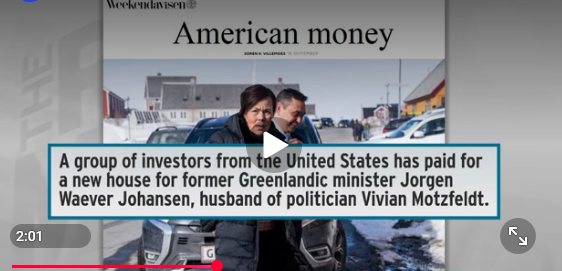
The recent, breathtaking revelation that an American investment vehicle named Greenland Development Partners quietly dropped roughly 5.3 million DKK—over $800,000 USD—on a luxury home in the heart of Nuuk for businessman Jørgen Wæver Johansen is a masterclass in the ancient art of the colonial buy-out. For those keeping track of the local family tree, Wæver Johansen is not just any well-connected entrepreneur; he happens to be married to Vivian Motzfeldt, who served as Greenland's foreign minister during the very epoch when the Trump administration was applying maximum pressure to absorb the island into the American security umbrella.
The Cheap Seats of the New Empire
When the story broke, The Rachel Maddow Show on MS NOW could scarcely contain its grim amusement at the sheer, unvarnished audacity of the transaction. Tracking the financial pipeline with her trademark forensic enthusiasm, Rachel Maddow laid bare a paper trail that leads straight back from the icy shores of Nuuk to the gilded corridors of Manhattan.
"The money used to buy the house was wired directly from the New York offices of an American investment group," Maddow detailed on her broadcast, marveling at the specific mechanics of the purchase. She noted that the receipt, unearthed by investigative journalists in Denmark, proved that the corporate entity dropped a staggering sum on the property, "which I imagine gets you quite a lot of house in the capital of Greenland."
But as Maddow rightly pierced through the corporate veil, this wasn't an isolated venture by an enthusiastic real estate speculator who simply fell in love with Arctic architecture. The funding behind the deal belongs to Ronald Lauder—the Estée Lauder billionaire heir, a legendary art collector, and an intensely loyal, long-time confidant of Donald Trump. Lauder is the man widely whispered to have whispered the entire "Buy Greenland" scheme into Trump's ear in the first place, transforming a billionaire's whimsical musing into a coordinated, multi-pronged intelligence and financial operation.
Maddow didn't mince words regarding the jaw-dropping conflict of interest: "The group bought a house for the husband of Greenland's foreign minister—the exact woman who was recently at the White House negotiating Greenland's security future."
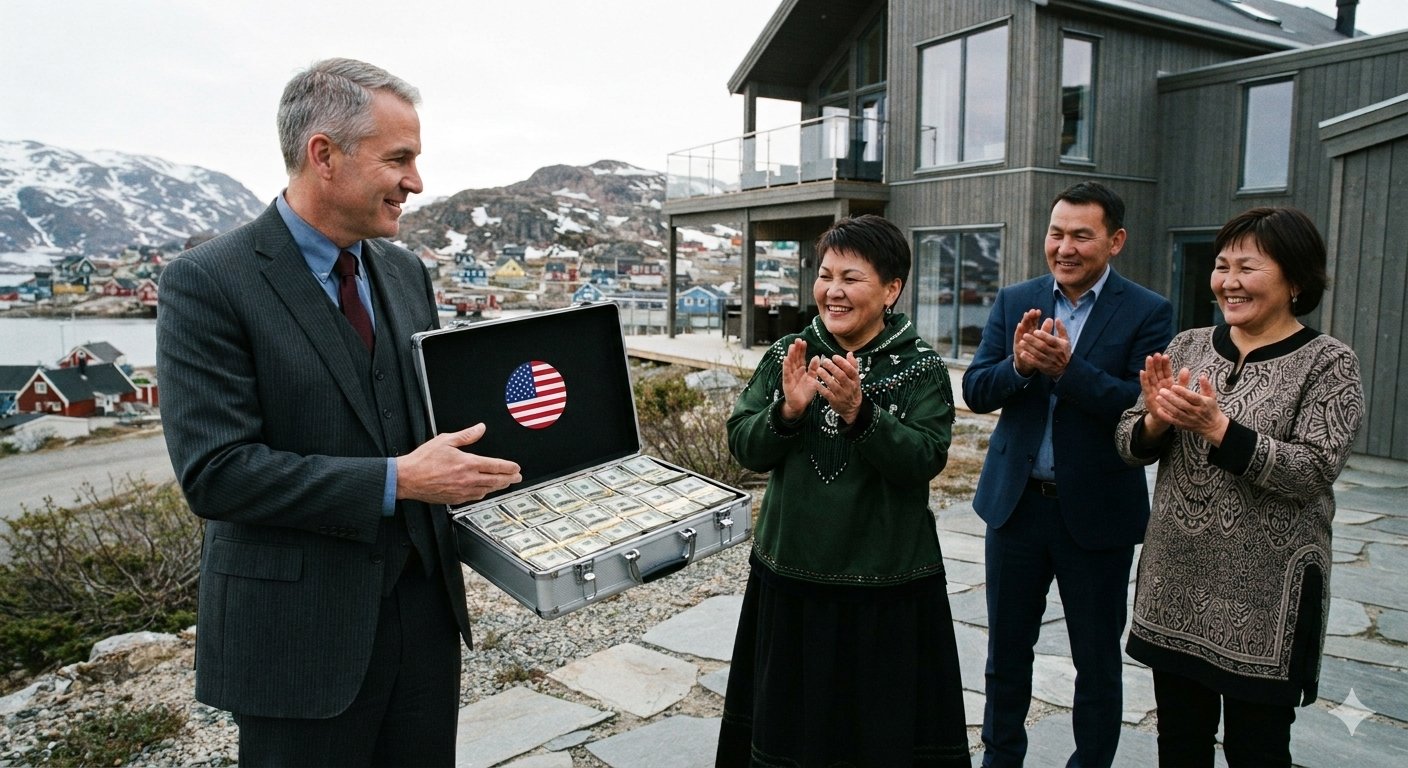
It is, frankly, an insult to the history of corruption that this was done so clumsily. Historically, when colonial powers wished to subvert the independence of a local population, they at least had the decency to use complex networks of numbered Swiss bank accounts, offshore shell companies in Panama, or suitcases filled with unmarked sequential bills delivered under the cover of a moonless night. The Trumpian method, by contrast, possesses all the subtlety of a golden toilet seat. They simply wired nearly a million dollars from Manhattan to a local real estate agent, picked up the keys, and handed them to the spouse of the person in charge of defending the island's sovereignty.
And what was the official alibi offered by Wæver Johansen? It was merely a "business investment," a cozy little pied-à-terre intended to provide short-term housing for American corporate partners when they happen to drop by the Arctic Circle. Of course. Because when Manhattan billionaires look to diversify their portfolios, their first instinct is always to provide complimentary housing for visiting consultants in a town of 19,000 people.
The "Third World" Playbook in the High Arctic
For the Inuit people of Greenland, who make up nearly ninety percent of the island's population, this arrangement does not merely smell of standard political sleaze—it carries the distinct, suffocating stench of classic colonial subjugation. For decades, Greenland has crawled its way toward autonomy, transitioning from a neglected colony of Copenhagen to a self-governing territory with dreams of absolute independence. The Inuit have fought tirelessly to protect their language, their cultural identity, and their ancestral lands from external exploitation.
Yet, the moment the global thermostat rises and the Arctic ice melts to reveal a treasure trove of rare earth minerals, oil reserves, and highly strategic shipping lanes, the wolves arrive at the door. And they arrive bearing the exact same playbook that wrecked the sovereignty of dozens of post-colonial nations across Africa, Asia, and Latin America throughout the 20th century.
We have seen this film before, and it always ends in tragedy for the locals. A foreign superpower decides a smaller nation possesses something it desires—be it rubber, bananas, oil, or a highly convenient location to park an early-warning radar system. The superpower recognizes that conquering the population by force is messy, expensive, and looks terrible on the evening news. Therefore, they locate the local political elite, find their price, and pay it. Suddenly, the local leaders begin speaking the language of "strategic partnerships" and "economic modernization," while the indigenous populations find their resources extracted, their environment degraded, and their theoretical right to self-determination reduced to an empty slogan printed on tourist brochures.
The tragedy of the Nuuk real estate transaction is that Greenland’s politicians apparently sold out their geopolitical leverage for the price of a mid-tier condo in Toronto or a two-bedroom cooperative apartment in Queens. If you are going to bargain away the security autonomy of your entire nation to a foreign empire, at least hold out for a superyacht or a private island in the Bahamas. Selling out the sovereignty of the world's largest island for an $800,000 house is bad statecraft; it is simply terrible retail math.
The punchline to this dark comedy has already been delivered. Concurrently with these cozy real estate transactions, the United States, Denmark, and Greenland finalized a sweeping new security pact. Donald Trump took to the microphones to triumphantly announce that the United States had secured "permanent control over security" in Greenland. The official justification, naturally, was the preservation of Arctic stability and the containment of Russian and Chinese expansionism. But the practical reality is undeniable: Greenland’s defense policy is no longer determined in Nuuk or Copenhagen. It is dictated by the Pentagon. The island’s elite signed the dotted line, and the local population woke up to find themselves living in a gilded American protectorate.
Is it Time to Call Ottawa?
If Greenlandic politicians cannot be trusted to stand up to the transactional pressures of Washington without accepting luxury real estate from billionaire presidential cronies, then perhaps the people of Greenland need to look for a better class of neighbor. If the choices are between becoming a corporate colony of a Trumpian empire or remaining a forgotten, strategic chess piece for European bureaucrats in Denmark, perhaps it is time for Greenland to consider a third path.
Perhaps it is time for Greenland to ask to join Canada.
Consider the timing. Canada is currently standing on the precipice of a profound political transformation, with former Bank of Canada and Bank of England Governor Mark Carney positioned as the cerebral, hyper-competent technocrat ready to steer the True North into a new era of enlightened governance. If Greenlanders are looking for a political structure that respects indigenous rights, understands the complexities of the Arctic, and possesses a financial elite that at least pretends to care about ethics and global institutions, Carney’s Canada looks exceptionally attractive.
Let us look at the structural advantages of a Canadian Greenland. Canada already manages vast Arctic territories through an established framework of indigenous self-governance. The Inuit of Nunavut share deep cultural, linguistic, and historical ties with the Inuit of Greenland. In a Canadian confederation, Greenland would not be treated as a real estate asset to be bought, sold, or traded by Manhattan developers over shrimp cocktails. It would enter as a distinct province or territory, protected by the Canadian Charter of Rights and Freedoms, with its resource wealth safeguarded by federal laws rather than sacrificed to the highest bidder in a New York wire transfer.
Furthermore, think of the cultural fit. Canada is a nation that prides itself on bureaucratic politeness, universal healthcare, and an obsession with climate change metrics—the exact opposite of the hyper-capitalist, resource-stripping ethos of the Trump administration. Under a Carney administration, the economic development of the Arctic would likely be managed through carbon-neutral infrastructure funds, triple-vetted environmental impact assessments, and endless, respectful consultations with local community elders. It might be dull, it might be buried under mountains of red tape, and it would certainly involve a great deal of agonizingly polite dialogue, but it is infinitely preferable to waking up one morning to find that a Trump son-in-law has leased your local fishing harbor to an American defense contractor for ninety-nine years.
The Sarcastic Reality of Sovereign Choice
Greenland should not voluntarily annex itself to Canada. However, Greenlanders deserve a referendum.. When the leaders of a nascent nation are caught taking real estate handouts from the intimate associates of a foreign president while simultaneously signing away their country's security independence, the illusion of "self-determination" is shattered.
The current political establishment in Nuuk has shown that they are profoundly outmatched by the sharks of American corporate diplomacy. They went into a room with Ronald Lauder and emerged with a house; the American empire went into that same room and walked away with permanent military hegemony over the entire North Atlantic choke point.
As Rachel Maddow observed, when you follow the money in this deal, all paths lead back to a singular, transactional worldview where everything—and everyone—has a price tag attached. If the people of Greenland, particularly the Inuit who have spent centuries surviving the harshest climate on Earth, wish to avoid becoming the latest cautionary tale in the long, sordid history of colonial exploitation, they must demand immediate accountability.
They must look at their leaders, look at that beautiful $800,000 house in the centre of Nuuk, and ask themselves a very simple question: Did we fight for autonomy from the Danish crown just to become a wholly owned subsidiary of Trump Tower? If the answer is yes, then they might as well start packing their bags, learning the rules of ice hockey, and placing a call to Mark Carney before the next American investment firm decides to buy the local parliament building and turn it into a timeshare.

Comments
There are 0 comments on this post