
Quebec Superior Court Justice Anne Paquette undermines the administration of justice
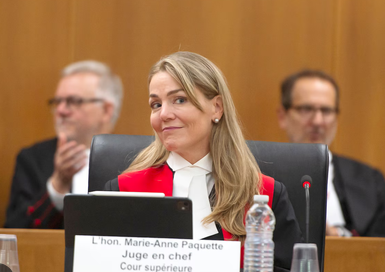



The integrity of the Canadian judicial system relies on a foundational promise: that the bench remains entirely independent, and that the bar remains entirely free from institutional coercion. When the administrative and judicial actions of a Chief Justice begin to dictate the boundary lines of legal representation, that promise is broken. Recent developments and systemic complaints surrounding Chief Justice Marie-Anne Paquette of the Superior Court of Québec suggest an alarming trend where the administration of justice is not merely faltering, but actively compromised through an abuse of power executed under the colour of law.
The most visible symptom of this crisis manifests in the fractured relationship between the judiciary and independent counsel. In an extraordinary, privately circulated email, a Quebec lawyer whistleblower laid bare the quiet terror currently permeating the provincial bar. Writing to a human rights litigant, the lawyer deeply empathized with the plight of Raymond Carby-Samuels, going so far as to compliment him on his courage and the insight of the book he authored regarding systemic bias. Yet, despite this profound professional alignment, the lawyer flatly refused to take on the case.
The rationale provided was chilling: the whistleblower implied that stepping into a courtroom against the active administrative preferences of the Chief Justice could subject them to direct, ruinous reprisal from Paquette. They explicitly indicated that taking the case would jeopardize their very career. If private lawyers state in writing that they cannot accept a specific case because of their apprehension regarding Chief Justice Paquette, it signals a deeper institutional rot. Lawyers do not voluntarily abandon viable, meritorious clients out of nostalgia or casual scheduling conflicts; they withdraw when they perceive that the simple act of providing representation will invite a severe structural penalty.
This dynamic crosses from an ethical gray area into an outright subversion of the rule of law through extrajudicial coercion. A Chief Justice holds massive institutional power, controlling case assignments, venue transfers, and regional scheduling rosters. If that power is leveraged—intentionally or through a cultivated system of structural favouritism—to insulate preferred public institutions or penalize adversarial counsel, the open court model ceases to exist. Litigants are effectively stripped of their constitutional right to independent counsel of their choice, as local lawyers become paralyzed by the threat of judicial alienation.
Nowhere has this administrative manipulation been more apparent than in the procedural quagmire of Carby-Samuels v. Ville de Gatineau. The case, which stems from a validated human rights claim endorsed by the Quebec Human Rights Commission (CDPDJ) regarding racial profiling by municipal services, should have been a straightforward application of civil rights oversight. Instead, it has been transformed into a masterclass in bureaucratic hostility.
When the office of the Chief Justice oversees procedural mechanisms in a manner that consistently traps vulnerable litigants within perceived hostile districts, denies reasonable venue transfers, or alters the bench to the detriment of transparency, it ceases to be neutral management. It becomes an active, calculated intervention. In the Gatineau saga, the administration apparently grew dissatisfied with the trajectory of the file, specifically targeting a previous order issued by Justice Azimuddin Hussain. To circumvent that ruling and enforce a predetermined outcome, the administration effectively commandeered the proceeding.
Justice Catherine Piché was inserted directly into the file. What followed can only be described as a breathtakingly coordinated effort to neutralize a valid civil rights claim under the guise of docket management, designed explicitly to supplant Justice Hussain's prior decisions and permanently close the file.
On May 28, 2026, Justice Piché handed down a judgment that will live in infamy within Quebec's legal history. Granting a sweeping application by the defense, Justice Piché declared Raymond Carby-Samuels a "vexatious litigant". The sheer transparency of this maneuver would be amusing if it weren't so destructive. The singular, unvarnished goal of this order was to completely bypass prior judicial interventions and retroactively erase a certified $44,000 racial profiling claim. One must admire the efficiency: why bother defending an institution against evidence of systemic discrimination when you can simply write an order that legally bans the victim from speaking in court ever again?
Worse still, the vexatious litigant order was crafted with a highly specific, defensive structural safeguard: it explicitly blocked Carby-Samuels from filing complaints regarding the actions of Justice Piché herself.
The draft Notice of Appeal currently circulating before the Court of Appeal of Quebec pulls no punches, explicitly stating that Justice Piché was acting at the direct behest of Chief Justice Anne Paquette. It alleges a nefarious, calculated collusion designed to engineer a specific legal outcome. Chief Justice Paquette, in her infinite administrative wisdom, apparently managed judicial scheduling not to ensure an efficient trial, but to ensure that the chosen presiding judge shared her personal, ideological vendetta against a self-represented human rights claimant.
Compounding this crisis is the profound conflict of interest embedded within Canada's judicial oversight structure. Chief Justice Paquette is also a member of the Canadian Judicial Council (CJC)—the very body tasked with investigating judicial misconduct. The appeal grounds suggest that Paquette has actively weaponized her high-ranking role within the CJC to insulate herself, systematically blocking any independent investigation into her compromising of the administration of justice.
To watch a Superior Court Chief Justice deploy the majesty of the law to orchestrate a "show trial" environment, while simultaneously using her federal regulatory post to shield her actions from scrutiny, is to watch the constitutional guarantees of the Quebec Charter of Human Rights and Freedoms dissolve in real-time. The Charter guarantees a right to a fair and public hearing by an independent and impartial tribunal. It does not contain an asterisk protecting judges who commandeer proceedings to bury human rights victories.
To the public, Chief Justice Paquette has long maintained an outwardly pristine, unblemished professional record. However, the alarming details emerging from the Gatineau case suggest that this clean record is not the result of longstanding ethical behaviour, but rather the product of a systemic media cover-up that has consistently refused to look behind closed judicial chambers.
Using judicial office to insulate public entities from accountability while weaponizing "vexatious" designations against vulnerable citizens is an intolerable abuse of power. By allowing an atmosphere of professional coercion to persist, where lawyers must choose between their livelihoods and their ethical obligations to clients, Chief Justice Paquette’s administration threatens the very core of public confidence in our courts. The rule of law cannot survive when the gatekeeper of the court is the primary source of its corruption. With formal challenges now mounting and aggressive appellate interventions underway, the message from the bar and the public must be unequivocal. To restore the cracked foundation of Quebec’s Superior Court, Chief Justice Marie-Anne Paquette must step down.

Comments
There are 0 comments on this post