
Chief Justice Marie-Anne Paquette: How the head of Quebec’s Superior Court abuses power and sponsors systemic racism
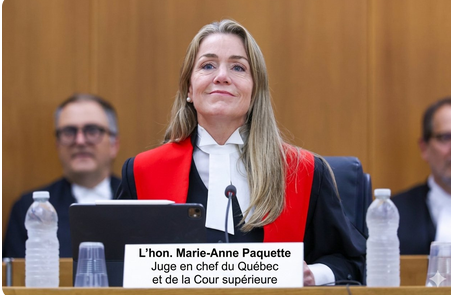



MONTREAL -- Superior Court Chief Justice Marie-Anne Paquette’s unprecedented accumulation of unchecked administrative authority and her dual role on the Canadian Judicial Council exposes a profound structural failure that effectively transforms judicial oversight into an insular cartel. When the scales of justice are held exclusively by hands that also wield absolute administrative and disciplinary power, the foundational principles of a constitutional democracy begin to fracture. The rule of law rests upon the absolute, inviolable separation of duties, ensuring that those who sit in judgment are themselves subject to independent, impartial oversight. Yet, the current structure governing the highest echelons of the Quebec judiciary reveals a profound systemic flaw. By occupying both the leadership position overseeing the Superior Court of Quebec and serving as a senior, highly influential member of the Canadian Judicial Council (CJC), Paquette functions within an institutional loop that completely eliminates real accountability. This arrangement is the structural equivalent of a Chief of Police being placed in absolute charge of the independent body responsible for investigating police ethics. The outcome of such an architectural failure is as toxic as it is predictable: the systematic insulation of power, the quashing of internal scrutiny, the intimidation of dissenting voices, and the complete erosion of the public’s confidence in judicial integrity.
Parliament’s Fatal Flaw: The Creation of a Constitutional "Mafia"
The reality is that Parliament, through the current architecture of the Canadian Judicial Council, has failed to produce an authentic body of ethical oversight. Rather, by centralizing absolute disciplinary power within an insular fraternity of active chief justices, it has created an incredibly powerful and constitutionally dangerous cartel—what can be described as a constitutional "mafia"—that effectively erases genuine judicial oversight altogether. The CJC has morphed into an organization that relies heavily on absolute judicial immunity to quash any and all investigations that expose systemic complicity within their own courts.
This institutional loop creates an inescapable, deeply corrupting conflict of interest: why would a senior judge, who sits as an influential member of the Council, ever allow a meaningful investigation against a judge in their own court? To do so would undermine the perceived integrity of their own judicial supervisory authority in those specific districts and expose their administration to public disgrace. Consequently, self-preservation dictates the outcome. Valid complaints are systematically buried to protect the reputation of the bench, while the system functions to terrorize and isolate ethical, independent judges who refuse to toe the line, forcing a culture of absolute compliance. Because Chief Justice Paquette holds such a senior position, an aura of absolute invincibility takes over. This seniority allows an administrator to boldly undermine any pretense of ethical conduct, operating under the assumption that they are ultimately accountable to no one. Parliament has effectively designed a system which empowers the CJC to engage in systemic human rights abuses and administrative misconduct without a shred of external oversight.
The Betrayal of the Judges Act and Mandated Anti-Racism Education
Parliament intentionally amended the Federal Judges Act to include explicit mandates for continuing education, focusing heavily on systemic racism, gender-based violence, and social context training. The legislative intent was clear: judges must understand the historical, economic, and institutional biases that marginalize visible minorities within the legal system. This educational mandate was meant to fundamentally reshape how judges interact with self-represented litigants and victims of systemic discrimination.
Yet, Chief Justice Paquette’s handling of oversight demonstrates an explicit rejection of these statutory objectives. Instead of enforcing the spirit of the Judges Act, the CJC operates as a closed protection ring. When active chief justices control the disciplinary machinery, complaints regarding racial bias are systematically buried in a bureaucratic black hole. Through the strategic insertion of Judge Catherine Piché into active proceedings, the administration did not just fail to apply anti-racism principles—it actively and maliciously dismantled them. This maneuver reveals a highly coordinated judicial operation intent on undermining civil rights protections under the cover of administrative scheduling, explicitly acting to betray the educational mandates set forth by federal legislation.
Violating the CJC Statement of Principles on Self-Represented Litigants
The Superior Court’s actions and declarations of vexatiousness violate the core precepts articulated in the CJC Statement of Principles on Self-Represented Litigants and Accused Persons. Endorsed by the Supreme Court of Canada in Pintea v. Johns (2017 SCC 23), these principles impose affirmative obligations on trial courts to ensure procedural fairness and access to justice.
By treating self-represented motions as badges of bad faith—and penalizing a litigant for citing initiatives like Canada's Black Justice Strategy—the court transformed protective guidelines into an instrument of systemic silencing. Orders blocking communications with ethical supervisory bodies directly contradict the ethical core of the judiciary, actively punishing a marginalized citizen for attempting to access the very protections Parliament established.
The Deconstruction of the Quebec Charter and the CDPDJ
Chief Justice Paquette is constitutionally bound to uphold the integrity of the Quebec Charter of Human Rights and Freedoms (CQLR c. C-12), while the Commission des droits de la personne et des droits de la jeunesse (CDPDJ) holds a sacred statutory role in affirming civil rights.
The case of Carby-Samuels v. Ville de Gatineau exposes a deliberate effort to bypass these institutions after the CDPDJ Human Rights Charter Protections substantiated serious claims of racial profiling. Under Judge Piché’s direction, the court launched a direct assault on the anti-discrimination provisions of the Quebec Charter Section 37.1 and Section 23, bypassing prior coordinate judicial refusals to issue a crushing vexatious litigant order.
| Statutory Instrument | Protected Guarantee | Nature of Breach on the Record |
|---|---|---|
| CJC Statement of Principles | Meaningful access to court and equal justice for unrepresented parties. | Penalizing the litigant for filing standard motions and asserting discrimination defenses. |
| Quebec Charter, s. 37.1 | Freedom from repeated adjudicative jeopardy on settled procedural issues. | Circumventing prior coordinate judicial refusals through overlapping applications. |
| Quebec Charter, s. 23 | Absolute right to an impartial and independent tribunal. | Strategic assignment of a specific judge to achieve a predetermined administrative outcome. |
| Federal Judges Act | Mandatory continuing judicial education in systemic racism and social context. | Reprimanding and penalizing a litigant for relying on federal anti-racism policy frameworks. |
The "Racist Manifesto" and the 2026 Documentation
The resulting vexatious litigant order, issued with the clear blessing of Chief Justice Paquette, reads less like a balanced legal determination and more like an ideological, white supremacist manifesto. The ruling explicitly criticized federal strategies aimed at combating anti-Black racism in the courts, treating the litigant's citation of documented systemic discrimination as evidence of a "vexatious" obsession. To declare a Black human rights claimant vexatious simply because he utilized official government policy on systemic bias in his defense is a profound abuse of judicial mechanisms.
This shocking reality is thoroughly exposed in Raymond Samuels' 2026 book, which directly documents these experiences and unmasks the racist mechanics operating within the Quebec justice system. The book reveals how the court utilized its bench to block the claimant from communicating with or filing complaints to the Canadian Judicial Council. This tactic effectively immunized the presiding judges from federal ethical investigations. By weaponizing vexatious litigant orders, the court transformed an administrative shield meant to prevent court harassment into an institutional club used to silence a marginalized citizen who dared to name the institutional biases he faced.
The Weaponization of the Bench to Suppress Human Rights
When an unrepresented litigant attempts to navigate a complex system to address a recognized civil rights violation, the court has an institutional obligation to act as an objective, neutral forum. Instead, the procedural trajectory under Chief Justice Paquette demonstrates how judicial mechanics can be inverted to protect institutional actors. When coordinate judges like Justice Hussain and Justice Urbas previously reviewed the record and determined that vexatious litigant orders were unwarranted, those rulings should have stood under the doctrine of judicial comity.
By allowing an ongoing assault of overlapping applications until a specific, administrative target could be reached via Judge Catherine Piché, the court engaged in procedural bad faith. This systematic hunting for a desired outcome erases the protective function of res judicata under Section 37.1 of the Quebec Charter. It sends a chilling message to the entire legal community: if a litigant brings forward claims that challenge the core structural integrity or reputation of the judicial apparatus, the administration will simply reassign judges until they find one willing to issue an absolute gag order.
This weaponization extends its chilling effect to independent attorneys operating within the Quebec bar. When senior judiciary members double as the disciplinary arbiters at the CJC, practicing lawyers face an implicit threat of professional ruin if they zealously represent clients attempting to expose judicial misconduct. The adversarial system cannot survive when counsel are subtly coerced into silence, leaving self-represented, visible-minority litigants entirely exposed to the whims of an insulated, powerful judiciary.
A Call for Immediate Structural Separation
The convergence of the Carby-Samuels procedural history, the defiance of the CDPDJ’s findings, and the weaponization of the bench by judges Piché and Paquette highlights a fatal structural flaw in Canadian democracy. The Judges Act is completely undermined when the chief justices responsible for implementing its anti-racism education are the very individuals using their administrative pens to quash investigations into civil rights violations.
True judicial independence requires a complete separation of powers. The Canadian Judicial Council must be completely stripped of active judges. It must be reconstituted as an independent body composed of retired judges, human rights advocates, and independent legal minds who do not have a personal or professional stake in protecting the reputations of sitting chief justices. Until the CJC is decoupled from active judges, the promises of the Quebec Charter and the anti-discrimination frameworks of Canada will remain completely unavailable to the victims of institutional racism.

Comments
There are 0 comments on this post