
Toronto's genius walk-up apartments

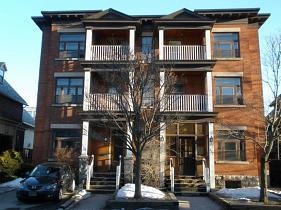


Toronto's housing market may be slowing down, but it’s been incredibly hot for a decade; still, developers haven’t done much to evolve the forms of housing in the city. There are still single-family houses (mostly in the suburbs), high-rise condos (everywhere), and not much in between. This big-and-small dichotomy is in keeping with the development history of Toronto; in the 1960s we went from building houses, almost exclusively, to building high-rise towers across the metro area. (And we’re now seeing how unwise that was.)
But other cities find a useful middle ground: walk-up apartment buildings. They are the fabric of most European cities and the best cities in North America. In Boston they take the form of three- and four-storey wood-framed buildings, with reasonably sized apartments. That's where architect and academic Tim Love hails from; head of the architecture/planning office Utile, he's teaching at U of T this year. And he may be helping to generate a new model for Toronto. A few weeks ago he and U of T profs Ivan Saleff (some of his work, PDF) and Robert Wright wrapped up their studio class on Walk-Up Urbanism. Their students came up with some brilliant and very practical designs for three- and four-storey buildings that would work on Toronto lots and would provide interesting and varied apartments, with decent outdoor space, all at a much lower cost than condos.
They’re going to release some of these designs soon in an online publication, and I’ll bring it to you then. I share the professors' hope that these proposals will help to spark new developments and even new developers, to fill a market niche - between the $300,000 studio and the $1-million house - that’s badly underserved. (One exception proves the rule: Quadrangle and Sorbara Group built walkups at Sixty Loft, at Bathurst and Front. They were reasonably affordable and they are quite handsome.)

More walkups would be, as Love told me, very good for the city. It would allow gradual and subtle intensification of the city’s less dense neighbourhoods. It would be ideal, in theory, for the city’s “Avenues†- the corridors along transit routes where we should be building for the next generation. (Mass numbers of these things are just what would be needed, as John McGrath argues, to make a new subway line viable. If city zoning and politics allowed for it, which they don’t right now.)
I also hope to see more innovation in general from the city’s developers this year. The construction and development industries, especially in Toronto, are way too risk-averse. I understand: nobody likes to gamble capital when they have the prospect of a big and predictable return. But people are looking for alternatives: homes that are contemporary, liveable, and not too expensive. It’ll be better for the future of the city if we see them soon.
Internet site reference: http://spacingtoronto.ca/2012/01/05/no-mean-city-step-up-toronto

Comments
There are 0 comments on this post