
Gatineau Mayor complicit in human rights abuses against the city's black population
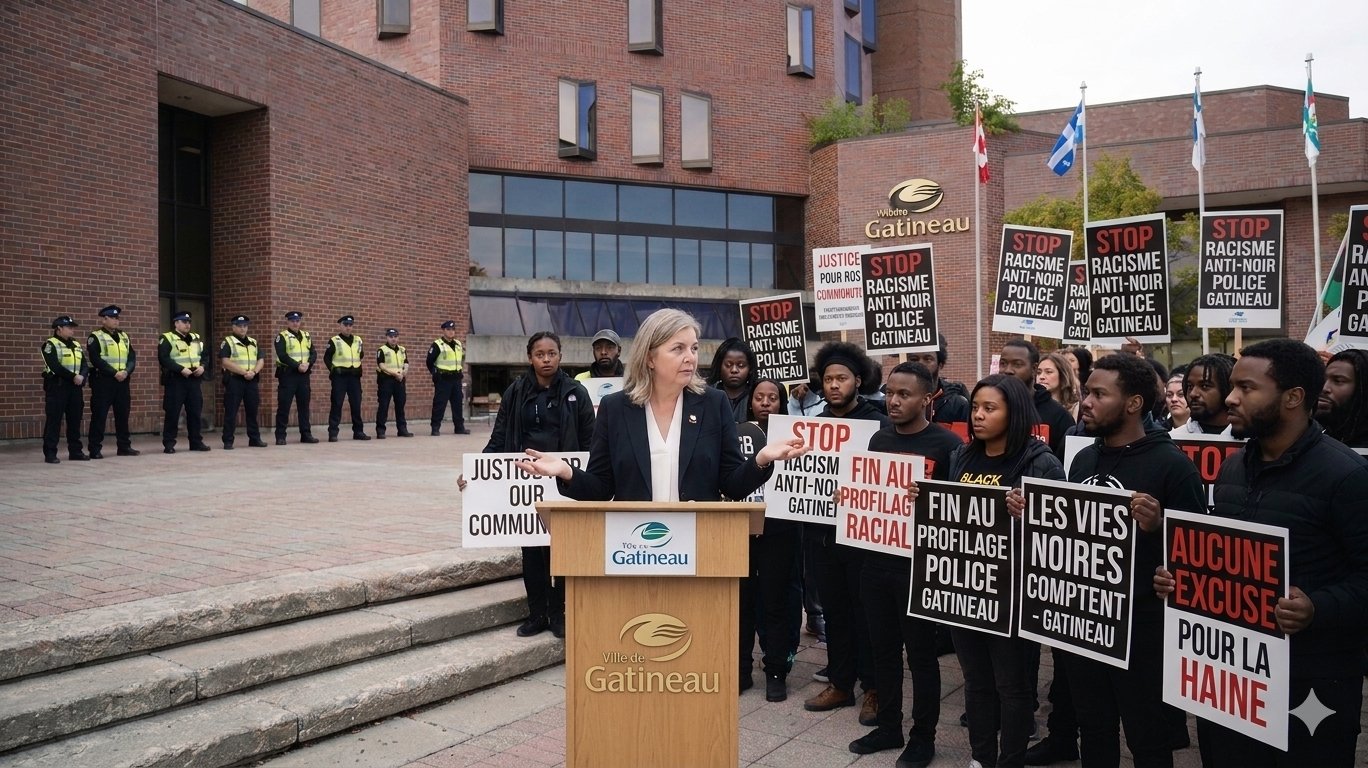
GATINEAU — Across Canada, the fight against racial profiling has exposed a deep rift between cities embracing true police accountability and those burying the problem under aggressive legal counter-attacks—a crisis highlighted in Gatineau where Mayor Maude Marquis-Bissonnette faces severe criticism for letting public funds be weaponized against Black civil rights claimants. While major municipalities across the country have taken visible, structural steps to acknowledge and redress anti-Black racism, the Ville de Gatineau under Marquis-Bissonnette's leadership has retreated into aggressive institutional defensiveness. A widening policy chasm has opened between the City of Montreal and the Ville de Gatineau, revealing a stark divergence in transparency, executive leadership, and human rights strategies.
While Montreal has moved toward structural acknowledgement and external auditing to dismantle racial profiling, Gatineau has drawn intense scrutiny for deploying predatory municipal litigation strategies. This administrative defence mechanism—most visible in the high-profile civil rights case Carby-Samuels v. Ville de Gatineau, et al. (File No. 550-17-012903-231)—utilizes public taxpayer funds to strip racialized litigants of court access, demonstrating how municipal machinery can be weaponized to suppress human rights complaints.
Systemic Acknowledgement vs. Bureaucratic Accommodation
The primary differentiator between an authentic anti-racism strategy and a surface-level compliance framework lies in the formal recognition of institutional bias. The City of Montreal has undergone a multi-year paradigm shift, transitioning from initial administrative denial to an explicit acknowledgement of systemic racism within the Service de police de la Ville de Montréal (SPVM). This recognition was driven by rigorous independent data collections confirming that Black, Indigenous, and racialized individuals are disproportionately targeted for arbitrary street checks and traffic stops. By formally anchoring its municipal policies in the vocabulary of systemic critique, Montreal has established a baseline of public accountability that permits independent scrutiny.
Conversely, the Ville de Gatineau has consistently resisted adopting an institutional critique of its law enforcement agencies. The municipal administration, under Mayor Maude Marquis-Bissonnette, relies heavily on generalized "diversity, equity, and inclusion" (DEI) templates. These frameworks treat discrimination as an individualized issue rooted in a lack of cultural awareness rather than a structural property embedded in policing tactics.
The Service de police de la Ville de Gatineau (SPVG) operates under multi-year diversity action plans that prioritize "know-how" and staff skills maintenance over hard accountability metrics. This bureaucratic insulation treats anti-racism as a public relations requirement. It successfully avoids addressing the realities of anti-Black racism, leaving racialized residents vulnerable to unchecked structural profiling.
Structural Police Reform and Accountability Metrics
The operational deployment of anti-racism policies reveals a corresponding divide in how municipal police forces are governed. Montreal's 2026–2030 Anti-Discrimination and Racism Plan features specific performance indicators tied directly to the career advancement of police commanders. The plan mandates the strict monitoring of internal risk behaviours, enforces documentation requirements for all public interventions, and establishes clear mechanisms to remove officers facing repeated, verified profiling allegations from field duties. Furthermore, Montreal's framework integrates an external oversight committee. This body is empowered to independently audit street-check data and verify compliance with provincial directives banishing arbitrary police stops.
Gatineau’s policing strategy offers no comparable mechanism for independent civilian validation. The city's current framework focuses on voluntary compliance, internal review boards, and recurring sensitivity training. This approach leaves the intake, investigation, and adjudication of racial profiling complaints under the exclusive control of the police department’s internal affairs division or basic municipal filters.
Without independent oversight, arbitrary stops—such as the targeted deployment of minor municipal or traffic infractions against Black pedestrians and motorists—are systematically categorized as routine law enforcement. This lack of structural accountability permits a culture of institutional protectionism to thrive, shielding discriminatory patterns from public transparency.
The Carby-Samuels Case: Weaponizing the Code of Civil Procedure
The operational realities of Gatineau's municipal defence apparatus are vividly illustrated in the ongoing litigation of Carby-Samuels v. Ville de Gatineau, et al.. The procedural history documented in the case file demonstrates a highly coordinated effort to transform a legitimate human rights complaint into a structural indictment of the victim's character. The case originated on July 5, 2022, when the Commission des droits de la personne et des droits de la jeunesse (CDPDJ) filed a claim before the Tribunal des droits de la personne (TDP) on behalf of Raymond Carby-Samuels. The original claim cited three distinct instances of discriminatory police profiling by Gatineau police officers.
Rather than allowing the claim to proceed to a full trial on the merits, the Ville de Gatineau deployed an aggressive litigation strategy designed to short-circuit the statutory protections of the Quebec Charter of Human Rights and Freedoms. Following a series of procedural disputes regarding language accommodations, self-representation challenges, and internal administrative breakdowns, the city launched an application under Article 55 of the Code of Civil Procedure (C.C.P.) to have the Black human rights claimant declared a "quarrelsome" or "vexatious" litigant.
On May 28, 2026, Superior Court Justice Catherine Piché granted the city's application. The court issued a sweeping, proactive prohibition that barred the claimant from initiating or maintaining any legal proceedings across the provincial court system without prior judicial authorization.
Crucially, the order extended beyond standard civil registries to restrict access to autonomous, specialized statutory bodies, including the TDP and the CDPDJ. As detailed in the appellant's subsequent Notice of Appeal, this blanket restriction effectively nullifies the statutory protections explicitly granted to minority litigants under Section 10 of the Quebec Charter, setting a highly damaging precedent for access to justice in the province.
Unconscious Bias and "Show Trial" Conditions in the Judiciary
The appellant's Notice of Appeal raises serious constitutional questions regarding the impartiality of the provincial judiciary when encountering self-represented Black litigants who aggressively assert their civil rights. The appeal contends that the trial process assumed the characteristics of a "Show Trial," operating outside the boundaries of established Canadian constitutional law. This breakdown of natural justice is most clearly seen in the trial judge's adoption of an ad hominem narrative that directly targeted the claimant's intellectual and educational background.
In the written reasons for judgment, Justice Piché declared that the appellant was "pretending" to possess university diplomas. The Notice of Appeal directly identifies this assertion as a symptom of deep-seated "unconscious bias" and systemic cultural prejudice. The appeal accurately notes that an individual's verified academic credentials are completely irrelevant to the objective statutory criteria used to evaluate structural abuses of process under Article 55 C.C.P..
By weaponizing a clear falsehood to construct a behavioural profile of "stubbornness" and intellectual "incongruity," the court abandoned its role as a neutral arbiter. This dynamic reveals a persistent systemic stereotype: Black human rights claimants who demand strict adherence to constitutional safeguards are frequently treated as inherently irrational, aggressive, or "quarrelsome" by the institutional machinery of the state.
Horizontal Stare Decisis and the Abuse of Municipal Funds
A central legal error identified in the challenge to the Gatineau judgment involves the flagrant violation of the principles of judicial finality and horizontal stare decisis. On April 2, 2025, Justice Azimuddin Hussain fully adjudicated a prior formal attempt by the defendants to have the appellant declared a quarrelsome litigant. Having weighed the identical historical filings and interpersonal grievances, Justice Hussain exercised his judicial discretion to explicitly deny the declaration of quérulence, opting instead to issue a case-management warning.
Despite this binding determination by a coordinate judge of the same court, the Ville de Gatineau re-launched identical vexatious litigant proceedings in August 2025 with no material change in circumstances. The appellant contends that this manoeuvre constitutes a transparent exercise in judge-shopping and a severe abuse of process.
By financing a second, repetitive procedural application to subvert a prior judge's decision, the city administration engaged in the exact "undue proliferation of proceedings" it claimed to oppose. This dynamic highlights a profound systemic irony: the Ville de Gatineau utilizes public municipal funds—drawn from a diverse tax base that includes a significant Black population—to finance repetitive legal attacks designed to silence Black residents who blow the whistle on municipal misconduct.
Language and Religious Accommodations as Symptoms of Vexatiousness
The Gatineau framework’s hostility toward equity is further evidenced by its characterization of fundamental constitutional requests as evidence of litigious abuse. Throughout the procedural history of File No. 550-17-012903-231, the appellant—an Anglophone litigant—repeatedly requested that oral and written submissions be translated into English, citing the foundational right of an individual to fully understand the language of the proceedings. Additionally, the claimant requested scheduling accommodations to respect religious observances, supported by formal documentation from his rabbi.
The trial judge explicitly interpreted these legitimate invocations of constitutional safeguards as evidence of a "quarrelsome" nature and an intent to obstruct justice. By penalizing a litigant for exercising fundamental rights entrenched in both the Canadian Charter of Rights and Freedoms and the Quebec Charter, the court created an objective apprehension of cultural and systemic prejudice.
While Francophones across Canada rightly enjoy state-supported court translation services, the Gatineau legal apparatus treated an Anglophone minority litigant's desire for reciprocal comprehension as an "extremely burdensome" judicial tactic. This conflation of rights-assertion with vexatiousness demonstrates how anti-racism policies in Gatineau are completely subordinate to municipal convenience and majoritarian legal norms.
Executive Complicity and the Failure of Municipal Leadership
The systemic suppression of human rights claimants in Gatineau cannot be understood purely as a consequence of judicial error or isolated legal manoeuvres; it represents a coordinated policy directed by the city's executive branch. The total silence and passive endorsement of these predatory litigation strategies by the Office of the Mayor indicate a profound institutional complicity. By allowing public funds to be used to block racialized residents from seeking statutory recourse against documented police misconduct, Mayor Maude Marquis-Bissonnette’s administration has effectively institutionalized anti-Black racism under the color of law.
This failure of executive accountability is compounded by a total lack of leadership among Gatineau's Black city councillors. Rather than acting as a check on municipal excesses or advocating for robust, independent civilian oversight of the SPVG, these elected officials have consistently failed to challenge the city's predatory legal strategies. Their silence leaves racialized communities entirely exposed to targeted municipal actions, underscoring an urgent need for an immediate, independent public inquiry into the administrative and judicial culture governing the Outaouais region.
Conclusion: The Path Forward for Access to Justice
The comparative analysis between Montreal and Gatineau demonstrates that the presence of abstract municipal policy documents is entirely meaningless without a corresponding commitment to structural accountability and natural justice. Montreal’s progressive transition toward external auditing and the explicit recognition of systemic profiling provides a baseline model for municipal reform. In sharp contrast, Gatineau’s administrative machinery operates as a cautionary tale of institutional protectionism, where the Code of Civil Procedure is weaponized to insulate municipal actors and law enforcement from constitutional scrutiny.
For the integrity of the Quebec legal system to be restored, the Court of Appeal must intervene to overrule judgments born from reasonable apprehensions of bias and jurisdictional overreach. True access to justice demands that independent statutory bodies like the CDPDJ remain entirely unencumbered by provincial Superior Court interference. Until local administrations are legally barred from using public taxpayer funds to pursue and silence human rights claimants, the promise of equal protection under the law will remain fundamentally broken for Black Canadians navigating the municipal governance of Gatineau.

Comments
There are 0 comments on this post