
Why Canada must step forward to broker peace in Ukraine
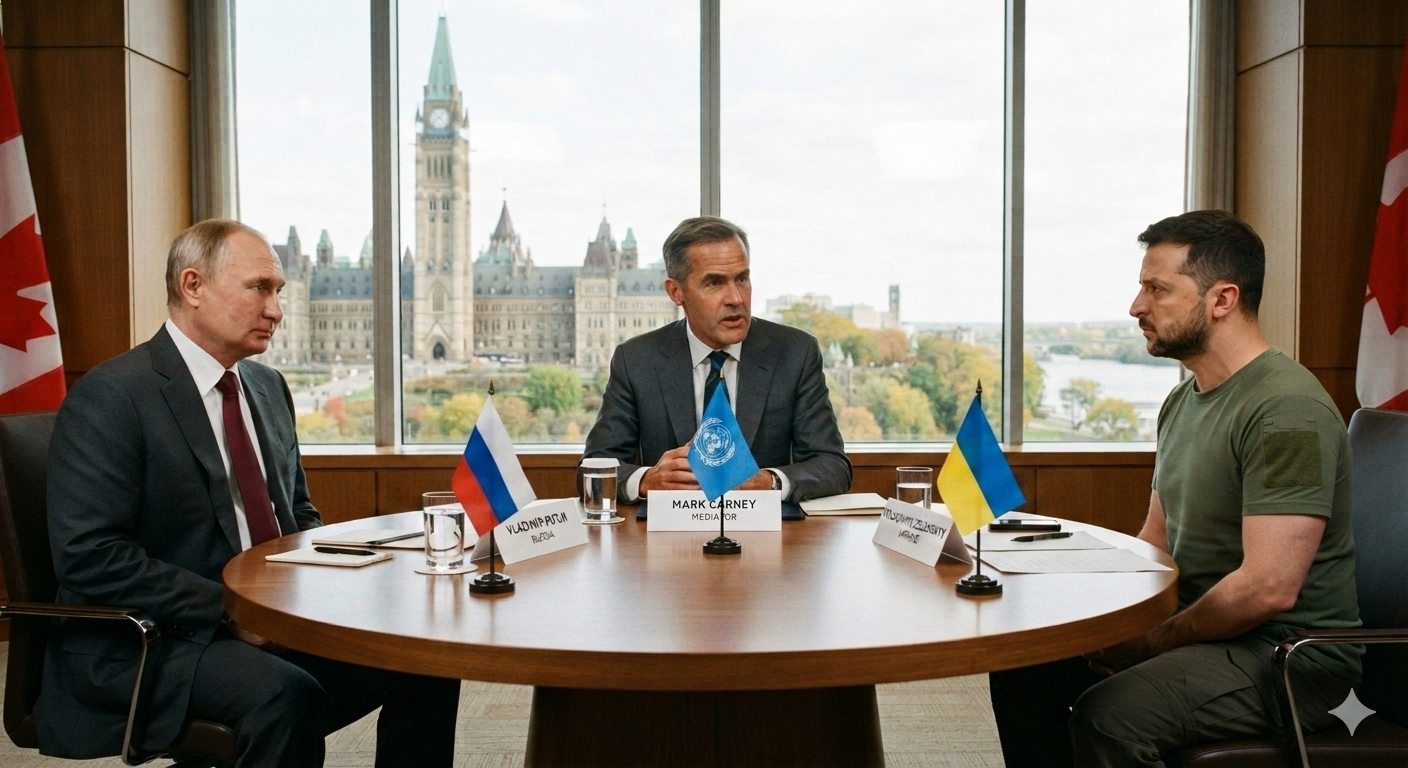



OTTAWA — As the catastrophic war between Russia and Ukraine continues to grind through its fifth year of exhausting attrition, draining global resources and fracturing international stability, Canada faces a profound, defining moment of geopolitical choice. For years, the federal government has chosen a comfortable but ultimately passive path of reactive politics. Ottawa has routinely signed major cheques, delivering billions of dollars to an overseas stalemate while aligning itself with a Western consensus that seems entirely devoid of a coherent exit strategy. Meanwhile, back at home, ordinary Canadian citizens are paying the price. They witness a steadily fracturing domestic economy, record inflation legacies, and an eroding social safety net that can no longer shield the vulnerable.
It is time for a radical, courageous pivot in our nation’s foreign policy. Canada must volunteer to act as the primary, independent mediator to negotiate a lasting peace settlement between Russia and Ukraine. By stepping into this vacant diplomatic arena, Ottawa can achieve a trifecta of historic victories: it can halt an exhausting economic drain, responsibly repatriate billions of taxpayer dollars to rescue our vital domestic social services, and leverage Canada's unique position of independence to achieve what no other country has managed to date.
To borrow a turn of phrase typical of The Globe and Mail’s own editorial board, “A nation’s global ambition must never outpace its domestic realities; true statesmanship lies not in the endless financing of overseas stalemates, but in the courage to broker the peace that brings our resources back home.”
The Domestic Toll of Foreign Expenditure and the Infrastructure Gap
Since the escalation of hostilities in Eastern Europe, Canada’s financial commitment to the conflict has been staggering. Billions of dollars in heavy military hardware, specialized ammunition, direct financial loans, and humanitarian assistance have been sent overseas—a massive ledger tracked meticulously by organizations like Global Affairs Canada. While the initial impulse to support an ally against sovereign aggression was noble and aligned with international law, the long-term economic reality for ordinary Canadian taxpayers has crossed the threshold from sustainable assistance into domestic neglect.
Every single dollar shipped across the Atlantic is a dollar pulled directly out of a domestic ecosystem that is crying out for structural reinvestment. An activist, interventionist foreign policy that prioritizes endless foreign defense spending is a luxury that a nation with crumbling domestic services simply cannot afford. True sovereignty must begin at home. If a state cannot guarantee the well-being, health, and security of its own people, its moral authority to police the rest of the globe is severely compromised.
Canada’s own public infrastructure is no longer just straining under pressure; it is actively fracturing under the weight of a severe fiscal burden. As noted by the Parliamentary Budget Officer (PBO), Canada's persistent deficits are projected to drive the federal debt-to-GDP ratio to an alarming 42.5 per cent by 2030-31. At the same time, authoritative reports from Oxford Economics reveal a staggering structural reality: Canada faces a US$34 billion annual infrastructure funding gap. To put this in perspective, Canada must mobilize a mind-boggling US$4.7 trillion in total infrastructure investments by 2050 just to keep its transportation, power grids, and community systems from failing entirely.
Consider the concrete realities that Canadians face daily while their tax dollars fund overseas conflicts:
- Healthcare Stagnation: Across every province, emergency rooms are facing chronic understaffing, leading to historic, dangerous wait times and rolling service closures. Healthcare workers are profoundly burned out, and specialized treatment backlogs continue to grow, yet provincial health transfers remain chronically underfunded relative to an exploding population.
- The Housing Crisis: Affordable housing has evolved from a complex policy challenge into a full-blown national emergency. An entire generation of young Canadians has been effectively locked out of homeownership, while families are squeezed by soaring rents and inaccessible mortgages, pushing thousands into homelessness or severe housing insecurity.
- Social Safety Nets: Municipal food banks from coast to coast are reporting record-breaking usage, struggling to keep pace with the needs of low- and middle-income citizens who can no longer afford basic groceries. Core welfare, disability programs, and mental health initiatives are similarly starved for resources.
- Municipal Infrastructure: Aging transit systems, clean water infrastructure, and community recreational spaces are desperately deferred across Canadian cities due to municipal budget shortfalls and a lack of robust federal matching grants.
By pivoting our national posture from being a primary financier of an open-ended war to becoming an active, neutral architect of peace, Canada can responsibly wind down its massive foreign military expenditures. These freed-up taxpayer dollars can then be immediately repatriated to stabilize provincial healthcare transfers, fund federal subsidized housing developments, and reinforce local community welfare programs that directly improve the lives of Canadians.
Toward a Canadian Superpower
As Canada navigates this era of internal rebalancing, the nature of our international ambitions must undergo a profound evolution. Prime Minister Mark Carney must lift Canada out of its traditional, self-limiting “middle power” status and actively transition the country into a contesting diplomatic superpower. This shift is not a matter of mere hubris; it is a vital strategy for national survival. Under the unpredictable pressure of a weaponised U.S. executive order framework—such as the recent Section 338 actions imposing punitive 50 per cent tariffs on Canadian goods—Canada faces an explicit economic threat. The aggressive economic, territorial, and sovereignty rhetoric from Donald Trump’s administration has raised the stakes dramatically, forcing Canada to build an unassailable shield against American annexation aggression.
To deter a heavy-handed Washington, Canada can no longer behave like a passive junior partner waiting for the rules-based order to fix itself. We must establish our own centers of gravity. Successfully volunteer-brokering a peace agreement between Russia and Ukraine would serve as the ultimate catalyst for this metamorphosis. Resolving a multi-year conflict that has completely stumped the United States, NATO, and European powers would immediately elevate Canada’s global standing. It would showcase a sophisticated degree of diplomatic acumen and autonomous leverage that demands absolute international respect. By demonstrating that Ottawa can wield geopolitical influence independently of—and more effectively than—Washington, a Canadian-led peace deal would secure our sovereignty, diversify our strategic partnerships, and assert Canada as an undeniable, self-determined force on the global stage.
The Global Vacuum: Why Traditional Arbiters Have Failed
To understand why Canada must step forward now, one must look closely at the profound vacuum of credible diplomatic leadership on the global stage. Previous attempts by other nations to mediate an end to the war have repeatedly faltered, primarily because those self-appointed moderators carry historic baggage or are deeply entangled in regional alliances that compromise their objectivity in the eyes of the combatants.
Major European players like France and Germany are inherently compromised in the eyes of Moscow. As core members of NATO and heavy suppliers of Ukrainian weaponry, they are viewed as active combatants by proxy rather than neutral arbiters. Their early attempts to broker dialogues were structurally undermined by their direct strategic stakes in the geopolitical outcome. Similarly, nations like Turkey and Israel have attempted to position themselves as bridges between East and West. However, Turkey’s position as a NATO member with complex Black Sea maritime ambitions, combined with Israel’s shifting domestic security crises, has prevented either nation from maintaining the singular, sustained focus and unassailable neutrality required to secure a binding, long-term treaty.
While countries like India, China, or Brazil have floated vague peace frameworks, their proposals are frequently viewed with deep suspicion by Kyiv and its Western allies. These nations are often seen as overly sympathetic to Moscow’s economic interests or driven by a desire to reshape the global order to their own advantage, rather than securing a just peace based on international law.
Furthermore, the shifting political landscape in Washington has fundamentally complicated the path to peace. With the United States administration under Donald Trump pursuing a highly transactional, erratic, and unpredictable approach to international alliances, the traditional Western diplomatic framework has fractured. Washington can no longer be viewed as a steady, reliable, or neutral arbiter of global stability. This geopolitical friction creates a profound, historic vacuum—one that a principled, wealthy, and stable middle power is uniquely equipped to fill.
Canada’s Unique Leverage and Credibility: Reviving a Historic Legacy
Canada possesses a distinct, overlapping set of geopolitical advantages that give it unparalleled leverage to reach a historic peace deal—outmatching any country that has attempted to moderate this conflict to date.
1. Strategic Independence from Washington
Canada’s relationship with the Trump administration allows Ottawa to chart a distinct, autonomous path. By establishing a clear, independent foreign policy stance that sits outside of Washington’s transactional maneuvers, Canada commands a rare form of global credibility. We are viewed internationally not as a blind proxy for American hegemony, but as an independent, rule-of-law nation capable of making balanced, sovereign decisions based on long-term stability rather than immediate political theatre. This independence gives Moscow a negotiating partner that is insulated from Washington's domestic hyper-partisanship, while simultaneously reassuring Western allies of a stable, democratic mediator.
2. The Power of the Diaspora
Crucially, Canada is home to one of the largest Ukrainian diasporas in the world. This deep, historic, and multi-generational connection means that Canada’s commitment to a fair, secure, and dignified peace for Ukraine is entirely beyond question. Unlike detached mediators in the Middle East or Asia, Canada holds a profound cultural understanding, structural empathy, and shared history with the Ukrainian people. This unique relationship gives Ottawa the trust and the necessary moral leverage to help Kyiv navigate incredibly difficult, painful concessions, ensuring that any brokered peace is durable, honorable, and protective of long-term Ukrainian sovereignty. Kyiv knows Canada will not sell out its future; Moscow knows Canada has the ear of the Ukrainian leadership.
3. Restoring the Pearsonian Tradition and Canadian Peacekeeping Legacy
For decades, Canada’s global identity was defined by the Pearsonian tradition—a foreign policy philosophy rooted in active mediation, constructive compromise, and international peacekeeping. Lester B. Pearson understood that a middle power’s greatest strength is not its military might, but its capacity to build bridges where empires see only walls.
The historical precedent for this is unassailable. During the 1956 Suez Crisis, the world stood on the precipice of a disastrous global conflict when Britain, France, and Israel invaded Egypt, triggering a furious standoff with the Soviet Union and the United States. While larger empires prepared for war, Pearson bypassed the superpower posturing. He utilized Canada’s unique, unblemished credibility as a middle power to conceptualize and deploy the world's very first United Nations Emergency Force (UNEF). This masterstroke of creative diplomacy defused a nuclear flashpoint, allowed the invading empires a dignified retreat, and earned Pearson the Nobel Peace Prize.
This was not a solitary fluke. Time and again, Canadian initiative has settled global peace. From Canada's decades-long moderation efforts on the International Control Commission (ICC) in Indo-China to our decisive role in stabilizing volatile borders in Cyprus and the Balkans, Ottawa has historically proven that it possesses the structural DNA required to manage complex geopolitical decoupling. Stepping forward to negotiate peace today is not a retreat from the world stage; it is a triumphant return to our truest, most effective strength. Canada's historic reputation as a fair-minded, stable democracy provides the exact diplomatic framework needed to establish a neutral zone for structured, serious dialogue.
A Pragmatic Framework for Peace
A Canadian-led peace initiative would reject the false, simplistic dichotomy of total military victory or total surrender. Instead, Canada’s highly capable diplomatic corps can construct a realistic, multi-stage framework focused on mutual security guarantees, humanitarian corridors, and long-term regional economic stability.
By volunteer-brokering these discussions, Canada can champion an agenda that addresses:
- Guaranteed Sovereignty and Security: Securing internationally backed, concrete safety parameters for Ukraine that ensure its long-term independence and protection against future aggression, without inflaming regional military alliances.
- Economic Reconstruction and Healing: Developing a comprehensive global fund dedicated to rebuilding Ukraine’s destroyed cities and infrastructure, financed by international cooperation and the redirection of resources away from endless military resupply.
- Geopolitical De-escalation: Creating a new, stable security architecture for Eastern Europe that addresses legitimate border anxieties, lowers the nuclear flashpoint risk, and prevents future regional escalations.
- Humanitarian Repatriation: Prioritizing the structured return of displaced citizens, the tracking of missing persons, and the immediate processing of prisoners of war through verified, neutral channels.
Conclusion: Statesmanship Requires Domestic Realism
True statesmanship requires the courage to acknowledge when a policy has run its course and is no longer serving the public good. Continuing to funnel billions of dollars into an open-ended, bloody foreign conflict while Canada's own domestic social systems erode, healthcare wait times skyrocket, and citizens struggle to feed themselves is neither strategic nor sustainable. It is an abdication of domestic responsibility.
Canada has a rare, fleeting opportunity to alter the course of global history. Our independence from the erratic crosswinds of American politics gives us the credibility to lead; our deep cultural ties give us the trust to negotiate; and our severe domestic realities give us the urgent mandate to act. It is time for Ottawa to step forward, volunteer as a mediator for peace, and bring our taxpayer dollars back home to the Canadians who look to their government for support. Leadership means knowing when to stop fighting other nations' wars, and when to start brokering the world's peace.

Comments
There are 0 comments on this post