
CUSMA: Mark Carney’s Washington DC pilgrimages project weakness, not strength -- Canada must do better


🔎 The Peril of the Petitioner
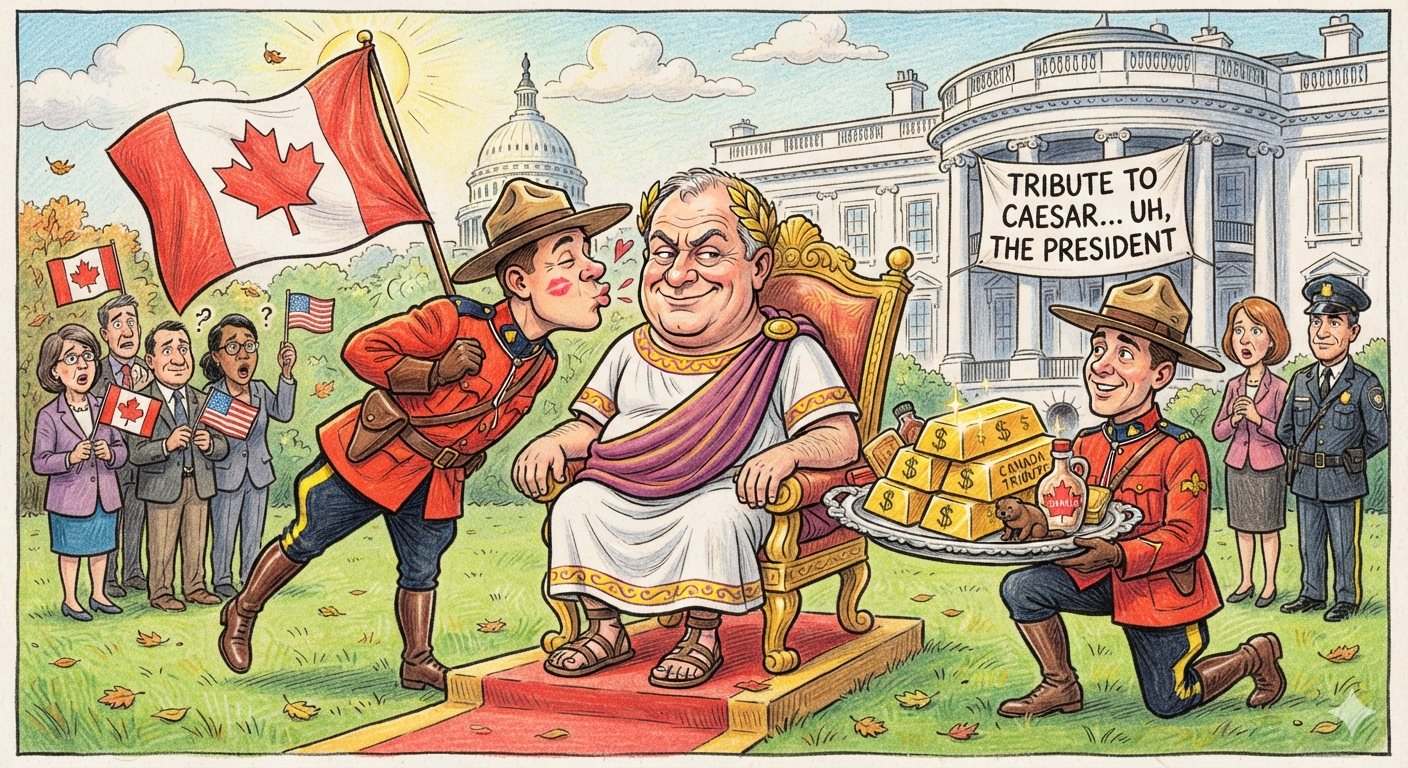
The definition of diplomatic insanity is repeating the same submissive playbook and expecting an outcome of mutual respect. Yet, Prime Minister Mark Carney’s government seems intent on replicating the exact strategic miscalculations of the late Trudeau era in its dealings with the Trump administration. By treating Washington, D.C., as a shrine of absolute authority and Ottawa as a mere regional outpost, Canada’s current foreign policy apparatus is actively eroding the foundational architecture of middle-power sovereignty.
The structural humiliation of Canada on the contemporary world stage began in earnest in late November 2024. In a panic over threatened blanket tariffs, Justin Trudeau flew down for an unannounced dinner at Mar-a-Lago before Donald Trump had even taken the oath of office. It was during this specific, poorly calculated visit that Trump’s toxic rhetoric demanding Canada become the "51st state" found its footing. This was a direct consequence of a Canadian Prime Minister appearing at a private resort like an anxious petitioner to an emperor. What was intended as a bold stroke of personal diplomacy instead signaled profound structural weakness. It broadcast to the incoming administration that Canada would break its own protocol and come running at the snap of a finger.
Tragically, the Carney government has learned nothing from this historical warning. It has chosen to institutionalize this exact posture of deference. By constantly dispatching ministers and emissaries to the American capital, the current government presents Canada not as a sovereign peer, but as a restless colony begging for attention from "The Empire." Even as trade negotiations battle over autos and new 50 per cent tariff deadlines loom, the Prime Minister treats a journey to Washington not as a rare, high-stakes summit but as a routine chore. This continuous bowing to pressure shifts the psychological balance of the bilateral relationship, explicitly reinforcing the Trump regime's belief that it holds all the structural leverage.
📊 The Illusion of Canadian Dependency
The tragic irony of Carney's frantic pilgrimages is that they ignore the immense economic leverage Canada actually holds. Ottawa frequently behaves as a vulnerable junior partner, forgetting that the Canada-U.S. trading relationship is a story of profound mutual dependence, not American charity.
According to reports from Global Affairs Canada, trade in goods and services is an integral engine of our economy, representing approximately two-thirds of Canada's GDP. While Canadian officials track data from Statistics Canada showing resilient merchandise trade surpluses, total bilateral trade between Canada and the United States exceeds $1.3 trillion annually. This represents one of the largest economic partnerships on Earth, where billions of dollars worth of commerce cross the border every single day. This is not a one-way street:
- The Prime Export Market: Canada remains the top export destination for over 30 U.S. states.
- The Manufacturing Engine: American manufacturing relies on Canadian industrial inputs. Michigan, Ohio, and Illinois are deeply dependent on integrated border crossings like the Ambassador Bridge, where a disruption instantly triggers plant closures across the American Midwest.
- Energy Security: As highlighted by industry metrics on EnergyNow, Canada exported approximately $157.5 billion worth of crude oil, refined petroleum products, natural gas, and natural gas liquids to the United States in 2025. Canada provides more than 60% of all crude oil imports to the United States.
By running to Washington at every rhetorical tweet, the Carney government signals that Canada is terrified of economic isolation. In doing so, it hides our greatest asset: the fact that a trade war would cause catastrophic inflation and job losses within the borders of the United States itself.
💡 The Strategy of Reciprocal Dignity and the Mexican Front
A wiser, more historically grounded approach would reject this subservient choreography entirely. Diplomatic protocol is not a collection of empty formalities; it is the visual and structural projection of national power. The Carney government must stop treating Washington as the default venue for continental governance and instead demand the strict, unyielding reciprocation of high-level talks.
True diplomatic leverage requires a symmetrical theatre of operations. If American policy decisions threaten Canadian economic stability, the resolution of those disputes must occur as frequently on the banks of the Ottawa River as they do along the Potomac. Forcing a Washington delegation to fly into Ottawa is a vital necessity for a country seeking to project independence. It forces American negotiators to step outside their domestic echo chamber, confront a distinct sovereign reality, and acknowledge that Canada is a power in its own right.
Furthermore, Canada must recognize that its continental leverage is amplified through solidarity, not isolation. The Carney government’s current tendency to engage in isolated, bilateral scrambles in Washington breaks a fundamental rule of North American trade dynamics: Canada should never negotiate structural changes to continental commerce without Mexico at its side. Attempting to carve out an exceptionalist, "Canada-first" exemption from the Trump administration’s protectionist agenda is a mathematical and geopolitical error.
The rationale for a unified front with Mexico is hardwired into the North American supply chain:
- The Automotive Backbone: The auto sector operates as a single, trilateral ecosystem under the framework of the Canada-United States-Mexico Agreement. A vehicle's components routinely cross North American borders up to eight times during assembly. A part stamped in Ontario is joined with a component fabricated in Querétaro before final assembly in Michigan.
- The Aerospace and Electronics Link: Aerospace and advanced electronics supply chains rely on specialized manufacturing nodes split cleanly between Canadian engineering and Mexican production lines.
By failing to maintain a unified northern and southern front, Ottawa allows Washington to implement a classic strategy of continental fragmentation. When Canada negotiates alone, it accepts the premise that its economic survival is subject to a transactional whim rather than a codified trilateral framework. A collective defense with Mexico forces Washington to face an integrated trading bloc that controls massive supply chains, raising the economic and political costs of American protectionism.
📖 The Verdict of History and the Legacy of Defiance
The current government's lack of diplomatic tact contrasts sharply with the records of Canadian statesmen across the political spectrum. Leaders from Sir John A. Macdonald to Sir Wilfrid Laurier, John Diefenbaker, Lester B. Pearson, Pierre Elliott Trudeau, and John Turner understood that Canada’s proximity to an economic giant required an attitude of firm independence, not perpetual anxiety. They recognized that once a middle power begins to act like a client state, its neighbours will treat it as one.
When John Diefenbaker occupied the Prime Minister's office, he famously resisted intense pressure from the Kennedy administration during the Cuban Missile Crisis and the Bomarc missile dispute. Diefenbaker fiercely guarded Canadian sovereignty, flatly refusing to let the Pentagon dictate Canada’s military readiness or foreign policy timelines. He famously noted that Canada was a partner, not a satellite state.
Similarly, Pierre Elliott Trudeau mastered the art of pushing back against Washington's gravitational pull. Confronted with the protectionist "Nixon shock" tariffs of 1971, Trudeau did not scramble to Washington to beg for an exemption. Instead, he pursued the "Third Option"—a deliberate, structural policy to diversify Canadian trade toward Europe and Asia to reduce vulnerability to American economic whims. Trudeau famously reminded Washington that Canada would chart its own path, establishing independent diplomatic ties with Cuba and China despite fierce American objections.
History, as catalogued on Wikipedia, provides a clear blueprint for this dignity. Sir Wilfrid Laurier famously declared that there would be "no more pilgrimages to Washington," a realization that Canadian sovereignty withered whenever Ottawa appeared too eager for American approval. This principle was maintained even during periods of intense economic integration. When the historic Canada-U.S. Free Trade Agreement was being hammered out in the 1980s, the Mulroney government did not merely send its teams southward to plead for terms. Archives at Library and Archives Canada confirm that the pivotal Twelfth Negotiating Session of those intense talks was held directly in Ottawa in April 1987.
During that exact same month, U.S. President Ronald Reagan traveled to the nation’s capital to address a joint session of Parliament and formally advance the treaty. Months prior, U.S. Vice President George H.W. Bush and Treasury Secretary James Baker had similarly traveled to Ottawa to iron out structural impasses with Canadian officials. These moments were not accidental; they occurred because Canadian negotiators insisted that the physical theatre of diplomacy must reflect the equal sovereignty of the contracting parties.
🏒 The "Elbows Up" Demand for Sovereignty
Ultimately, securing Canadian sovereignty on a changing continent demands a holistic, "elbows up" strategy across all levels of domestic leadership. The failure in Ottawa, however, cannot be laid entirely at the feet of the Carney government. Canada's federal opposition parties share the blame; they have thoroughly failed to challenge the government on these repetitive, submissive begging sessions in Washington. This domestic silence creates a vacuum of accountability, inviting increasingly outrageous, toxic proposals from the Trump regime—including renewed threats of annexation or devastating tariffs—because American strategists recognize the underlying, unchallenged weakness at the core of Canada's political establishment.
While federal leaders across the partisan aisle falter, the Ontario Premier stands out as the one Canadian leader who truly understands the necessary posture. Recognizing that Canada must project a position of absolute economic and political strength to Trump and the protectionist cabal he represents, Queen's Park has consistently argued that showing weakness only invites further American bullying. Carney's continuous, submissive pilgrimages achieve the exact opposite, undercutting provincial leverage and signaling an eagerness to capitulate.
The historical record proves that Washington will send its highest officials to Ottawa when Canada insists on its own worth. By failing to demand this basic reciprocity and failing to stand united at home, the political establishment is compromising our long-term national standing. It is time for Ottawa to halt the constant pilgrimages to Washington, take a page from Ontario's playbook, stand its ground, and finally begin acting like the sovereign, independent power it claims to be.

Comments
There are 0 comments on this post