
Stopping a U.S. military attack against Canada starts with walking away from NORAD


If Donald Trump feels entitled to treat core continental economic partnerships like CUSMA as disposable chips in a protection racket, Canada must muster the strategic audacity to look across the Atlantic for its very survival. For generations, the Ottawa establishment has cowered under the shadow of American economic brinkmanship, terrified of what happens if Washington abruptly pulls the plug on our trading relationship. We have comforted ourselves with the geopolitical fiction that by outsourcing our continental defense to a binational command structure, we buy goodwill, security, and a seat at the table where the decisions governing our own airspace are made.
But as the global architecture fragments under an unpredictable, hyper-nationalist White House, that comfortable premise has shattered. We are no longer living in a predictable world governed by nostalgic sentiment or international law. We are dealing with a raw, transactional Washington that calculates risks purely through the prism of leverage, hard power, and counterweights. In a recent interview with The New York Times, Prime Minister Mark Carney shocked the nation by revealing that his administration has actively studied the possibility of a U.S. military attack against Canada. Carney defended the move as essential "risk management," arguing that it would be entirely irresponsible for a Canadian leader to ignore what he termed an "extreme tail risk". As Carney has forcefully warned, a nation that relies on its "moral standing" while completely neglecting its hard power will inevitably find its negotiators reduced to the permanent subservience of an economic "vassal state".
The existential lesson of this new era is clear: economic sovereignty cannot survive without credible, independent hard power. If Canada is to stop a potential U.S. military attack, deter cross-border coercion, and preserve its democratic independence, it must disable Washington’s primary geopolitical lever over Ottawa. We must dismantle our integration with the North American Aerospace Defense Command (NORAD). True sovereignty is not granted by legacy alliances; it is exercised through uncompromised command.
The Vulnerability of a Subordinated High Command
The foundational tragedy of Canadian defense policy is that our strategic thinking is no longer entirely our own. By deeply integrating our command frameworks into a binational system headquartered in Colorado Springs, we have effectively placed the intellectual and operational core—the very "brains"—of the Canadian Armed Forces under American custody. When a crisis hits, the data feeds, the threat assessments, and the pre-programmed operational responses are filtered through a machinery where the final veto belongs exclusively to the White House.
This deep institutional subordination is the exact source of Trump’s persistent ridicule—his public taunts that Canada is a security freeloader that relies entirely on American charity to survive. For the current American political elite, an alliance is not a partnership of shared values; it is a protection racket. By remaining stubbornly tethered to NORAD, Canada legitimizes this insulting narrative. We allow Washington to claim ownership over our skies, giving American leaders the rhetorical ammunition to demand that Ottawa surrender its economic and political autonomy as payment for "protection."
Worse still, this integrated framework creates a dangerous conflict of interest at the highest levels of our military infrastructure. Under the current NORAD structure, Canadian personnel are hardwired into a chain of command topped by a dual-hatted American general who answers directly to the Pentagon and the U.S. President. In an era where a volatile American administration could adopt an aggressive, hostile posture toward its northern neighbor, this integration becomes an existential trap. To guarantee 100% sovereign control over our own armed forces, Canada’s top military commanders must be completely severed from Washington's chain of command. Their absolute, undivided loyalty must belong to the Canadian people, unclouded by integrated binational protocols that could freeze their ability to act in Canada's self-defense during a continental rift.
+--------------------------------------------------------------------------+

|                     THE COMMAND CRISIS: WHERE LOYALTY LIES               |
+------------------------------------+-------------------------------------+

| Under NORAD Framework              | Under Sovereign Canadian Autonomy   |
+------------------------------------+-------------------------------------+

| - Joint data filtering via Pentagon| - 100% independent intelligence     |
| - High command tied to White House | - Commanders answer ONLY to Ottawa  |
| - Vulnerable to unilateral dictates| - Flexible, adaptive defense plans  |
+------------------------------------+-------------------------------------+
The Strategic Blindspot: Why Integration Kills Defense Secrets
The final, fatal flaw of remaining within NORAD is that it strips Canada of the ability to hold the sovereign secrets necessary to stave off an adversary in an attack. In the realm of military strategy, a nation’s greatest asset against a superior force is its asymmetric knowledge—its classified contingencies, its hidden capabilities, and its unilateral intelligence assessments.
NORAD's institutional architecture, by its very design, demands total data transparency and systemic synchronization. Because our early-warning systems, tracking grids, and communications arrays are hardwired into the Pentagon, Canada cannot maintain significant defense secrets from the United States. In a world where Washington is our partner, this transparency is celebrated. But in a world where an unstable American administration actively deploys propaganda to condition its electorate for the economic or territorial subjugation of Canada, total transparency becomes an extraordinary military liability.
If Canada cannot keep secrets from the Americans, Canada cannot formulate independent defense strategies to safeguard its borders when American and Canadian interests violently collide. We are effectively showing our entire playbook to the very entity we may need to deter. Walking away from NORAD allows Canada to build isolated, domestic intelligence enclaves and national electronic warfare networks that do not automatically sync with American databases. It allows us to plan, hide, and maneuver without triggering an automated notification in Colorado Springs.
       [ TRUMP'S TRANSACTIONAL MANDATE ]      [ CARNEY'S SOVEREIGN WARNING ]
           CUSMA treated as leverage             U.S. posture could turn hostile
                                                          /
                                                         /
                       v                                 v
                 +---------------------------------------------+

                 |    THE IMPERATIVE FOR ABSOLUTE AUTONOMY     |
                 +---------------------------------------------+
The Atlantic Realignment: Partnering with the Euro-Nordic Bloc
The standard rejoinder to any proposal of Canadian withdrawal from continental defense is financial: critics argue that without the American military umbrella, the cost of patrolling our immense landmass would bankrupt the nation. This argument is a false dichotomy that assumes Canada must stand entirely isolated. True security does not come from outsourcing your defense to a single domineering neighbor; it comes from diversifying your alliances based on mutual respect for sovereignty.
Instead of hiding under an unreliable American umbrella, Canada must replace Trump’s America with the United Kingdom, France, and the Nordic countries as our primary military allies. These nations are our natural strategic partners. The United Kingdom and France possess highly sophisticated, independent conventional and nuclear power projection capabilities, and they have historically demonstrated a willingness to maintain distinct diplomatic identities independent of Washington’s grand strategies. More importantly, the Nordic nations—Norway, Sweden, and Finland—are the undisputed global pioneers of the exact security architecture Canada must urgently adopt: Total Defence.
By establishing formal, deep-tier defense pacts with these European and Commonwealth allies, Canada can implement an international "tripwire" system on its own soil. Stationing permanent international troops from these allied blocs across Canadian territory would fundamentally rewrite the Pentagon's tactical calculus. Under this framework, any aggressive American coercion, trade ultimatums, or cross-border overreach would instantly cease to be an isolated border skirmish between a superpower and its vassal state. It would instantly trigger a massive global crisis involving European economic blocs and nuclear-armed partners, forcing Washington to calculate an unacceptable international political cost before making a single hostile move.
+--------------------------------------------------------------------------+

|                    THE STRATEGIC REALIGNMENT OF CANADIAN ALLIANCES       |
+------------------------------------+-------------------------------------+

| Legacy: The American Trap (NORAD)  | Future: The Euro-Nordic Coalition   |
+------------------------------------+-------------------------------------+

| - Pre-programmed American doctrine | - Multi-lateral Tripwire Pacts      |
| - Shared assets used for U.S. BMD  | - Sovereign, independent networks   |
| - Total exposure to U.S. political | - Deep integration with European    |
|   and military blackmail           |   and Commonwealth partner states   |
+------------------------------------+-------------------------------------+
Diverging Arsenal: Procuring Euro-Nordic Capabilities
Walking away from the Pentagon’s production lines means ending Canada's reliance on weapon systems designed for global American power projection. Instead, Canada must procure military hardware from British, French, and Nordic defense partners, prioritizing systems engineered specifically for asymmetric territory denial and sovereign Arctic enforcement.
The cornerstone of this new, sovereign naval strategy has already been laid by the Carney administration. By bypassing American defense contractors and selecting Germany's ThyssenKrupp Marine Systems (TKMS) as the preferred supplier for up to 12 cutting-edge Type 212CD submarines, Canada has taken its most significant step toward independent maritime deterrence. These conventionally powered, bleeding-edge vessels feature a fuel cell air-independent propulsion system that allows for over 40 days of fully submerged, near-total silence—an indispensable asset for hiding under Arctic ice shields away from automated U.S. tracking arrays. Furthermore, Ottawa's recent General Security of Information Agreement with Berlin establishes a trusted framework for exchanging sensitive technical and intelligence data. This allows Canada to cultivate vital defense secrets entirely independent of Colorado Springs or Washington surveillance.
+----------------------------------------------------------------------------+

| ESTIMATED FISCAL REALIGNMENT: THE CARNEY 3.5% GDP TOTAL DEFENCE MODEL      |
+------------------------------------+---------------------------------------+

| Strategic Capital Reallocation      | Projected Annual Allocation (CAD)    |
+------------------------------------+---------------------------------------+

| NORAD Modernization Clawback       | $4.5 Billion (Diverted from Pentagon) |
| German Submarine Stream (TKMS)     | $24.0 Billion (Initial 12-Vessel Pact)|
| Sovereign Satellite & Cyber Enclave| $6.4 Billion (Independent Systems)    |
| Provincial Militia Subsidies       | $5.1 Billion (Distributed Training)   |
| Indigenous Shield Infrastructure   | $3.8 Billion (Northern Resiliency)    |
+------------------------------------+---------------------------------------+

| TOTAL ANNUAL SECURITY OUTLAY       | $43.8 Billion                         |
+------------------------------------+---------------------------------------+
*Note: This framework absorbs the $24-billion procurement cost of the German Type 212CD fleet—the largest military procurement in Canadian history—while maximizing domestic economic spillover through localized infrastructure redevelopments.
To complement the German submarine fleet, the Canadian Armed Forces must shift the remainder of its procurement to specialized European systems:
- A2/AD Missile Networks: Replacing dependencies on American radar-guided frameworks with French-built SAMP/T air defense batteries and MBDA Aster missiles, establishing independent anti-access/area-denial bubbles over key northern entry points.
- Arctic Tactical Mobility: Procuring Swedish BvS10 Beowulf all-terrain tracked vehicles and Saab Gripen-E fighter jets. The Gripen is engineered specifically for sub-zero climates, capable of operating from short, unpaved highways and being serviced by civilian reserve crews during a national mobilization.
Domestic Dividend: Industrial Benefits of the Euro-Nordic Shift
The benefits of this procurement pivot extend far beyond tactical autonomy; they represent a historic domestic industrial dividend. For decades, purchasing American hardware meant watching billions of Canadian tax dollars disappear into the defense corridors of Texas and Virginia, yielding meager domestic offsets. By partnering with the German-Norwegian Type 212CD submarine consortium, Canada has unlocked an industrial template that directly builds northern sovereign capacity.
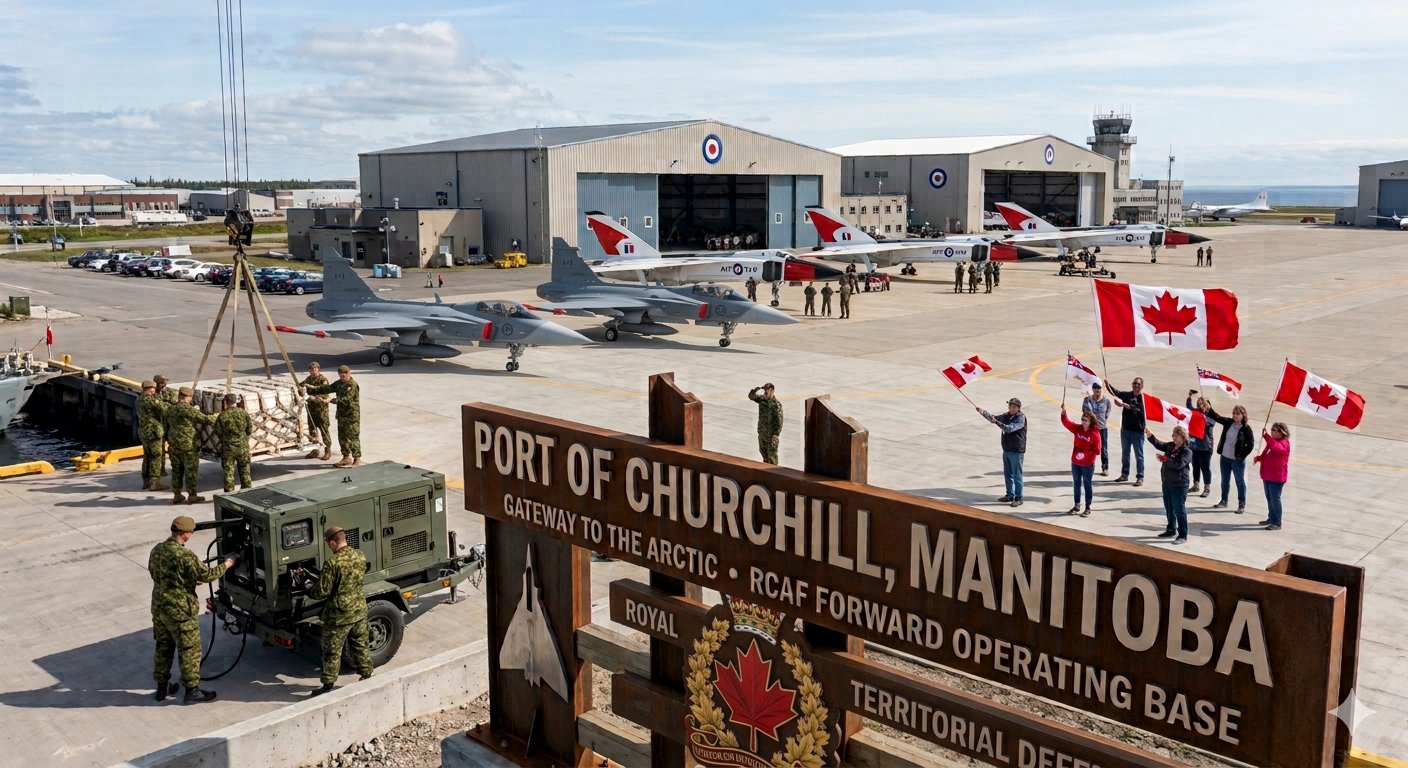
The crown jewel of this framework is the proposed multi-billion dollar redevelopment of the Port of Churchill, Manitoba. As Canada's only deep-water Arctic port connected to the national rail grid, Churchill is uniquely positioned to serve as the strategic anvil of our northern defense. Under the terms of the TKMS agreement, European maritime engineering firms will collaborate with Canadian industry to transform this legacy outpost into a state-of-the-art, year-round naval refueling, maintenance, and logistics hub.
This massive infrastructure injection will bring deep-water dredging, winterized dry docks, and advanced telecommunications arrays to the Hudson Bay coastline. Beyond its military utility as a hidden staging ground for our silent German-built submarines, the upgraded port will serve as a vital commercial gateway for green energy exports, agricultural trade, and regional supply chain security. For the first time, Canadian defense spending will actively build the civil infrastructure required to sustain vibrant, resilient northern communities, transforming a military necessity into a generation-defining economic engine for Western and Northern Canada.
Constructing the Six-Layer Total Defence Web
Transitioning away from NORAD forces a hard, necessary shift from a centralized, top-heavy military model to a decentralized doctrine of total society defense. A conventional military campaign reliant on uniform command nodes is highly vulnerable to a near-peer adversary; if the central executive in Ottawa is decapitated or compromised by cyber warfare, the national will to resist is broken. To shatter this paradigm, Canada must construct a comprehensive, six-layer vertical defense web—totaling roughly one million personnel—that distributes legal and operational command authority directly down to provinces, municipalities, and Indigenous nations.
This distributed network, inspired by the resilient societies of Northern Europe, ensures that every regional unit possesses the statutory authority to make independent strategic choices even if communication with the federal capital is permanently severed.
                       [ ADVERSARY KINETIC ATTACK ]
                                    |
                                    v
            +-----------------------------------------------+

            |  THE SIX-LAYER TOTAL SOCIETY DEFENCE WEB      |
            +-----------------------------------------------+

            | 1. THE CORE SPINE (Armed Forces & A2/AD)       |
            +-----------------------------------------------+

            | 2. PROVINCIAL BASTIONS (Autonomous Militias)  |
            +-----------------------------------------------+

            | 3. THE CIVIC SHIELD (Municipal People's Corps)|
            +-----------------------------------------------+

            | 4. THE GRASSROOTS EDGE (Veteran-led Cells)    |
            +-----------------------------------------------+

            | 5. INDIGENOUS SOVEREIGN SHIELD (Land Defense) |
            +-----------------------------------------------+

            | 6. THE FORWARD DETERRENT (Euro-Nordic Pacts)  |
            +-----------------------------------------------+
                                    |
                                    v
                     [ WAR OF INFINITE ATTRITION ]
Transitioning to a decentralized total defense model requires a six-layered architecture designed to ensure resilience at every level of society.
- 1. The Core Spine: Consists of the professional Canadian Armed Forces and reserves reoriented from foreign deployments toward domestic deterrence, managing A2/AD systems and sovereign cyber operations.
- 2. The Provincial Bastions: Establishes regional militias under provincial Emergency Management Acts to provide localized defense tailored to unique geographic terrain.
- 3. The Civic Shield: Deploys municipal People's Corps to secure critical infrastructure, food, water, and local logistics.
- 4. The Grassroots Edge: Forms flexible, community-based cells led by veterans and citizens to maintain autonomous information and counter-intelligence networks.
- 5. The Indigenous Sovereign Shield: Empowers First Nations, Inuit, and Métis communities in territorial defense, leveraging generational terrain knowledge while integrating holistic health and food security.
- 6. The Forward Deterrent: Secures international backing via European and Commonwealth defense pacts, introducing allied tripwire forces to deter unilateral aggression.
Statutory Mobilization: Provincial Emergency Management Acts
A total society defense model cannot rely solely on a federal declaration under the Emergencies Act, which risks creating a single point of failure in Ottawa. Instead, the legal framework for mobilization relies on cascading provincial statutory powers, specifically updated Provincial Emergency Management Acts.
Under this decentralized framework, provincial Premiers hold the explicit statutory authority to activate regional defenses if federal communication lines are severed or compromised during an attack:
- Autonomous Militia Activation: Premiers can instantly transition provincial park rangers, conservation officers, and volunteer search-and-rescue organizations into localized defense units operating autonomously within their respective borders.
- Critical Infrastructure Custody: The acts grant provinces the legal authority to commandeer regional supply chains, securing water treatment plants, provincial power grids, and local telecom networks independent of federal directives.
- Civilian Logistics Integration: Municipalities are legally integrated into the provincial command structure, allowing local police and civic corps to manage neighborhood logistics, trauma-informed medical triages, and food distribution hubs within hours of a defensive alert.
Conclusion: Taking Full Command
Stepping away from a defense treaty that has underpinned Canadian security policy since 1957 is an undeniably radical proposition. It would trigger intense consternation in Washington, send shockwaves through the legacy military establishment in Ottawa, and require a serious, long-term national commitment to defense self-reliance. It requires us to discard the comfortable, lazy assumption that our neighbor will always look out for us.
But continuing down the path of total continental integration offers only the slow, quiet surrender of our national independence. We cannot protect Canadian sovereignty by keeping the brains of our military locked in a Pentagon boardroom, nor can we secure our economy when our defense integration leaves us completely vulnerable to political and military blackmail. If an unstable American administration can threaten to tear up CUSMA whenever it wants to force a concessions-heavy trade deal, Canada must possess the fortitude to look at NORAD and recognize that the deal no longer serves our national interest.
True power respects power. A transactional world does not adapt its posture out of deference to historical sentimentality. It is time for Canada to follow the cold-blooded realism of the modern age: walk away from Trump, walk away from NORAD, secure our own secrets, and finally bring the absolute command of our destiny back home where it belongs.
Now that the final comprehensive draft is complete, let me know if you would like to:
- Draft a complementary briefing note summarizing how the new six-layer structure interacts with the National Defence Act.
- Refine the economic metrics within the Port of Churchill section to outline specific regional job creation estimates.
- Structure an op-ed rebuttal blueprint to anticipate and address counter-arguments from traditional NORAD advocates.

Comments
There are 0 comments on this post