
NORAD: Could a joint command be the key to an American annexation?
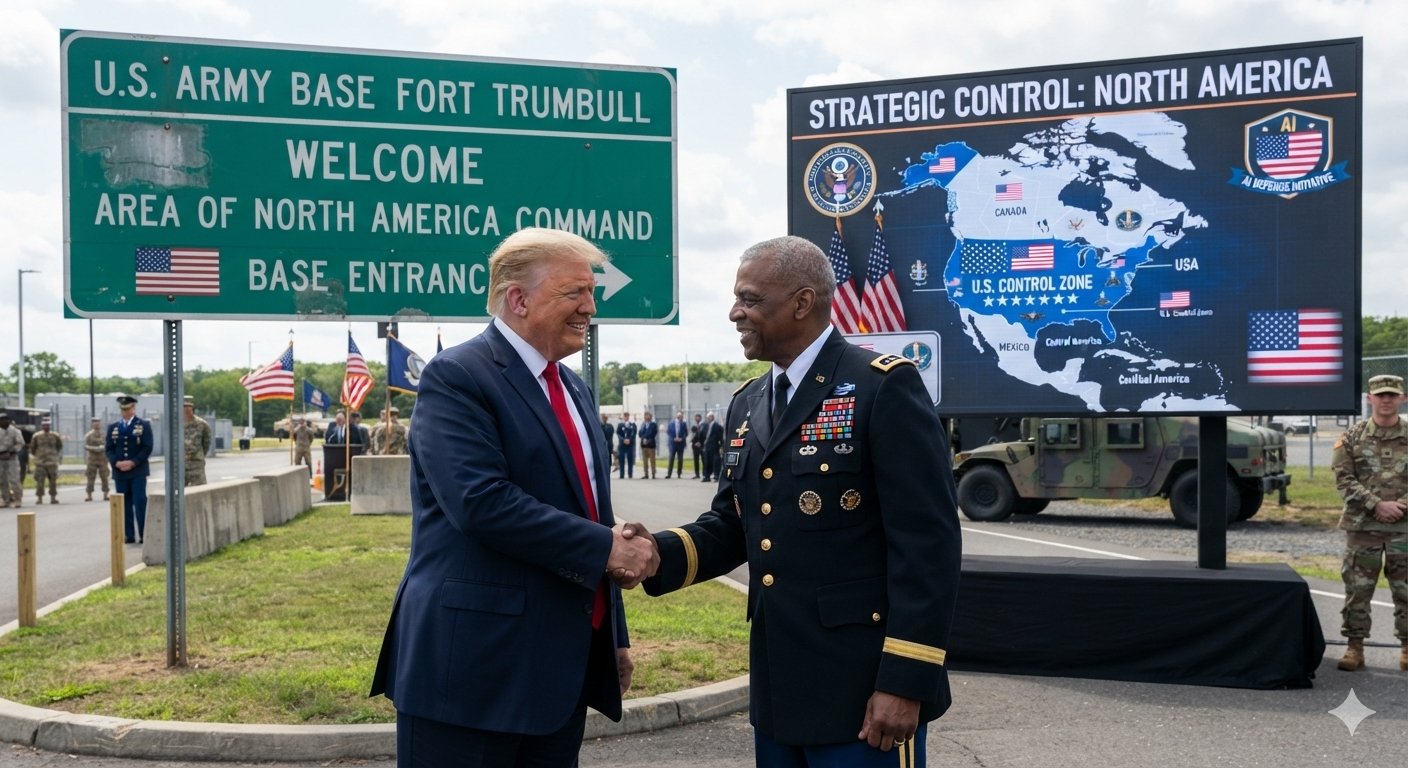


The geopolitical relationship between the United States and Canada has long been anchored by the world’s longest undefended border and an unprecedented level of military integration. At the absolute core of this alliance sits the North American Aerospace Defence Command (NORAD), a bi-national organisation established in 1957 to monitor and protect continental skies. For decades, NORAD has been hailed as a model of bilateral trust. However, as conventional political norms erode under a second Donald Trump administration—marked by explicit threats of "economic force" to absorb Canada and open assertions that the country should become America's 51st state—an unsettling question has entered mainstream defence discourse: Could the mechanisms of NORAD be weaponised by a U.S. president to compromise and ultimately seize Canadian sovereignty?
To evaluate this risk, one must first look at the unique, deeply intertwined nature of the command structure itself. Unlike traditional military alliances where nations maintain strict operational separation, NORAD blurs domestic boundaries. It features a fully integrated command structure where an American general typically serves as Commander-in-Chief and a Canadian general serves as Deputy Commander. They share radar data, early warning systems, satellite feeds, and operational control over aerospace defence.
Historically, mainstream defence experts have argued that this dual-key architecture serves as a strict safeguard against unilateral overreach. Because bilateral treaties govern NORAD, any offensive operation requires mutual consent. However, this comfort relies on a foundational assumption that a U.S. president will respect international law. Donald Trump has systematically dismantled that assumption. From launching unilateral strikes to threatening the institutions of global governance, his administration operates on a doctrine where international treaties are not binding obligations, but transactional arrangements subject to executive whim. By declaring that Article II of the U.S. Constitution grants him "the right to do whatever I want," Trump has positioned executive power not as a tool bound by the law, but as the entity that defines it.
In this legal reality, a hostile U.S. takeover of Canada would not look like a sudden, unprovoked tank assault across the 49th parallel. Instead, the tactical foundation for a forced annexation would likely materialise through the weaponisation of domestic emergency authorities to subvert NORAD from within.
Under the National Emergencies Act, a U.S. president possesses sweeping, loosely defined powers triggered by a simple executive declaration. If Washington were to declare a national security emergency along the northern border—citing a fabricated or heavily exaggerated crisis, such as a failure of Canadian border enforcement, a hostile foreign intelligence presence in the Arctic, or an imminent threat to the North American energy grid—the legal and operational landscape would instantly shift.
By framing the situation as a continental crisis requiring an immediate, centralised response, Trump could issue executive orders to effectively seize control of NORAD assets. Using expanded domestic military authorities, the White House could argue that the bi-national, consensus-based nature of NORAD creates an unacceptable vulnerability during a crisis, justifying the immediate suspension of dual-key operational protocols. American commanders within NORAD, bound by direct orders from their Commander-in-Chief, would be directed to override or bypass Canadian input under the pretense of urgent hemispheric survival.
Because NORAD grants the U.S. military deep, real-time visibility into Canadian airspace and defence responses, a unilateral seizure of the command gives Washington instant information dominance. The U.S. already possesses tracking data, operational frequencies, and direct communication lines with every critical node of Canada’s aerospace network. Once the integrated radar arrays, satellite feeds, and forward operating airbases are unilaterally placed under exclusive American command, Canada's structural sovereignty is effectively broken. The Canadian Armed Forces would find their primary air defence network operated by the very power occupying their territory.
This operational decapitation would allow a U.S. administration to present Ottawa and the international community with a fait accompli. With continental defences entirely federalised under the White House, the transition from an "emergency security intervention" to a forced annexation becomes a matter of administrative execution rather than a costly military invasion across thousands of kilometres of shared border.
Ultimately, the vulnerability of the alliance stems from Canada's historic defence dependency. For years, Ottawa has faced criticism for failing to meet its NATO defence targets and lagging behind on critical NORAD modernisation efforts, such as upgrading over-the-horizon radar in the Arctic. In a world where the rule of law is dictated by executive might, underinvesting in security means delegating sovereignty to a volatile neighbour.
The true risk to Canadian independence does not come from a hidden clause in a 70-year-old defence treaty. It lies in Canada's ongoing failure to independently secure its own territory. If Canada wishes to ensure its sovereignty remains ironclad, the solution is to rapidly build independent defence capabilities and fund NORAD as an equal, indispensable partner—ensuring that the keys to the continent can never be turned from Washington alone.

Comments
There are 0 comments on this post