
Why Vermont should join Canada already
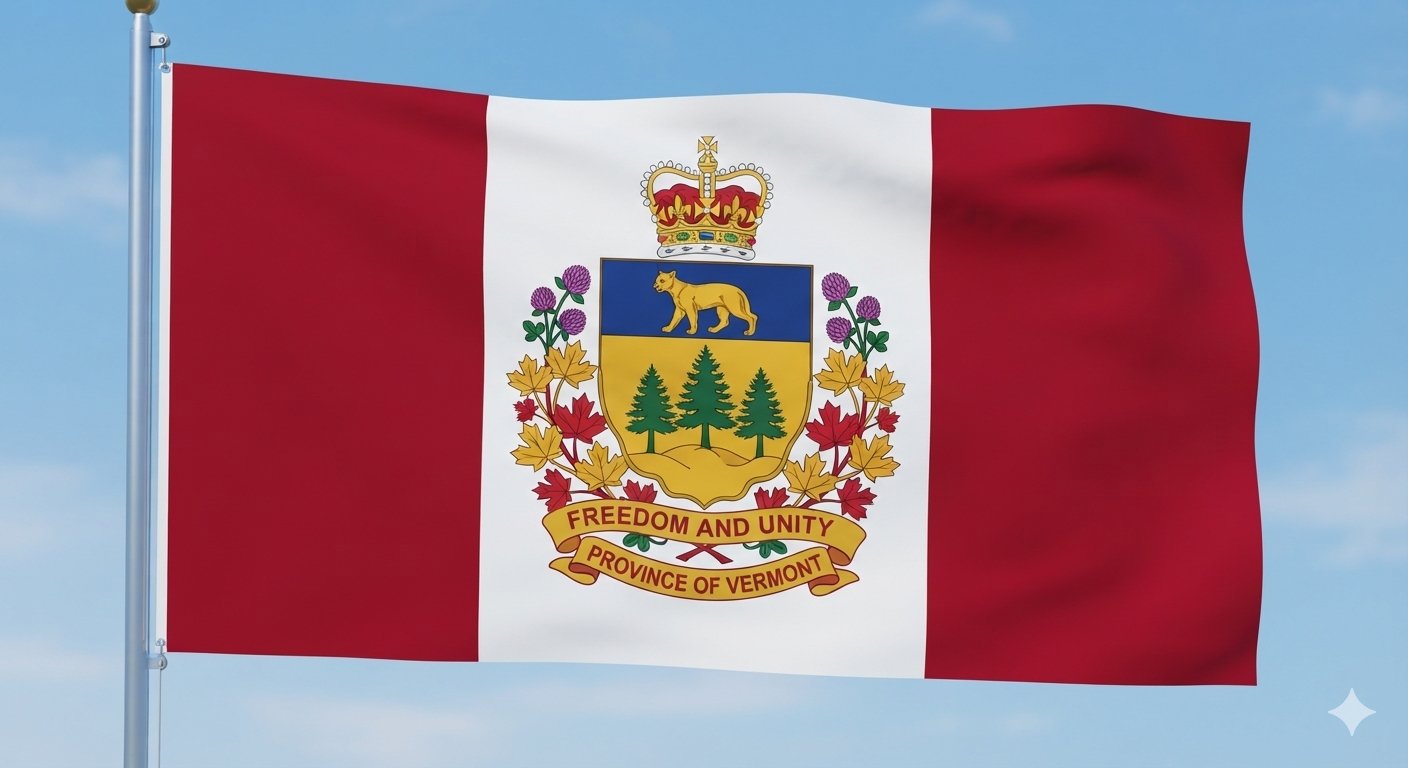



The United States is locked in a state of perpetual political exhaustion, a reality that citizens from coast to coast grapple with daily. But for one small, independent-minded state, a simpler solution sits just across the northern border. It is time for Vermont to stop trying to fix a broken federal system and finally join Canada.
This is not a radical proposition born of sudden frustration. It is the logical conclusion of a long-standing cultural, economic, and political misalignment—one rooted deeply in Vermont's history. Vermont has always been an outlier in the American experiment. It spent fourteen years as its own independent republic before reluctantly joining the Union in 1791. Today, its values, its infrastructure, and its identity align far more closely with the provinces of Quebec and Ontario than they do with Texas, Florida, or Washington, D.C.
In fact, looking north is embedded in the state's very DNA. During the Haldimand Affair in the 1780s, Vermont's founding fathers—including Ethan and Ira Allen—grew so frustrated by a hostile Continental Congress that they opened secret negotiations with the British Governor of Quebec to have the independent republic rejoin the British Empire as a province of Canada. This historical instinct to seek refuge across the northern border found a modern echo in the Second Vermont Republic movement, which advocated for secession and a tighter alignment with Canadian economic principles.
Consider the modern political landscape. Vermont is famous for its progressive social policies, its commitment to environmental stewardship, and its unique brand of independent politics. It is the state that gave the world Bernie Sanders, pioneered civil unions, and consistently ranks at the top of national lists for environmental protections. Yet, on the national stage, Vermont’s voice is routinely drowned out. Its tiny population gives it minimal leverage in a hyper-polarized Congress, leaving its citizens subject to federal policies, judicial rulings, and cultural battles that feel entirely alien to the Green Mountain lifestyle.
In Canada, Vermont would find its natural political home. The state’s commitment to social democratic principles is not a fringe position in Ottawa; it is the baseline of national consensus. The Canadian electorate broadly supports robust social safety nets, strict environmental regulations, and a government that prioritizes collective well-being over unbridled corporate power. As Canada’s eleventh province, Vermont would no longer have to fight against the federal current. It would simply be flowing with it.
The most immediate and life-changing benefit of this geopolitical shift would be healthcare. Vermont has long harbored an ambition to guarantee healthcare to all its residents. In 2011, the state attempted to pass a single-payer healthcare system, a bold initiative that ultimately collapsed under the sheer weight of federal funding complexities and the inescapable gravity of the American private insurance market. By joining Canada, Vermont would instantly achieve this decades-long goal. It would adopt the Medicare system, ensuring that every Vermonter could visit a doctor or hospital without the fear of financial ruin. The administrative waste of the American medical billing system would vanish, replaced by a streamlined, human-centric model that views health as a right rather than a commodity.
The economic arguments for annexation are equally compelling. Vermont’s economy is defined by small businesses, agriculture, green energy, and tourism. It relies heavily on trade and travel with its northern neighbor. The state shares an interconnected electricity grid with Quebec, drawing a massive portion of its clean energy from Canadian hydropower. Montreal is already the closest major metropolitan area for many northern Vermonters, serving as a cultural and economic hub far more accessible than Boston or New York.
Integrating into Canada would eliminate the border friction that currently slows down trade, tourism, and labor mobility. Vermont’s world-class dairy farms, craft breweries, and maple syrup producers would gain seamless access to a Canadian market that deeply values local, artisanal goods. Furthermore, Canada’s robust federal investments in infrastructure, public transit, and green technology would provide a massive boost to Vermont’s aging roads and bridges. Instead of begging a gridlocked U.S. Congress for infrastructure funds, Vermont would benefit from a Canadian federal government actively investing in the green transition.
Furthermore, Vermont's inclusion would be a massive asset to Canada. The country would inherit a highly educated, politically engaged, and economically stable population. Vermont’s thriving tech sector in Burlington, its prestigious educational institutions like Middlebury and UVM, and its leadership in sustainable agriculture would enrich the Canadian mosaic. Politically, Vermont would provide a stabilizing, progressive balance in Ottawa, offering a bridge of familiarity to the northeastern United States while fitting perfectly into Canada's decentralized federal structure.
Of course, the mechanics of such a secession and annexation would be complex. The legal hurdles under the U.S. Constitution are formidable, and the international negotiations would require unprecedented diplomacy. But history is not static. Borders have always shifted to reflect the changing realities of human geography, culture, and values. When a political entity finds itself completely disconnected from the nation-state that governs it, partition or realignment becomes a legitimate topic of discussion.
Vermont has spent over two centuries trying to fit a square peg into a round hole, attempting to maintain its unique, community-first identity within an American empire increasingly defined by polarization, inequality, and institutional gridlock. It is an exhausting endeavor that yields diminishing returns.
It is time to face reality. Vermont’s heart is already in Canada. Its values are written into the Canadian Charter of Rights and Freedoms. Its economic future is tied to the St. Lawrence River and the clean energy of the north. Joining Canada would not be an act of betrayal to Vermont’s history; it would be the ultimate fulfillment of its identity. It is time for the Green Mountain State to come home, pack its bags, and finally cross the border for good

Comments
There are 0 comments on this post