
Trump's Tariff Shell Game: Why 25 States are Suing the White House
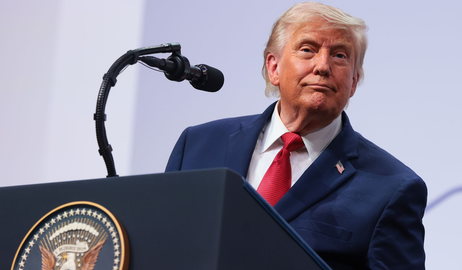


WASHINGTON — In the theatre of international commerce, the executive branch has long relied on the element of surprise. But the latest maneuvers from the White House have instead yielded a predictable result: a massive constitutional and economic showdown. On Monday, a powerful coalition of 25 American states launched a sweeping lawsuit in the U.S. Court of International Trade in New York, seeking to dismantle a newly enacted global trade wall.
The litigation represents more than a disagreement over trade policy. It is a direct accusation of a multi-billion-dollar legal bait-and-switch. Led by New York Attorney General Letitia James and joined by major economic engines including California, Pennsylvania, Illinois, and Michigan, the plaintiff states argue that the administration's new double-digit duties are a transparent "pretext". The states allege the White House has fabricated human rights concerns to illegally replace a previous protectionist agenda that was flatly struck down by the U.S. Supreme Court just six months ago.
The Anatomy of the Tariff Shell Game
To understand the depth of the states' current legal outrage, one must look at the chaotic trajectory of Washington’s trade policy since early 2025. Upon returning to the Oval Office, the president moved swiftly to upend decades of bipartisan consensus favoring open markets and integrated supply chains.
In April 2025, the administration invoked the 1977 International Emergency Economic Powers Act (IEEPA), implementing sweeping, double-digit "Liberation Day" tariffs on virtually all global imports. The justification was as broad as it was unorthodox: the nation’s longstanding trade deficit was declared a national security emergency.
That strategy collided with constitutional reality in February 2026. In a historic ruling, the U.S. Supreme Court declared that the IEEPA did not grant the executive branch unilateral authority to impose sweeping commercial taxes without congressional approval. The high court's decision forced the federal treasury into an embarrassing retreat, mandating the establishment of a massive refund process to return over $130 billion in illegally collected duties to American importers.
Rather than yielding to the judiciary, the White House pivoted to a temporary fallback regime: a blanket 10 percent worldwide tariff levied under separate emergency statutory provisions. Yet, as those stopgap measures neared their expiration at midnight on July 24, 2026, the administration unveiled its current, highly controversial maneuver.
The Office of the U.S. Trade Representative (USTR) announced a new tier of permanent tariffs, ranging from 10 to 12.5 percent, slapped across 59 separate nations and the European Union. This time, the official rationale had changed completely. The administration claimed the massive levies were designed exclusively to root out "forced labor" in global supply chains.
The Pretext Argument
The states' legal challenge cuts directly to the heart of this statutory shape-shifting. In their filed statement of claim, the 25 states assert that the administration's abrupt conversion to human rights advocacy is an arbitrary and capricious legal fiction. The timing of the new policy, dropping precisely as the old temporary tariffs expired, is cited as undeniable proof of an administrative shell game.
"After losing at the Supreme Court, the administration is once again trying to illegally raise taxes on families and businesses," stated New York Governor Kathy Hochul following the filing. "The Supreme Court has made it clear that this administration cannot ignore the law to impose sweeping tariffs".
The technical pivot relies on Section 301 of the Trade Act of 1974, a powerful provision meant to combat unfair or discriminatory economic practices by foreign partners. While Section 301 was successfully used during the president's first term to target Chinese trade practices, the states argue its application here is a structural absurdity. The new duties are so broad that they affect more than 99 percent of all U.S. imports, treating drastically different global economies as a single, uniform violator.
The lawsuit notes that when the administration used Section 301 against China in 2018, federal officials conducted an extensive, highly focused eight-month investigation into specific supply chain abuses. By contrast, the 2026 probe into 60 distinct trading partners was rushed through in just two months. The states argue that such an incredibly brief timeline makes a mockery of the statute, proving that federal officials were working backward from a predetermined political goal: maintaining a global tariff wall by any legal means necessary.
A Policy of Economic Gaslighting
For businesses operating across North America, the administration's ongoing trade brinkmanship has induced chronic economic whiplash. In their legal filings, the states outline how these volatile executive edicts act as a deeply regressive tax on domestic supply chains, hurting local industries while failing to address actual labor abuses abroad.
The new architecture splits the targeted countries into a rigid, two-tier penalty structure:
- The 10 Percent Tier: Applies to 15 economies—including the United Kingdom, the European Union, Indonesia, and Pakistan—deemed to have "partial plans" to address forced labor.
- The 12.5 Percent Tier: Slapped on 45 nations—including China, India, Japan, South Korea, and Vietnam—where the USTR claims insufficient regulatory progress has been made.
While certain product categories like crude oil, rare earth elements, and pharmaceuticals were granted narrow exemptions, the broad nature of the policy leaves few domestic sectors untouched. By forcing importers to pay steep penalties on everything from electronics to basic manufacturing components, the White House is accused of running an economic gaslighting campaign—claiming to protect factory workers while driving up the baseline cost of production for homegrown businesses.
"Despite losing every step of the way, the White House is trying yet again to inflict more chaos on working families and homegrown businesses," said Oregon Attorney General Dan Rayfield, whose state helped anchor the legal filing. The complaint emphasizes that a blanket import tax does absolutely nothing to improve human rights conditions globally; instead, it simply forces American consumers to foot the bill for an executive branch that refuses to take "no" for an answer from the courts.
Cross-Border Collateral Damage
The reverberations of Washington's tariff obsession are being felt acutely north of the border. Under the current USTR rules, Canadian products entering the United States are technically exempt from the 10 percent forced-labour tariff, provided they strictly comply with the complex rules of origin established under the Canada-United States-Mexico Agreement (CUSMA).
However, the administration has simultaneously opened a second front against its northern neighbour. In a separate, aggressive trade move, the White House has invoked Section 338 of the U.S. Tariff Act, threatening to slap separate, punitive tariffs of up to 50 percent on an array of Canadian goods starting August 19, 2026. Section 338 grants the president sweeping authority to penalize foreign nations deemed to be discriminating against American industries.
U.S. Trade Representative Jamieson Greer has aggressively defended the dual-track strategy, stating that "decades of moral suasion have not eradicated bad practices from global supply chains". Greer has explicitly warned that Washington will not hesitate to penalize Canadian exports if it believes Ottawa is failing to tightly police its own commercial borders.
The Canadian government has firmly rejected these claims, calling the accusations entirely baseless and maintaining that Canada's enforcement of labour standards remains among the highest in the world. Yet, with the White House openly looking to rewrite key aspects of the CUSMA trilateral agreement, many Canadian business analysts suggest corporate leaders are adopting a tense, wait-and-see approach before launching separate legal actions, hoping that scheduled diplomatic negotiations might defuse a full-scale trade war.
Defending the Constitutional Order
As the legal battle heads to the U.S. Court of International Trade, the White House continues to project a posture of absolute confidence. Administration spokesman Kush Desai dismissed the states' lawsuit, insisting that the executive branch is operating well within its lawful authority to eliminate foreign practices that burden American commerce. "Section 301 tariffs have proven to be a legally durable tool since the president's first term, and they remain so now," Desai declared.
But the 25 states are fighting for a much larger principle than the price of imported goods. They are defending the basic separation of powers that underpins the American republic. The U.S. Constitution explicitly grants the power to regulate foreign commerce and levy taxes to Congress, not the presidency. If an administration can easily rebrand an unconstitutional tax policy under a new statutory label to keep enforcing it, then court rulings become entirely meaningless.
By banding together to block these forced-labour tariffs, this coalition of states is drawing a clear line in the sand. They are demanding an end to a destructive cycle of trade-by-decree, forcing the White House to operate within the bounds of the law, and ensuring that international trade policy can no longer be used as a political shell game.

Comments
There are 0 comments on this post