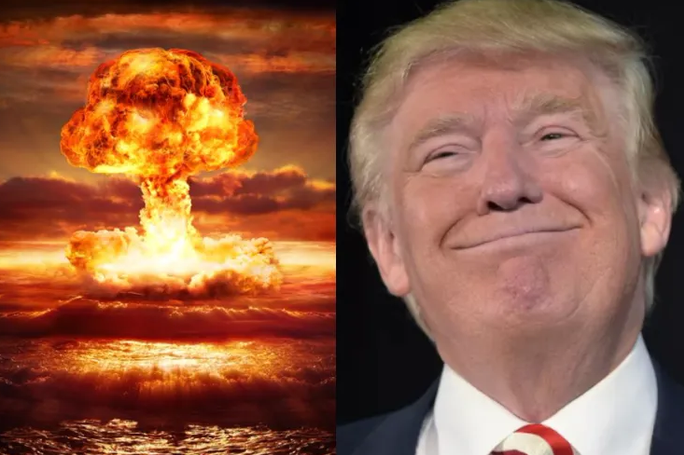
When anonymous U.S. officials leak alarming intelligence to major news networks regarding a potential "dirty bomb" plot in Washington, D.C., observers are forced to confront not only the alleged threat itself, but how such narratives historically function to manufacture public consent for war.
Recently, CNN reported that U.S. intelligence had intercepted "chatter" indicating that Iran was developing contingency plans to target senior Trump administration officials in the nation's capital using a radiological device or chemical weapon. Even as White House spokesperson Lauren Bis publicly maintained there were "no credible threats to the homeland" and intelligence officials debated whether Tehran possessed the capability to execute such a plot, the mere invocation of a "dirty bomb" in Washington carries immense psychological and political weight.
To understand why critics view these intelligence leaks with deep alarm, one must examine the documented warnings issued by the highest-ranking officials who served inside Donald Trump’s first administration, alongside a decades-long ideological undercurrent within American power structures. In October 2024, retired Marine Corps General John Kelly, Trump’s longest-serving White House Chief of Staff, broke his silence to issue an unprecedented warning to the American public. In interviews with
The New York Times and
The Atlantic, Kelly stated unequivocally that Trump "meets the general definition of a fascist" and prefers a "dictator approach to government". Most chillingly, Kelly confirmed on the record that while in office, Trump remarked more than once that Adolf Hitler "did some good things, too," and privately complained to Kelly: "I need the kind of generals that Hitler had"—demanding military leaders who would show him total personal loyalty over constitutional duty.
Kelly’s warnings were swiftly corroborated by other top national security officials from Trump’s own inner circle. Thirteen former Trump administration officials signed an
open letter backing Kelly’s account, asserting that Trump’s admiration for dictators like Hitler reflected a desire for unchecked power. Similarly, retired General Mark Milley, who served as Trump’s Chairman of the Joint Chiefs of Staff, warned in Bob Woodward's book
War that Trump is a "fascist to the core" and "the most dangerous person to this country". During the January 6, 2021, attack on the U.S. Capitol, Milley explicitly drew parallels to Nazi Germany, telling his staff: "These guys look like the brown shirts to me. This looks like a Reichstag moment".
Beyond private confessions to his generals, Trump’s public rhetoric and political playbook have increasingly mirrored the exact vocabulary and theatrical strategies of 1930s European fascism. Throughout his campaigns and presidency, Trump repeatedly referred to his domestic political opponents as "vermin" and "the enemy from within," while declaring at rallies that undocumented immigrants are "poisoning the blood of our country"—a phrase directly echoing Hitler’s manifesto
Mein Kampf. Despite claiming he had never read
Mein Kampf, a
1990 Vanity Fair profile documented that Trump’s first wife, Ivana, told her lawyer that Trump kept a copy of
My New Order—a collection of Hitler’s speeches—in a cabinet by his bed. Furthermore, Trump’s social media account notoriously shared a campaign video touting the creation of a "unified Reich" upon his return to power, while his rallies have adopted gestures, mass-spectacle aesthetics, and scapegoating tactics that historians of fascism—such as Ruth Ben-Ghiat and Timothy Snyder—have explicitly identified as deliberate emulations of authoritarian strongmen. (Trump and his spokespeople have consistently dismissed these comparisons as partisan smears.)
Yet to view Trump’s authoritarian affinity merely as an aberration is to ignore a long, largely underground ideological current among American political and military elites—one that stretches back to the mid-twentieth century. Critics of American neoconservatism and executive overreach often trace this intellectual lineage to Leo Strauss, the German-born political philosopher who fled Weimar Germany and taught at the University of Chicago. Having witnessed the collapse of the Weimar Republic, Strauss developed a deeply sceptical view of liberal democracy, egalitarianism, and mass participation. In his writings, Strauss argued that stable societies require a wise, secretive elite to guide the masses using "noble lies"—crafted myths and external threats designed to maintain social order and civic cohesion. As Straussian disciples went on to populate the highest ranks of Washington think tanks, the Pentagon, and Republican administrations, this elitist philosophy—which shares striking philosophical DNA with Carl Schmitt, the German jurist who became the legal theorist of the Third Reich—provided an intellectual justification for perpetual conflict, executive secrecy, and the manipulation of public fear.
That ideological cross-pollination was matched by a literal integration of Third Reich personnel into the American national security state following World War II. Through
Operation Paperclip, a clandestine U.S. intelligence program conducted between 1945 and 1959, the American government secretly recruited over 1,600 German scientists, engineers, and technicians—many of them ardent Nazi Party members and SS officers—to bolster U.S. military, aerospace, and intelligence capabilities during the Cold War. Rather than facing prosecution for war crimes or the use of concentration camp slave labour, these figures were handed security clearances, sanitized biographies, and leadership roles at the core of the American military-industrial complex.
The most famous recruit of Operation Paperclip was Wernher von Braun, the former SS major who engineered Hitler’s V-2 rocket program using enslaved labourers from the Mittelbau-Dora concentration camp before becoming the architect of NASA’s Apollo moon program. Ironically, before his death in 1977, von Braun became a whistleblower regarding the very military-industrial apparatus he helped build. According to his former spokesperson, Dr. Carol Rosin, a dying von Braun repeatedly warned her that entrenched defence planners and global elites were operating from a scripted playbook of manufactured enemies designed to justify permanent war footing, massive Pentagon budgets, and the eventual weaponization of space. Von Braun outlined a sequential list of fabricated or exaggerated threats—beginning with the Soviet Union, followed by international terrorists, "rogue nations" of concern, asteroids, and finally a staged extraterrestrial threat—warning Rosin that every single crisis would be leveraged as a "spin" and a lie to consolidate control.
Long before von Braun’s deathbed warnings, another five-star military leader saw this exact machinery taking shape and tried to alert the nation. In his
January 1961 Farewell Address, outgoing President Dwight D. Eisenhower—the Supreme Allied Commander who defeated Nazi Germany—issued one of the most prescient warnings in American history. Eisenhower cautioned citizens to "guard against the acquisition of unwarranted influence, whether sought or unsought, by the military-industrial complex," warning that the "potential for the disastrous rise of misplaced power exists and will persist" and could one day endanger American liberties and democratic processes.
That warning poses a stark, unavoidable question for the present moment: Does Donald Trump—who once ironically campaigned against "endless wars" and even echoed rhetoric about reining in defence contractors—now represent the ultimate archetype of the existential threat to democracy that Eisenhower warned against?
If the assessments of Trump’s own former chief of staff and top military commander are accurate, the historical parallel to the Reichstag Fire becomes impossible to ignore. In February 1933, the arson attack on the German parliament building in Berlin was immediately blamed by Hitler and the Nazi Party on communist agitators. Historians have long examined how the Nazi regime either orchestrated or immediately exploited the blaze to manufacture a state of existential panic—using the crisis to suspend civil liberties, eliminate political opposition, and establish absolute dictatorial control, laying the domestic foundation for World War II. Similarly, staged provocations—such as Japan's 1931 Mukden Incident in Manchuria, Nazi Germany's 1939 Gleiwitz radio station attack in Polish uniforms, and the U.S. military's rejected 1962 Operation Northwoods proposal to stage domestic terrorism and blame Cuba—demonstrate how false flag scenarios have repeatedly been designed to trigger war.
Against this backdrop, critics argue that the "America First" anti-interventionism once championed by the MAGA movement has been entirely sidelined by wealthy war hawks and financial backers who have driven the conflict with Iran that began in February 2026. Investigative reporting has highlighted how major donors and foreign lobbying interests pushed for confrontation with Tehran: as
The Guardian reported, fossil fuel billionaires, including Continental Resources founder Harold Hamm, poured tens of millions into Trump-linked political entities while pushing hardline anti-Iran policies prior to
U.S. oil companies reaping nearly $130 billion in wartime profits as global crude prices surged. Simultaneously, Gulf monarchies—specifically Saudi Arabia and the United Arab Emirates—lobbied the administration aggressively for strikes against Iran while committing billions of dollars in investments to funds tied to Jared Kushner and Trump-affiliated ventures. Meanwhile, a
Washington Post investigation revealed that defence technology startups backed by Donald Trump Jr. and Eric Trump through 1789 Capital and American Ventures have secured
at least $3.2 billion in direct federal contracts, loans, and awards (alongside an additional $3.1 billion in future contract options) since hostilities commenced—a brazen fusion of executive authority and defence profiteering that confirms Eisenhower’s darkest fears. For these entrenched financial and hawkish interests, perpetual conflict is not a failure of policy; it is a lucrative business model.
The irony of this self-enrichment was not lost on former President Barack Obama during a
campaign rally in Cleveland, Ohio, in October 2026. Mocking Trump’s signature 2016 pledge to clean up Washington corruption, Obama noted that the administration had instead turned pay-to-play politics into an art form—quipping to a roaring crowd: "Remember that whole thing about 'drain the swamp'? The only thing that got drained was the Reflecting Pool on the National Mall after some no-bid contract got it all messed up". As it turns out, Trump didn't drain the swamp; he simply installed gold-plated plumbing, charged taxpayers for the renovation, and invited his favourite billionaires, defence contractors, and foreign monarchs to come swim in it.
Yet beneath the dark comedy of swamp-creature irony lies a far more troubling ideological shift. Trump’s open admiration for global strongmen—from Vladimir Putin to Xi Jinping—combined with a persistent disregard for civil rights, judicial independence, and the constitutional rule of law, mirrors the exact systemic corruption he once promised to eradicate. Even within religious circles, theologians and Christian commentators have sounded the alarm. Writing in outlets such as
ABC Religion & Ethics and theological journals, Christian scholars have warned that Trump’s brand of militant nationalism, distortion of truth, and demand for quasi-religious devotion embody the biblical spirit of the "antichrist"—an authoritarian power that seduces the faithful while subverting justice and peace.
Backed into a political corner by an impending wave of congressional oversight, the hawks, defence profiteers, and elite strategists surrounding the administration face an existential threat to their power. Critics warn that a desperate administration could view a staged crisis not as a tragedy, but as a constitutional escape hatch. Under this chilling scenario, a planned "dirty bomb" incident in Washington—immediately blamed on Iran—would be used to justify a catastrophic, potentially nuclear U.S. retaliation. Such a strike would unleash enough global chaos to paralyze international institutions while serving as a modern Reichstag Fire at home: providing the ultimate pretext for Trump to declare a national state of emergency, impose martial law, suspend the newly elected Democratic Congress before a single subpoena is served, and replace American democracy with an Orwellian "Brave New World" of unchecked surveillance and permanent emergency rule.
In this engineered nightmare—a dark fulfilment of both Dwight Eisenhower’s and Wernher von Braun’s warnings about manufactured global crises and unchecked military-industrial power—nuclear superpowers would avoid mutual annihilation by quietly carving the globe into authoritarian spheres of dominance, leaving Russia, China, and a Trump-led America to rule their respective hemispheres without democratic interference.
A Constitutional Remedy Before the Point of No Return
Hopefully, such a catastrophic scenario never comes to pass, and the intelligence chatter leaked to the press remains nothing more than unverified contingency planning. Yet if a staged provocation or engineered escalation is indeed being contemplated behind closed doors, traditional political remedies will prove woefully inadequate. Impeachment alone cannot dismantle a plot of this magnitude, because the orchestration of a false-flag crisis and global escalation could never be the work of one individual acting in isolation—it requires a coordinated network of entrenched operatives, defence profiteers, and ideological hawks operating across the executive apparatus.
Consequently, the only viable mechanism to preempt and neutralize such a threat lies in decisive, collective constitutional action by the newly elected Democratic majorities in the House and Senate. Rather than waiting for a manufactured emergency to paralyze the legislative branch, incoming Democratic leadership must immediately petition the U.S. Supreme Court to confront a broader seditious conspiracy against the constitutional order. Such an action must firmly establish that the ongoing military campaign against Iran is fundamentally illegal under Article I, Section 8 of the U.S. Constitution, which vests the power to declare war exclusively in the United States Congress—not a unilateral executive.
Furthermore, lawmakers must treat the recent CNN intelligence leaks not as a pretext for escalation, but as evidentiary smoke pointing toward a potentially dangerous conspiracy within the national security state—one that demands immediate judicial intervention, transparent discovery, and sweeping congressional investigation. Only by reasserting constitutional law and exposing the machinations of the war hawks who championed the Iran conflict in the first place can Congress save the American republic from being manipulated into an irreversible global catastrophe.