
Wab Kinew is absolutely right about Quebec on Bill 21
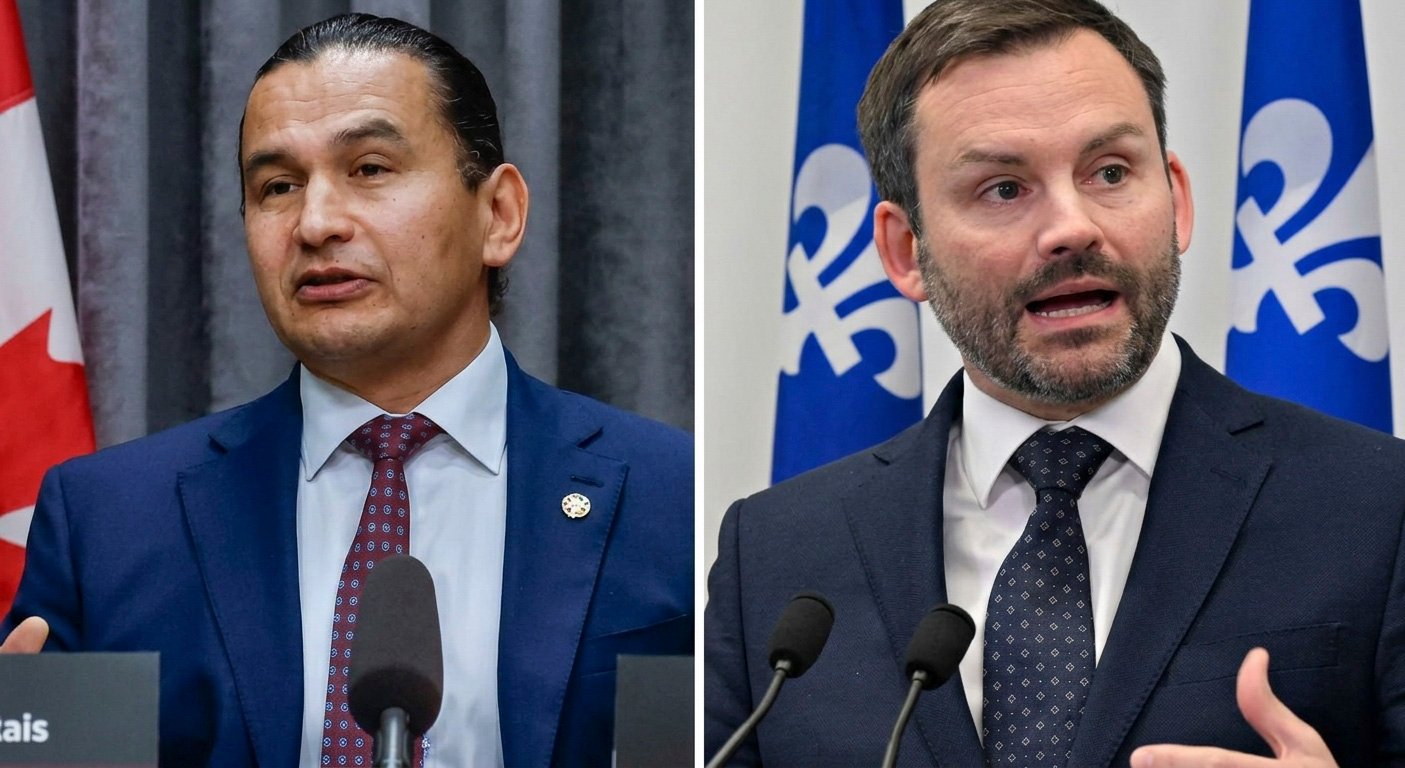

In a Canadian political landscape long defined by cautious platitudes, focus-grouped evasions, and timid federal hedging, Manitoba Premier Wab Kinew has delivered a rare, electrifying moment of moral clarity. Following the Supreme Court of Canada’s November 27, 2026, decision to largely uphold Quebec’s secularism law, Bill 21, Kinew refused to participate in the polite diplomatic dance that usually follows constitutional clashes in this country. Instead, he called the legislation exactly what it is: "legislative racism" and "legislated discrimination".
In doing so, Kinew did more than simply register his disagreement with a controversial provincial statute. He broke a decades-long taboo in Canadian public life. By speaking out forcefully and unapologetically against a law designed to bar Muslim women in hijabs, Sikh men in turbans, and Jewish citizens in kippahs from serving as public school teachers, police officers, and Crown prosecutors, Kinew has become the first prominent Canadian political leader since Pierre Elliott Trudeau to directly confront the institutional hypocrisy of Quebec’s nationalist elites.
For more than forty years, federal leaders and provincial counterparts alike have treated Quebec’s ethno-nationalist policies with kid gloves, terrified of offending political sensitivities in Quebec City or losing seats in the next federal election. Even as Bill 21 stripped thousands of qualified, tax-paying citizens of their career prospects simply because of the articles of faith they wear, Ottawa offered little more than furrowed brows and legalistic shrugging. It took an Indigenous premier from Winnipeg—a leader who understands firsthand what it means when the state uses the law to erase identity and enforce assimilation—to stand before the cameras and tell the unvarnished truth. As Kinew powerfully put it, the Canada we aspire to build must be a place where an RCMP officer is free to wear a turban, a teacher is free to wear a hijab, a Hutterite woman is free to wear a head covering, a Christian is free to wear a cross, and an Indigenous premier is free to wear his hair long. To ban those expressions of identity from public service is not neutrality. It is state-sponsored exclusion.
Pierre Elliott Trudeau’s Vision Betrayed
To appreciate the magnitude of Kinew’s stand, one must look back to the foundational principles that built modern Canada—principles articulated most clearly by Pierre Elliott Trudeau. When Trudeau introduced Canada’s official policy of multiculturalism in the House of Commons on October 8, 1971, he laid out an uncompromising vision of how a diverse, democratic federation must function.
"There is no official culture, nor does any ethnic group take precedence over any other," Trudeau declared before Parliament. "No citizen or group of citizens is other than Canadian, and all should be treated fairly." Trudeau understood that a nation composed of people from every corner of the globe could never achieve unity through coercion or cultural homogenization. True national unity, he argued, had to be rooted in confidence, openness, and mutual respect. He reminded Canadians that the values we must cherish "are not concepts of uniformity but human values: compassion, love, and understanding."
That 1971 declaration was not a passing rhetorical flourish. It became the bedrock of Canadian citizenship, further codified into federal law through the Canadian Multiculturalism Act of 1988 and woven into the interpretive fabric of the Canadian Charter of Rights and Freedoms in 1982. Across the vast majority of the country, that promise has been taken seriously. From British Columbia to Newfoundland, provincial and federal governments are legally and culturally bound to uphold pluralism, accommodating diverse faiths, languages, and backgrounds in the public square. When a Sikh Canadian wishes to serve in the Royal Canadian Mounted Police, the uniform adapts to honour both the badge and the faith. When a Muslim woman earns her teaching degree in Ontario or Manitoba, her hijab is recognized as a reflection of her personal conscience, not a threat to the state.
Yet in Quebec, a dangerous double standard has been allowed to fester, fracturing the country into two irreconcilable solitudes. While the rest of Canada is expected to practice rigorous tolerance and inclusion toward every minority group, Quebec’s political establishment has carved out an exemption for itself. In Quebec, the exclusionary identity politics of a dominant majority—crafted in the image of its political elites—is routinely excused, sanitized, and even celebrated under the guise of protecting the French language and culture. Disregarding Canada’s half-century commitment to multiculturalism, Quebec’s leadership demands uniform cultural conformity while expecting the rest of the nation to applaud its "distinct" approach. This constitutional and moral asymmetry is nothing short of outrageous.
Colonial Hypocrisy and Historical Gaslighting
The hypocrisy reaches peak absurdity when one examines the rhetoric and symbolism employed by Quebec’s current political leadership. Premier Paul St-Pierre Plamondon marches around Quebec City with the theatrical swagger of a revolutionary throwing off imperial shackles—going so far as to defy court orders and bar the King’s oath from his own legislative swearing-in ceremony—all while clinging tightly to a nineteenth-century colonial mindset of cultural supremacy.
On Saturday, November 28, 2026, St-Pierre Plamondon took to social media to demand that Wab Kinew retract his remarks, huffing that Kinew "should be ashamed of his disrespectful and intolerant remarks toward Quebec". The sheer irony of a premier who champions a law that banishes religious minorities from public employment accusing someone else of "intolerance" would be funny if the human cost were not so devastating.
Even more comical is the historical gaslighting that St-Pierre Plamondon and his nationalist allies deploy to justify their cultural gatekeeping. At every political rally and press conference, Quebec’s sovereignist and nationalist elites decry "colonialism" and rail against the supposed imposition of Canadian federal symbols. Yet these very same politicians proudly wrap themselves in the fleur-de-lis, flying it over the National Assembly and wearing it on their lapels as a badge of progressive liberation.
Someone ought to hand the Premier a history book. The fleur-de-lis is not an ancient, anti-colonial emblem of grassroots democracy. It is a symbol inextricably tied to the absolute monarchy of Bourbon France and its brutal, bloody colonial empire—an empire built on royal absolutism, religious intolerance, the expulsion of Huguenots, and the colonization of Indigenous lands. Meanwhile, these same elites systematically gaslight Quebecers into rejecting Canada’s Maple Leaf as a foreign, Anglo-Canadian imposition. In reality, the Maple Leaf was created and popularized as a national emblem in the nineteenth century by French Canadians themselves through the Saint-Jean-Baptiste Society—one of the oldest francophone institutions in Quebec. To reject a symbol born of French-Canadian heritage while wrapping discriminatory laws in the royalist banner of King Louis XIV requires an Olympic-level lack of self-awareness.
Institutional Denial of Systemic Racism
Worse than the historical amnesia, however, is the wilful blindness toward the lived reality of minority citizens in Quebec today. Let us be blunt: Paul St-Pierre Plamondon couldn’t recognize systemic racism if it walked up to him in the Salon Rouge and slapped him in the face.
Throughout his rise to the premier’s office, St-Pierre Plamondon has consistently dismissed the very concept of systemic racism, reducing a well-documented sociological and legal reality to mere "wokisme" that must be purged from universities and public discourse. In doing so, he is carrying on a proud, bipartisan tradition of institutional denial shared by his predecessors, François Legault and Christine Fréchette. Time and again, Quebec’s premiers and political elites have flatly refused to acknowledge that systemic racism exists at any level of Quebec society or government—even when staring directly at damning evidence produced by Quebec’s own public institutions.
Consider the sheer volume of official findings that Quebec’s political class has chosen to ignore. In 2019, the Viens Commission—a public inquiry established by the Quebec government itself—concluded unequivocally that Indigenous peoples in Quebec face systemic discrimination across public services, including policing, healthcare, youth protection, and the justice system. In 2020, following the tragic death of Joyce Echaquan in a Joliette hospital, a Quebec coroner ruled that systemic racism contributed directly to her death. Montreal’s own municipal police service and public consultation office have acknowledged the reality of systemic racism and racial profiling within local institutions, while Quebec’s own human rights commission has repeatedly documented systemic barriers facing Black, Indigenous, and racialized Quebecers in employment and housing.
Yet despite mountains of evidence gathered by Quebec’s own judges, coroners, and commissioners, premier after premier has stood at the podium and declared that systemic racism does not exist in la belle province. When a leader can look at Bill 21—a statute specifically engineered to target visible religious minorities and drive Muslim women out of teaching jobs—while simultaneously ignoring the findings of his own province’s public inquiries and insisting that systemic discrimination is an imaginary buzzword, political satire is rendered obsolete. You cannot fix a disease whose existence you refuse to diagnose, and Quebec’s elites have made denial an official article of faith.
The Supreme Court Chooses Politics Over the Law
Tragically, when called upon to serve as the final constitutional bulwark for vulnerable minorities, the Supreme Court of Canada once again chose political expediency over the integrity of the law. In its November 27, 2026, ruling in English Montreal School Board v. Quebec (Attorney General), the Court largely upheld Bill 21, validating Quebec’s pre-emptive use of Section 33 of the Charter—the notwithstanding clause—to insulate the law from fundamental rights challenges.
While a narrow four-judge majority confirmed that superior courts theoretically possess the authority to issue non-binding declarations stating that a law protected by Section 33 violates Charter rights, the Court conspicuously declined to issue such a declaration against Bill 21 itself. Even though three dissenting justices—Justices Karakatsanis, O'Bonsawin, and Martin—recognized that the law violates the Charter’s guarantee of gender equality under Section 28 by disproportionately harming Muslim women, the majority hid behind procedural deference. Worse still, Chief Justice Richard Wagner went out of his way to praise Bill 21 as being "rooted in Quebec's legitimate and historical commitment to ensuring the laicity of the state in a free and democratic society".
That single sentence from the Chief Justice will live in infamy in Canadian constitutional history. How can a society be described as "free and democratic" when the state dictates what religious garments a citizen may wear on her head before she is permitted to teach mathematics or direct traffic? By prioritizing federal-provincial peace and political deference over the clear, uncompromising application of Charter protections, the Supreme Court has abdicated its highest constitutional duty. The entire purpose of an entrenched bill of rights—and an independent judiciary—is to protect unpopular or outnumbered minorities from the tyranny of a legislative majority. A top court that allows governments to casually suspend basic human rights before a law is even tested, and then refuses to even name the resulting discrimination for what it is, endangers the freedoms of every single Canadian. Today it is the hijab and the turban in Quebec; tomorrow, emboldened by this ruling, other provincial governments will use the exact same playbook to strip away the rights of 2SLGBTQ+ youth, linguistic minorities, or political dissidents.
One Nation, True Secularism, and the Path Forward
As Wab Kinew rightly recognizes, Canada cannot survive as a patchwork quilt where fundamental human rights expire at provincial borders. We are one nation, built on a shared constitutional promise of mutual respect, human dignity, and equal citizenship. Over the past half-century, Canadians have consciously chosen a path of genuine pluralism—a model that recognizes our diversity not as a threat to social cohesion, but as our greatest collective strength. Fellow citizens living in Quebec—whether they are fifth-generation francophones, newly arrived immigrants from North Africa, or members of Montreal’s historic Jewish and Sikh communities—cannot be carved out of that constitutional promise in the name of a state-enforced cultural conformity.
Furthermore, it is time to reclaim the true meaning of secularism from those who have twisted it into a weapon of exclusion. Genuine secularism—true state neutrality—means that the government neither favours nor imposes any religion. It protects the sacred right of every individual to hold no religious affiliation at all, to question dogma, and to live free from clerical control. Quebecers fought a hard, necessary struggle during the Quiet Revolution to free their schools, hospitals, and government from the suffocating grip of the Catholic Church. That history deserves respect.
However, in a free and democratic Canadian society, state neutrality applies to the institution, not the individual. A government is neutral when its laws, courts, and classrooms treat every citizen equally regardless of belief—not when it forces its employees to strip away their personal faith at the door. State secularism can never be weaponized to deprive individual citizens of their own personal freedom of conscience and religion. A teacher wearing a hijab is no more imposing her religion on a classroom than a teacher wearing a wedding ring is imposing marriage on her students.
That is the true, enduring spirit of the Canadian Charter of Rights and Freedoms—a spirit that Wab Kinew has courageously defended on the national stage. By refusing to back down in the face of outrage from Quebec City, Kinew has reminded Canadians what real leadership looks like. While Quebec’s political class remains trapped in colonial nostalgia and systemic denial, and while Canada’s highest court has chosen political comfort over constitutional courage, Wab Kinew has stood tall for the principle that every Canadian deserves to be judged by the content of their character and the quality of their service, never by the symbols of their faith.

Comments
There are 0 comments on this post